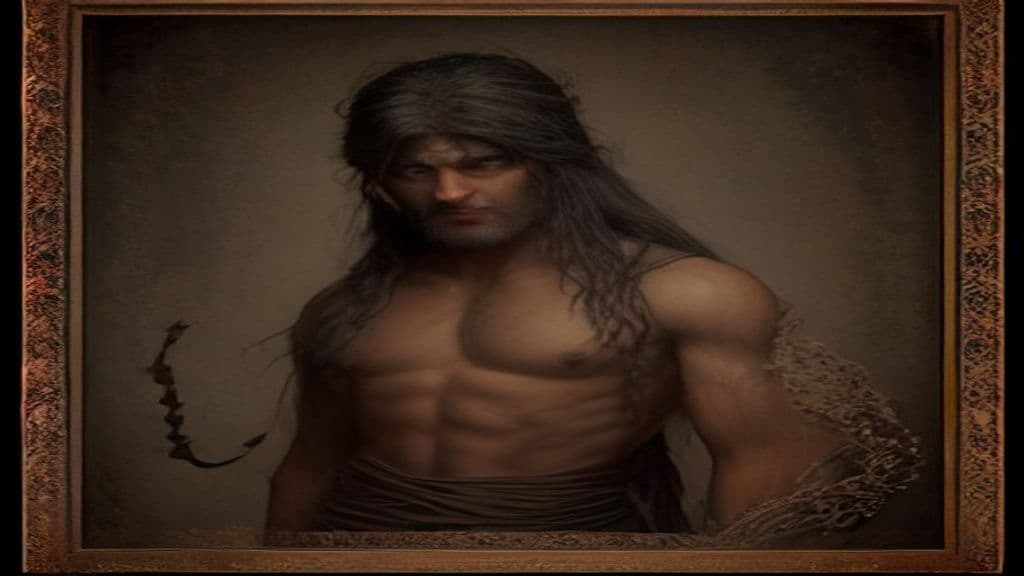
In Greek tradition Philoctetes is the son of Poeas (traditionally associated with Meliboea in Thessaly) and either Demonassa or Methone. He receives Heracles’ bow and arrows after assisting with Heracles’ funeral pyre; possession of those arms becomes a fateful condition in the Trojan War. During the expedition he suffers a wound (commonly to the foot) that festers and smells; because of the affliction he is abandoned on an island (commonly Lemnos in Homeric and tragic accounts), though some variants place the abandonment on Tenedos or Chryse.
Classical descriptions present him as an aging, war-wearied archer bearing a long-lasting festering wound. A late chronicler (Malalas, cited in summaries) describes him as of good height, well set, dark-skinned, with black hair, joined eyebrows, and an accurate archer’s bearing; dramatic portrayals (Sophocles) stage him as isolated and visibly affected by his long-term injury and its consequences.
Renowned skill with the bow: sources consistently describe Philoctetes as an accurate and effective archer and the lawful holder of Heracles’ bow and arrows, whose possession is linked by prophecy to Greek success at Troy. When restored to the Greek army he fights effectively; some traditions attribute to him multiple Trojan kills and in later variants the wounding or killing of Paris (the attribution of specific kills varies by source). He exhibits resentment and moral grievance toward those who abandoned him (Odysseus is the named adviser in the abandonment), and his fate is mediated by divine intervention (Heracles appears in Sophocles’ account to instruct his return and assure healing).
Weaknesses
- conditionfestering, malodorous wound (commonly on the foot)
- othersocial ostracism and resentment arising from abandonment
Wards
None recorded.
Phi Hua Khat (Rice-Field Ghost)
Phi Hua Khat is presented here as a named rice-field ghost in Thai folkloric terminology supplied by the user; however, the provided source set does not contain any specific attested information about this entity. General statements about Thai ghost beliefs are drawn only from Source 1; no direct descriptions, stories, rituals, or attributes for Phi Hua Khat itself appear in the supplied materials.
Phi Krasue
Phi Krasue is a nocturnal female spirit in Thai/Isan popular belief, depicted as a floating disembodied woman's head with trailing internal organs. Situated within Buddhist-syncretic and local animist worldviews, it functions as a visceral, boundary-enforcing specter in village and regional folklore and continues to appear in contemporary media.
Phi Phong
A ghostly spirit of northern Thai folklore described as the result of black magic gone awry; in modern media a related variant is depicted as a blood‑feeding nocturnal entity. It is framed in sources as arising from failed dark sorcery and appears in contemporary regional horror films.
Phi Pop
A Thai possessing spirit that inhabits a living person and compels them to consume raw entrails at night — the possessed victim may be unaware, accused by their community, and driven out.
Phi Tai Hong
Phi Tai Hong (ผีตายโหง) are vengeful, restless spirits in Thai folklore arising from people who die suddenly and violently. They are feared as especially dangerous and difficult to exorcise; the pregnant-woman variant (Tai Thang/Tai Thong Klom) is regarded as particularly malevolent.
Philippine mythical creatures
A broad, plural category of legendary beasts, monsters, and supernatural beings found across more than 140 ethnic groups in the Philippines; these beings occupy local folkloric cosmologies and are distinct from major deities and heroes. They appear in traditional tales and in contemporary retellings and media, which continue to reinterpret and popularize them.
Philoetius
Philoetius is a mortal cowherd and loyal servant in Homer's Odyssey who tends Odysseus's cattle on Ithaca. In the narrative he exemplifies household fidelity: he brings livestock to the palace, follows Odysseus's orders to secure the hall, hides the suitors' weapons, fights in the slaughter, and is promised freedom and reward for his loyalty.
Philomache (Phylomache)
Philomache (Ancient Greek: Φυλομάχη), also spelled Phylomache, is a mythological mortal woman appearing in classical Greek genealogical traditions as a Minyan princess of Orchomenus who in some accounts is named as the wife of Pelias of Iolcus and mother of Acastus and several daughters. She functions as a dynastic link in heroic-age family networks rather than as a supernatural being.
Philonis
Philonis (Ancient Greek: Φιλωνίς) is a mythic mortal woman from Greek genealogical tradition, variously identified as daughter of Daedalion or of Eosphoros and Cleoboea (and in some accounts as daughter of Deion of Phocus). She is named as the mother of Philammon by Apollo and Autolycus by Hermes and is sometimes equated with figures called Chione, Leuconoe, or Telauge in alternate traditions.
Philyra
Philyra is a homonymous name attested in several registers: as the name of multiple female figures in Greek mythology (an Oceanid mother of Chiron; a named wife of Nauplius; a daughter of Asopus and mother of Hypseus), as a Linnaean genus name applied to decapod crustaceans (e.g., Philyra globosa), and as a modern cultural reference used as an EP/album title in Mountain Goats setlists. The provided sources do not support treating Philyra as a single folkloric supernatural entity.
Phineus (son of Belus)
Phineus is a legendary Greek seer-king of the heroic age: a mortal prophet granted the gift of divination who is tormented (notably by Harpies) and appears in Argonautica-type narratives to counsel heroes such as the Argonauts. His parentage and fate vary across traditions, which attribute his blinding, harassment, and later partial restoration to different divine or heroic agents.
Phlegyas
Phlegyas is, in the provided source, a figure of Greek mythology identified as a king of the Lapiths. The material treats him as an individual human ruler within mythic genealogies rather than as a class of supernatural beings.
Community Record
- [1]Philoctetes (Wikipedia). Wikipedia, entry ‘Philoctetes’wiki
- [2]Philoctetes (Sophocles) — Internet Classics Archive. Sophocles, Philoctetes (translation available at MIT Classics)literary
- [3]Philoktetes by Sophocles | Project Gutenberg. Translation of Sophocles’ Philoctetes, Project Gutenbergliterary
- [4]Philoctetes — Madeline Miller: Myth of the Week. Madeline Miller, 'Myth of the Week: Philoctetes' (modern retelling/commentary)other
- [5]Segal, Sophocles' Tragic World: Divinity, Nature, Society (archive). Charles Segal, Sophocles' Tragic World: Divinity, Nature, Society (archival copy)academic
- [6]Philoctetes (Sophocles play) — Wikipedia. Wikipedia, entry ‘Philoctetes (Sophocles play)’wiki