Polynices is presented in the surviving Greek tradition as a scion of the Cadmean royal house, son of Oedipus and thus member of the cursed genealogy of Thebes. Following Oedipus' fall, Polynices and his brother Eteocles come to conflict over rulership—accounts vary as to whether an alternation agreement broke down or one brother expelled the other (ancient sources such as Hellanicus, Pherekydes, and mythographic summaries offer variant reports). Polynices is said to have gone into exile at Argos, where King Adrastus received him and his daughter Argia married Polynices. With Argive support Polynices leads the expedition against Thebes (the Seven against Thebes); he and Eteocles slay one another in battle. Polynices' death precipitates the contested refusal of burial under King Creon's edict in Sophocles' Antigone, and later traditions record his son Thersander among the Epigoni who avenge the fallen and secure the throne.
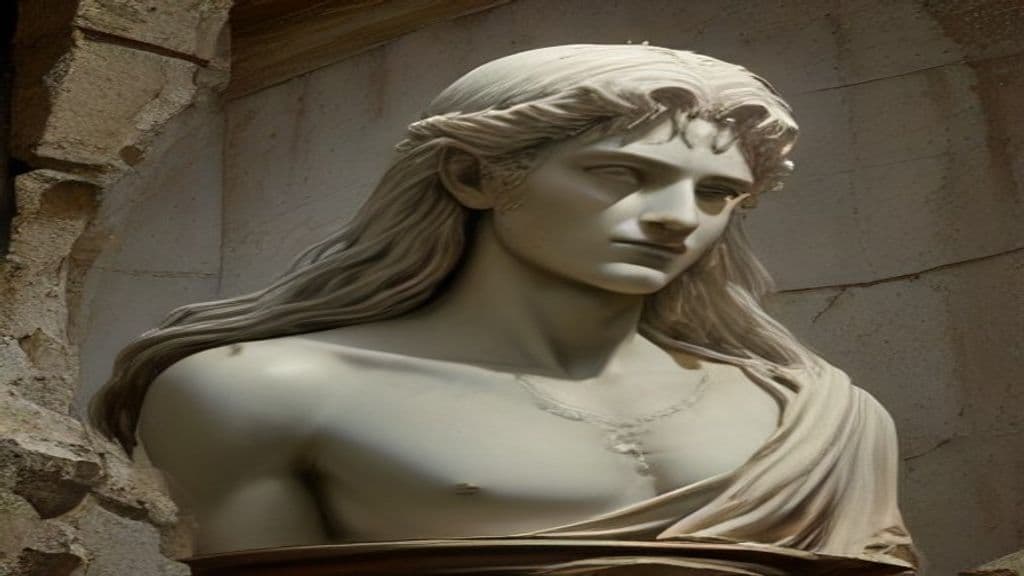
Surviving literary sources give little sustained physical description of Polynices as an individual; he appears primarily through his role as a prince and warrior. Poetic and theatrical representations attach symbolic martial imagery to him—Aeschylus' Seven against Thebes tradition records emblems and devices (for example, a shield bearing the personification of Justice/Dike is associated with one of the attackers in epic representations), and tragic staging emphasizes his armed identity as claimant and combatant. Visual and material details (stature, facial features, specific garments) are sparse or absent in the provided summaries, leaving his concrete portrait largely determined by dramatic and epic symbolism rather than a consistent descriptive canon.
Polynices is depicted as a political claimant, military leader, and warrior rather than a supernatural agent. He organizes resistance to Eteocles' rule by securing refuge and alliance at Argos, marrying Adrastus' daughter Argia, and co‑leading the Argive force of the Seven against Thebes. In battle he engages in single combat with his brother; in multiple accounts the fraternal duel results in mutual death. His actions have political, religious, and moral consequences in the narrative world: his attempted seizure of Thebes frames him as a traitor within civic logic (justifying Creon's punitive edict in Sophocles), while his denial of proper burial becomes a theological and ethical crisis that invokes the prophet Tiresias and results in divine disapproval and tragic fallout.
Weaknesses
- conditionmortal vulnerability (human death)
- conditionbound by familial curse and fate
Wards
- otherpolitical sanction (Creon's edict forbidding burial)
Eteocles
Eteocles is a mytho-historical Theban king of the Greek tradition, son of Oedipus, who becomes central to the dynastic feud with his brother Polynices that culminates in the war of the Seven against Thebes and the mutual killing of the two brothers.
Adrastus
Adrastus (Ancient Greek: Ἄδραστος or Ἄδρηστος) is a legendary king of Argos in the Greek mythic-historical tradition, best known as the leader of the expedition of the Seven against Thebes and as a figure tied to oracular counsel, dynastic marriages, and local hero cults.

Epigoni
A mythic generation in Greek tradition comprising the sons (progeny) of the Argive heroes who fought in the first war against Thebes; they mount a second expedition against Thebes ten years after their fathers and function in the Theban epic cycle as heirs who avenge and continue their fathers' deeds.
Community Record
- [1]Polynices — Wikipedia. Wikipedia contributors. "Polynices." Wikipedia, The Free Encyclopedia.wiki
- [2]Seven against Thebes — Wikipedia. Wikipedia contributors. "Seven against Thebes." Wikipedia, The Free Encyclopedia.wiki
- [3]The Seven Plays in English Verse by Sophocles (Project Gutenberg). Sophocles. Translations collected at Project Gutenberg. (Antigone and related plays.)literary
- [4]Antigone — character analysis (Storgy summary). Storgy. "Antigone — Character Analysis: Polynices."other
- [5]Who's Who in Classical Mythology (archive.org). Who's Who in Classical Mythology. Archive summary reference.other
- [6]LP0061 Thebes Mythical History (archive.org). Archive collection on Theban mythic history.other