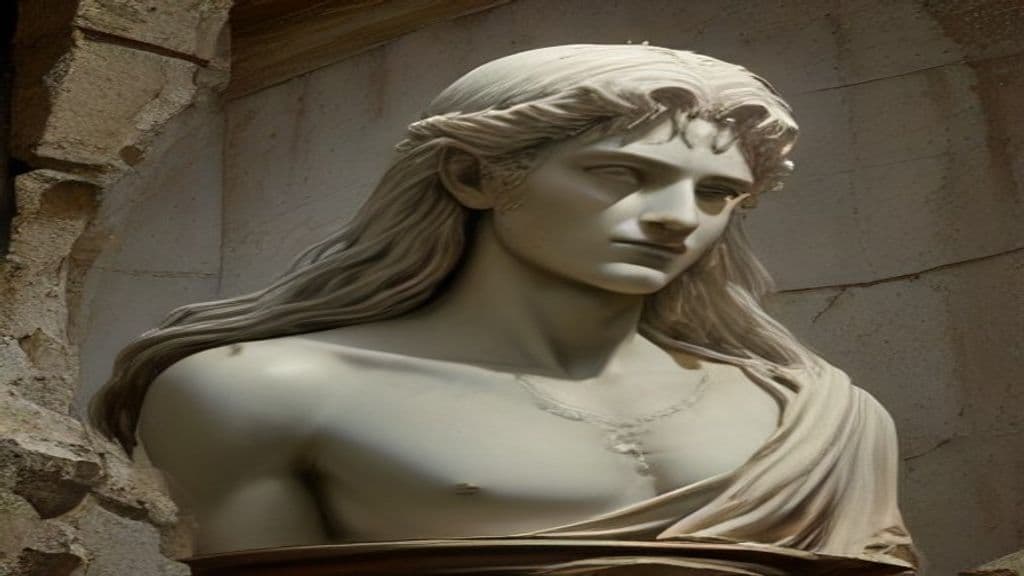
Adrastus is presented in the Greek tradition as a dynastic ruler of Argos (and in some accounts of Sicyon). Genealogical details vary across sources, a common feature of mythic genealogies, but he appears in the generation contemporary with Polynices and Tydeus. An oracle prompted Adrastus to give his daughters in marriage to two exiled princes (commonly identified as Polynices and Tydeus), and he promised to help restore them, an oath that led him to raise the coalition known as the Seven against Thebes. He reconciled factional rivals in Argos (notably by marriage exchange with Amphiaraus) and later took part in the subsequent expedition of the Epigoni. Later traditions credit him with civic-religious acts such as the founding of the Nemean Games and report local hero cults to his memory at sites including Sicyon, Megara, and Colonus.
Narrative and epic sources do not provide a fixed personal portrait of Adrastus; instead he is represented through his public role, possessions, and depiction in art and drama. He is attested in literary works from Homer and Pindar to Euripides and later mythographers, and is depicted in visual art from as early as the 6th century BC. Characterizations in tragedy and epic present him as an aged, ruling figure and interlocutor (for example in Euripides' The Suppliants) rather than emphasizing distinctive physical features.
Adrastus is human and mortal; his prominence lies in kingship, leadership, political skill, and pious responsiveness to oracles rather than supernatural powers. He is repeatedly portrayed as a capable speaker and reconciler of rival houses, a marshal who can raise and lead an Argive force, and a guarantor of dynastic alliances. In the Theban campaign he survives when the other chief champions of the expedition are killed, an outcome in the tradition attributed to his divine or fabulous horse Arion, which is described in some sources as a wondrous equine associated with divine parentage and which rescues him in battle. Adrastus' agency is thus political and heroic rather than intrinsically magical.
Weaknesses
- conditionmortality and susceptibility to fate/oracularly foretold outcomes
- otherreliance on alliances and divine aid (e.g., dependence on Arion and the goodwill of seers like Amphiaraus)
Wards
None recorded.

Amphiaraus
Amphiaraus is a legendary Greek seer and chthonic hero, famed as one of the Seven against Thebes. After his death—when the earth opened and swallowed him—he was venerated at the Amphiareion of Oropos as a healing and oracular figure whose sanctuary received petitioners seeking dream-delivered solutions.

Epigoni
A mythic generation in Greek tradition comprising the sons (progeny) of the Argive heroes who fought in the first war against Thebes; they mount a second expedition against Thebes ten years after their fathers and function in the Theban epic cycle as heirs who avenge and continue their fathers' deeds.
Abas
Abas (Ancient Greek: Ἄβας, gen.: Ἄβαντος) is not a single mythic being but a recurring personal name borne by multiple mortals and minor mythic figures in Greek epic and genealogical traditions — kings, founders, seers, warriors, attendants, a centaur, and a youth transformed by a goddess. The name is glossed in the sources as 'guileless' or 'good-hearted' and appears across Argive, Theban, Trojan, Euboean, and other local cycles.
Aegisthus
Aegisthus (Greek Αἴγισθος, Aigisthos) is a mortal member of the House of Atreus in Greek myth who, born of incestuous circumstances and raised by shepherds and a goat, participates in dynastic murder and usurpation — notably the slaying of Atreus in some accounts and the conspiracy (with Clytemnestra) that results in Agamemnon's death — and is later killed by Orestes, an episode that figures in narratives about inherited guilt, vengeance, and the transition from private retribution to public justice.
Agamemnon
Agamemnon is the legendary king of Mycenae (or Argos), head of the House of Atreus, and commander of the Achaean forces at Troy in Greek epic and tragedy. His story links dynastic guilt, ritual obligation, and political authority, culminating in the sacrifice-at-Aulis episode and his murder on return from Troy followed by juridical atonement in the Oresteia.
Ajax (Aias)
Ajax (Ancient Greek: Aias) is a human heroic figure of the Trojan-cycle tradition and the tragic protagonist of Sophocles' play Ajax. In the surviving tradition he is a mortal Salaminian warrior celebrated for physical strength and martial reputation whose wounded honor, rage, and resulting suicide are the focus of Sophocles' drama.
Ajax the Great
Ajax the Great (Ancient Greek: Αἴας, Aíās) is a mortal heroic figure of the Trojan War cycle, famed as a towering, steadfast Greek champion and defender of the Achaean ships. Prominent in Homer’s Iliad, he is portrayed as second only to Achilles in martial standing and as a paragon of defensive strength and reliability.
Alcinous
Alcinous (Ancient Greek: Ἀλκίνοος, Alkínoos, "mighty mind") is a legendary human king of the Phaeacians in Greek epic tradition. He is portrayed as an ideal hospitable monarch who receives wandering heroes (notably Odysseus and the Argonauts), presides over feasts and games, adjudicates disputes, and provides ships, gifts, and safe passage. Variant genealogies and island-identifications appear across sources, but his role as a beneficent royal host is consistent.
Alcmeonis
A lost early Greek epic poem (Ancient Greek: Ἀλκμεωνίς / Ἀλκμαιωνίς) traditionally counted among the Theban cycle; known only from a small number of fragmentary references, it narrated the story of Alcmaeon’s killing of his mother Eriphyle in vengeance for the death of his father Amphiaraus.
Amphialus (Amphialos)
Amphialus (Ancient Greek: Άμφίαλος, Amphialus/Amphialos, lit. 'of two seas') is a recurring personal name in classical Greek epic, genealogical tradition, and later pastoral/romance literature. The name is applied to several distinct mortal figures — a Phaeacian athlete in the Odyssey, various seafaring companions and suitors in Homeric summaries, a son of Neoptolemus and Andromache in genealogical accounts, and a noble/warrior character in early modern Arcadian romances — rather than to a single supernatural being.
Amphinomus
Amphinomus (Ἀμφίνομος) is a personal name borne by several human figures in Greek tradition, most notably a princely suitor of Penelope in Homer's Odyssey; other bearers appear in local genealogies, a Catanian civic legend, and a later historical record as a geometer. The sources treat Amphinomus as mortal personages rather than a supernatural being.
Andromache
Andromache (Ancient Greek Ἀνδρομάχη) is a human figure of ancient Greek literary tradition: the wife of Hector of Troy who exemplifies virtuous fidelity, ritual mourning, and the losses suffered by women in war. She appears in Homeric epic and later classical sources as grieving spouse, captive concubine after Troy's fall, and later queen in post-war narratives.
Antimachus of Teos
Antimachus of Teos (Greek: Ἀντίμαχος ὁ Τήϊος) is an early Greco-Ionian epic poet cited in later antiquity as the putative author or ascription-anchor for fragmentary Theban-cycle material (notably sometimes the Epigoni). Later authors quote or reference him for sententiae and as a chronological marker; his identity is contested and sometimes conflated with the much later Antimachus of Colophon.
Antiphus
Antiphus (Ancient Greek Ἄντιφος) is a personal name borne by several mortal men in Greek myth and epic traditions rather than a single supernatural being. Multiple figures named Antiphus appear in genealogies and narratives as princes, warriors, companions of heroes, colonists, and victims in the heroic age (generation of Heracles, the Trojan War, and the Odyssey).
Community Record
- [1]Adrastus. Wikipedia entry 'Adrastus' (overview and citations to ancient sources)wiki
- [2]Adrastus (mythology). Wikipedia disambiguation and summary of mythic traditionswiki
- [3]The Suppliants by Euripides (text). Euripides, The Suppliants (dramatic text; Adrastus appears as a speaking character)literary
- [4]LP0061 Thebes Mythical History (Archive). Collected material on Theban mythic history (context for the Seven against Thebes cycle)other
- [5]Euripidis Fabulae (Archive edition). Printed edition of Euripidean fragments and plays referencing Adrastusother
- [6]Plays. Six: Euripides (Archive). Collected plays of Euripides containing appearances of Adrastusother
- [7]Museum/painting references (Athena and Adrastus). Reference to visual depictions of Adrastus in ancient artother
- [8]Wikidata: Adrastus. Wikidata entry aggregating data and identifiers for Adrastusother