In the Postclassic K'iche' narrative preserved in the Popol Vuh, Qʼuqʼumatz appears as a principal divine actor in the creation of the present world and of humanity. The Popol Vuh summary in the supplied sources states that Qʼuqʼumatz, together with the god Tepeu, created the world and humanity; this joint creation locates Qʼuqʼumatz within a collaborative pantheon of creator deities that brought into being the ordered cosmos inhabited by humans. Secondary summaries and comparative sources place Qʼuqʼumatz within the broader Mesoamerican Feathered Serpent complex, indicating that the K'iche' creation account participates in a region-wide symbolic vocabulary that fuses avian and serpentine imagery for cosmogenic and civilizing powers.
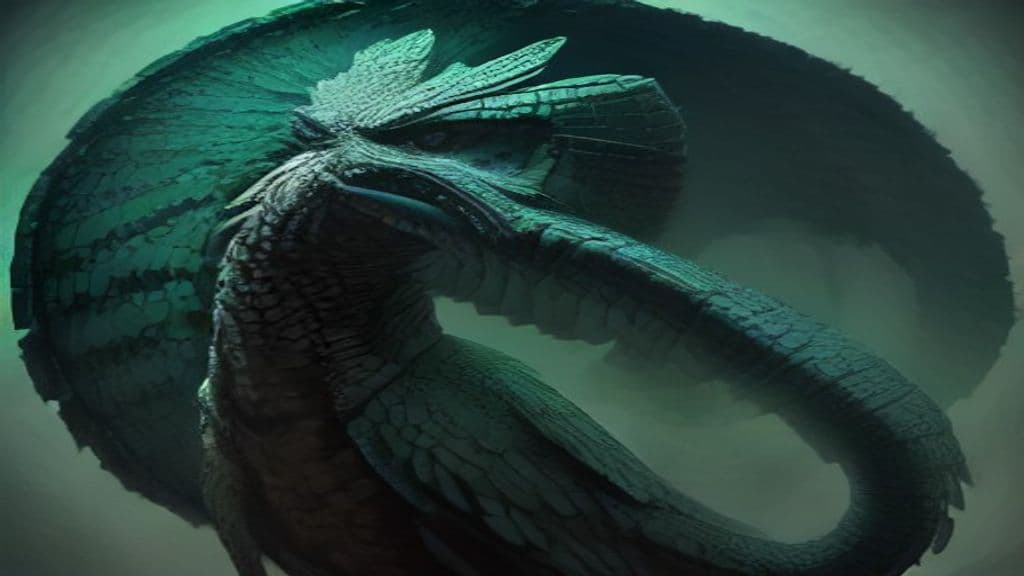
Sources identify Qʼuqʼumatz by the compound K'iche' name meaning 'feathered serpent' (q'uq / quetzal feather + kumatz / serpent), and describe it iconographically as a being combining quetzal-feather attributes with serpent form. The provided materials supply no detailed pictorial or ritual iconography beyond this composite label; available descriptions therefore emphasize the hybrid avian–reptilian morphology implicit in the name rather than an extended visual catalogue.
According to the Popol Vuh summary and supporting encyclopedic entries in the supplied notes, Qʼuqʼumatz is a creator-deity associated with wind and rain and is described as carrying out cosmological mediation: the sources state that it helped create the world and humanity with Tepeu, is a god of wind and rain, and is represented in the Popol Vuh as associated with the sun's motion and descent into the underworld and as mediating between various powers in the Maya cosmos. These descriptions present Qʼuqʼumatz as possessing formative creative agency, influence over atmospheric elements (wind and rain), and a role in ordering or transmitting celestial motion and relations among realms, as narrated in the K'iche' tradition.

Quetzalcoatl
Quetzalcoatl is the central Mesoamerican 'Feathered' or 'Plumed Serpent' figure prominent in Aztec and broader pre-Columbian religious thought, associated with wind (Ehecatl), the planet Venus, learning, arts and crafts, merchants, and the priesthood. Represented as a hybrid serpent-and-bird emblem, Quetzalcoatl functions as both a deity and an organizing sacred principle linking sky and earth.
Kukulkan
Kukulkan is the Maya Feathered Serpent deity — a plumed serpent figure functioning as a divine animal, a mediator in Classic royal ritual (the Vision Serpent), and a territorial/political divinity in Postclassic Yucatán (notably Chichén Itzá and Mayapán). The cult circulated across the Maya area and appears in archaeological, iconographic, and folkloric sources.
Community Record
- [1]Q'uq'umatz (Wikipedia). Wikipedia: Q'uq'umatzwiki
- [2]Q'uq'umatz (Wikidata). Wikidata: Q'uq'umatzwiki
- [3]Feathered Serpent (Wikipedia). Wikipedia: Feathered Serpentwiki
- [4]Meaning of the name Q'uq'umatz (Behind the Name / name-meaning summaries). Behind the Name: Q'uq'umatz (name etymology summary)other
- [5]Meaning of the name Q'uq'umatz (Name-Doctor / name-meaning summaries). Name-Doctor: Q'uq'umatz (etymology summary)other
- [6]Mention of Ququmatz and Tohil among K'iche' (Feathered Serpent list). Wikipedia: Feathered Serpent (mentions Ququmatz and Tohil among Kiche Maya in listing)wiki
- [7]Popol Vuh summary references collected in encyclopedic sources (as cited). Summary of Popol Vuh account as presented in secondary sources (see Wikipedia entry and linked references)literary