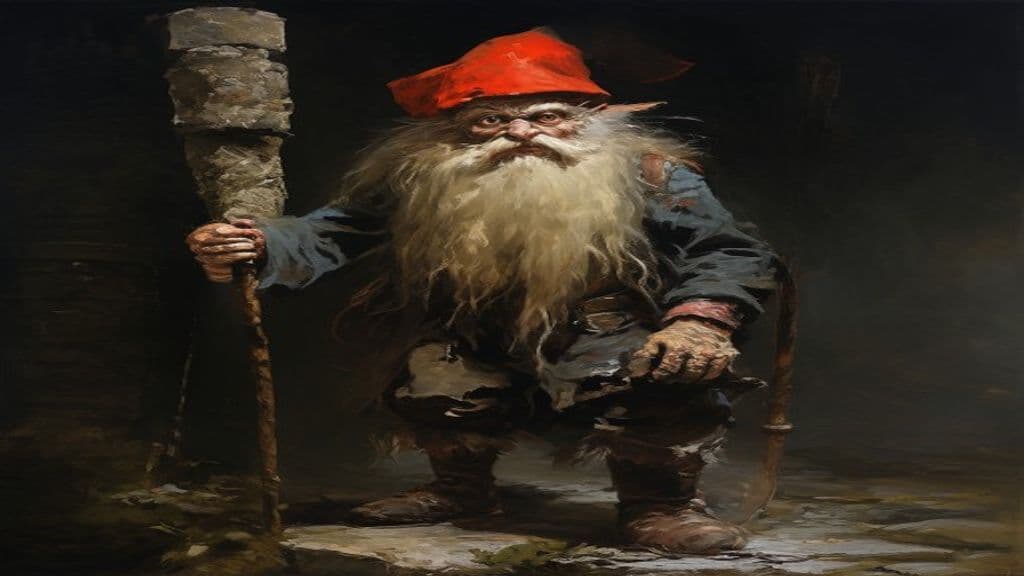
Attested in folkloric sources rather than presented as a historical figure, the redcap is linked in tradition to ruined strongholds and to the social memory of tyranny and wicked deeds that occurred there. One named variant in the lore links a redcap familiar called 'Robin Redcap' to the medieval noble William de Soulis; this association appears in ballad and local tradition accounts (reported in collected summaries) as part of the storytelling around particular ruins such as Hermitage Castle rather than as documentary history.
Folklore descriptions depict the redcap as a small, thickset, old elf-like figure: long prominent teeth, skinny fingers tipped like talons, large fiery red eyes, grisly hair down the shoulders, wearing iron boots, carrying a pikestaff in the left hand, and—most characteristically—a red cap which tradition says is soaked in the blood of victims, giving it a crimson hue.
Traditional accounts portray the redcap as violent and territorial: he is said to hurl huge stones at travellers who shelter in his lair and to kill intruders, afterwards soaking his cap in their blood. He is described as 'unaffected by human strength' in the sources, implying ordinary force cannot easily dislodge him. Folklore records a consistent reactive vulnerability: words of Scripture or the brandishing of a crucifix will cause the redcap to utter a dismal yell and vanish in flames, often leaving behind a large tooth. Regional variants recorded in the sources allow for different temperaments, with at least one Perthshire telling describing a small man who bestows good fortune on those who see or hear him.
Weaknesses
- symbolcrucifix
- mantrawords of Scripture
Wards
- symbolcrucifix (brandished)
- mantrarecitation of Scripture
Rauni
Rauni is a sparsely attested name for a being in pre-Christian Finnish mythic material, recorded in runic-song variants and mentioned in a 1551 text by Mikael Agricola. Surviving sources preserve the name and variants but do not provide a clear, uncontested account of Rauni’s function, appearance, or rites.
Ravgga
Ravgga is attested in one source as a fish-associated fortune-telling being in Sámi mythology. Beyond a single-line definition identifying it as a 'fortune-telling fish god,' there is no supporting ethnographic or narrative detail in the supplied materials.
Raziel
Raziel is an angelic revealer in Jewish mystical literature, called the 'Angel of Secrets' and credited with transmitting esoteric books (notably Sefer Raziel) to prime ancestors; the name is also reused in modern fiction for characters and artifacts that evoke revelation or hidden knowledge.
Re'em (Jewish tradition)
A mysterious animal mentioned nine times in the Hebrew Bible, described as a creature of power and strength with unclear nature and translations. (Note: - Power tier should be Greater (as it is described with translations implying strength/ferocity comparable to powerful regional entities). - Weaknesses and wards should be addressed (not mentioned in )
Rebirth in Germanic Paganism
Concept of rebirth through naming and/or family line in pre-Christian Germanic society, tied to continuation of identity and heritage. (Note: * Power tier should be Lowered to Lesser (local spirit) as the abilities described do not suggest a cosmic or deity-level power. * Summary is accurate, but it could be more concise. * Origin story lac)
Red King (term)
“Red King” is a polyvalent label used across literature, popular media, history, science, and other fields rather than a single, coherent folkloric supernatural being. The term appears as character names (e.g., Lewis Carroll's Through the Looking-Glass), nicknames for historical figures (William II, 'Rufus'), monsters in genre media (Ultraman, comics), and non-supernatural uses (red king crab, scientific hypotheses).
Reepicheep
Reepicheep is a fictional Talking Mouse in C. S. Lewis's Chronicles of Narnia. He is the martial chief of the Talking Mice, a courageous knightly figure who appears in Prince Caspian and The Voyage of the Dawn Treader and briefly in The Last Battle, whose personal quest for "Aslan's Country" functions as a spiritual exemplar within the Narnian narrative.
Reginn
Reginn is a figure in Old Norse heroic-literary tradition who functions as a foster-father, master smith, counsellor, and plotting instigator in the Sigurð/Sigurd cycle. Appearing in the Poetic Edda (Reginsmál, Dvergatal) and the Völsunga saga, he is embedded in a kin-group (son of Hreiðmarr; brother to Fáfnir and Ótr) tied to a cursed hoard.
Rehua
Rehua is a very sacred sky-personage in Māori tradition who dwells in the highest heaven and is described as untouched by death with powers of healing and revival; in Tahitian material Rehua appears as a star-god associated with the New Year and the production of star-groups.
Reikon
Reikon (霊魂) is the Shinto/Japanese cultural concept of the human soul or spirit that persists after death. Proper funerary rites allow a reikon to join its ancestors; if rites are absent or death is violent, the reikon can remain among the living as a yūrei until ritually eased.
Reina Mora
The supplied sources do not document a supernatural entity called 'Reina Mora' in Cantabrian mythology. In the provided material, the phrase appears as the Spanish vernacular name for the Puerto Rican spindalis (a bird) and as the title of a 1954 film; no folkloric description, role, or mythological tradition from Cantabria is attested in these sources.
Reine Tournay
No evidence for a supernatural or folkloric entity named Reine Tournay appears in the supplied source set. The provided materials contain no descriptions, narratives, rituals, or cultural attributions for an entity by this name.
Community Record
- [1]Redcap. Wikipedia contributors, 'Redcap', Wikipedia, The Free Encyclopediawiki
- [2]Redcap (Wikidata). Wikidata entry Q1807901 'Redcap'wiki
- [3]Local Guides To Scottish Folklore And Legends By Region. Local Guides to Scottish Folklore and Legends by Region, Scotland's Enchanting Kingdom (online guide)folk