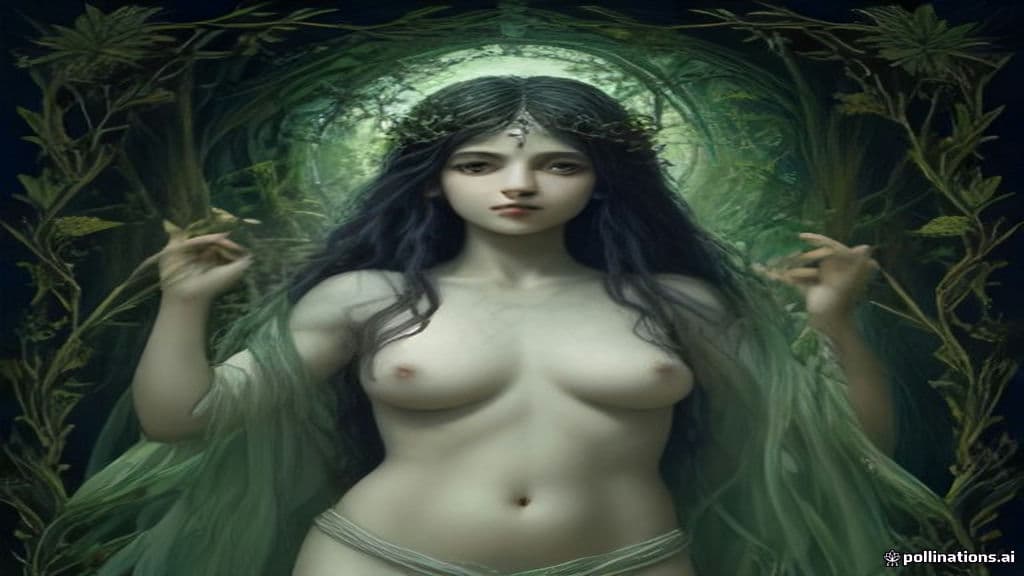
Ancient summaries and later reference works present Satyrion as a local nymph 'perhaps from the region of Taranto, Italy' whose union with the god Poseidon produced Taras, the eponymous founder of Taras/Tarentum. The name also appears as the ancient place-name for a locality (Saturo / Satyrion) near Taranto; archaeological notes and references to springs and an oracle at the site connect the toponym with lived cultic and hydraulic features. Sources phrase the geographic origin as tentative ('perhaps') and as an attested ancient toponym rather than giving a detailed primary narrative in the excerpts supplied.
As a mythic nymph: the supplied sources give no corporeal description of Satyrion-as-person; she is identified generically as a nymph and as the mother of Taras by Poseidon without physical detail. As a plant (herbal and materia medica usage): early modern herbals and plates describe 'Satyrion' orchids in morphological terms — large knobbed roots (branched or sectioned), a flowering stalk sometimes brownish, and leaves bright green often spotted with darker marks; one herbal notes plants growing around a foot high with red flowers. These botanical descriptions derive from herbal plates and commentators rather than from any depiction of a humanoid figure.
As a mythic figure, Satyrion's recorded rôle is genealogical/eponymous — she begets Taras with Poseidon; no other supernatural feats or powers are ascribed in the provided materials. As a plant and pharmaceutical label, 'satyrion' (applied to orchids or ragwort in sources) is repeatedly described in literary and early modern medical texts as an aphrodisiac and fertility agent: textual fragments instruct mixing orchid (satyrion) juice with oil to anoint the male organ and report that such preparations 'make the barren women kindle/inflame, with desire/fertility.' These effects are presented as medicinal/folk pharmacology rather than as direct supernatural capacities of the nymph herself.
Weaknesses
- othernone documented in sources
Wards
- othernone documented in sources
Community Record
- [1]Satyrion — Wikipedia. Wikipedia article 'Satyrion' (summary of classical identification, place-name, and aphrodisiac use; notes that satyrion appears twice in Petronius's Satyricon).wiki
- [2]Pleiades place: unnamed aqueduct / Satyrion springs (entry). Pleiades place resource noting springs near Satyrion and the phrase aqua nymphalis in classical context (association of water features and nymphs).academic
- [3]Herbal plates — exclassics.com (Male Satyrion Royal description). Herbal descriptive caption: 'The male Satyrion Royal hath large roots, knobbed... branched or cut into sundry sections like an hand.' (herbal plate/notes).other
- [4]Henriette's Herbal — Orchis / Satyrion descriptions. Herbal descriptive lines: 'This Orchis... grows to be a Foot high, the Leaves are a bright Green spotted with Black, and the Flowers, which grow on a brownish Stalk, are a Red...' (early modern herbal description applied to orchids called satyrion).other
- [5]Satisfying Satyrion – Early Modern Medicine (blog / commentary). Discussion of early modern medical references to 'satyrion' as an orchid-based aphrodisiac and its place in materia medica (secondary treatment of sources and recipes).other
- [6]Voynich.ninja thread (translation fragment of satyrion recipe). Secondary-site citation of a translation fragment: 'Anoint the Male Member with the juice of Satyrion, Orchid, mixed with the oil. Smear it, This, Makes the barren women kindle/inflame, with desire/fertility.' (used as attestations of recipe tradition; fragmentary).other
- [7]Partheniae — Wikipedia (archaeological/oracular notes). Referential material noting an oracle and archaeological finds at Satyrion and links to settlement/oracular guidance (used to support place/cult associations).wiki