
There is no single, fully documented origin story for an individual saunatonttu in the supplied materials. Contemporary and popular accounts place the sauna spirit within the broader Baltic‑Finnic worldview in which built and natural spaces were often conceived as inhabited by nonhuman presences; within that context a household or place spirit (tonttu) conceptually extends to the sauna as a specialized dwelling or ritual space. Modern tourism and folkloric summaries present the sauna as a liminal site 'steeped in mysticism and lore' and describe sauna guardians in general terms rather than providing a classical origin myth for a named saunatonttu (sources note cultural background but do not supply a primary traditional narrative).
Traditional sources in the provided material do not record a consistent or canonical physical description of a saunatonttu. Where visual forms are visible in the supplied corpus, they come from contemporary commercial products and popular imagery: wooden figurines marketed as 'Sauna Elf Tapani' and 'Sauna Elf Antero' (retail pages) that reflect modern, decorative portrayals rather than documented ethnographic descriptions. Scholarly or folkloric excerpts in the provided set do not offer a detailed traditional portrait of the sauna spirit.
Within the available sources the sauna spirit is presented primarily as a guardian or resident presence of the sauna, linked to the sauna's cultural role as a place for physical and spiritual cleansing. Popular and tourism accounts frame the sauna as a space where folklore and ritual overlap and describe 'sauna folklore' that includes spirits and guardians of bathhouses; however, the supplied texts do not enumerate specific traditional powers, interventions, or typical behaviors (for example, precise benevolent or malevolent acts, illness causation, or miraculous interventions are not documented in the excerpts).
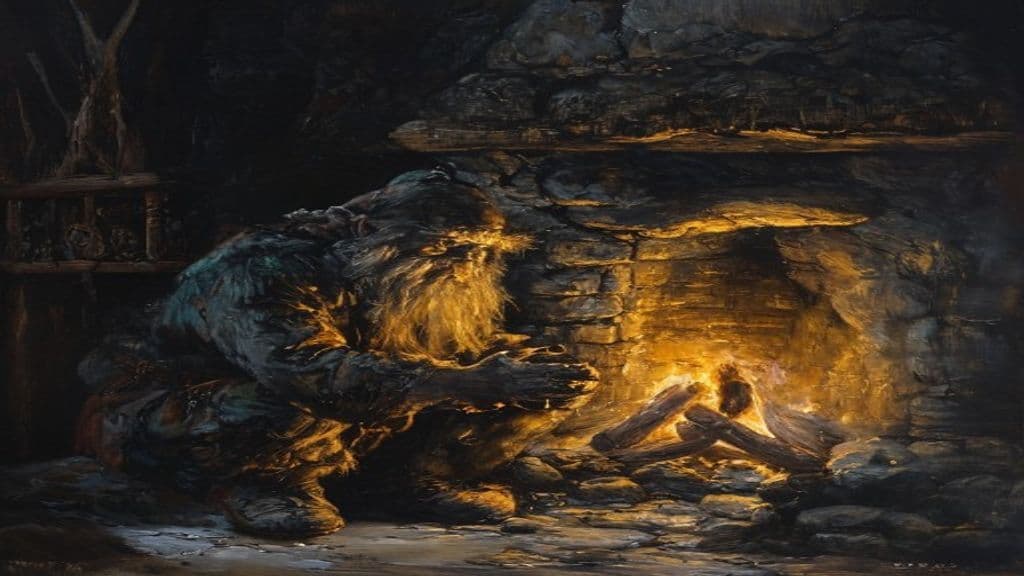
Domovoi
The house spirit of Slavic tradition — a small, invisible guardian of the home bound to a specific dwelling and its family. Protective when respected; dangerous when insulted or forgotten.
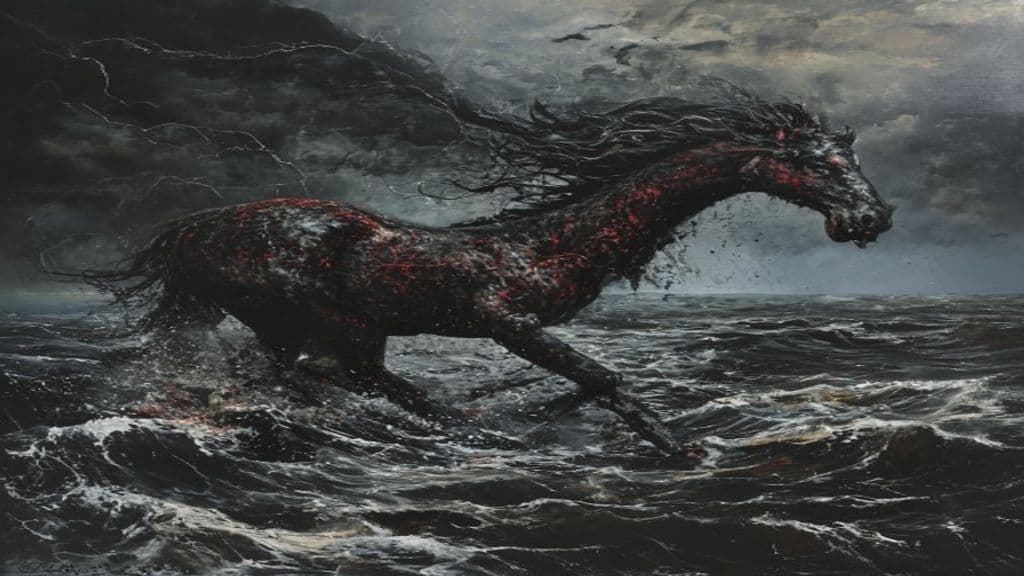
Nuckelavee
The most terrifying creature of Orcadian folklore — a skinless, horse-headed demon of the sea whose breath spreads plague and whose presence causes crops to wither. It cannot cross fresh water.
Antero Vipunen
A giant in Finnish mythology with valuable spells and knowledge, possibly associated with underworldly powers. (Note: * Power tier should be Ancient (deity-level) due to possessing "very valuable spells and knowledge", which suggests immense magical power but not necessarily cosmic-level. * Appearance should clarify )
Emuu
Emuu is attested in a brief modern catalogue entry as a "mythical creature from Finnish and Karelian folklores." Beyond this short label, the supplied sources contain no descriptive narratives, attributes, or rituals connected to Emuu.
Etiäinen
In Finnish folklore, an etiäinen is a harbinger that precedes a person, performing actions they will later undertake. (Note: 1. Factual claim in summary about "preceding a person" not explicitly supported by source material. 2. Power tier should be Primordial, as etiäinens are part of everyday life and associated with every)
Flogdrake
A Scandinavian firedrake or "fly‑dragon" associated with evening streaks of light in the sky and with tunnelling mountain lairs that hide ore and treasure. Primarily attested in Swedish folklore, it participates in a pan‑European motif of fiery serpents and is sometimes linked with household or earth spirits in nearby traditions.
Hongatar
A Finnish haltija (localized spirit) associated with the bear: presented in runic songs as the mother or progenitor of the bear, and named for the honka pine used to hang bear skulls during peijaiset (bear funeral/feast). She is an invited guest of those rites and forms part of a family/network of tree-linked female haltijas in Finnish/Karelian oral tradition.
Ilmatar (Luonnotar)
Ilmatar, also called Luonnotar, is a female spirit of the air and a nature-spirit figure in the Finno-Karelian epic tradition as compiled in the Kalevala. In Elias Lönnrot's Kalevala she is presented as the virgin mother who is impregnated by sea and wind and becomes the mother of the culture-hero Väinämöinen, though regional runic variants sometimes name other maternal figures for Väinämöinen.
Kanteletar
The Kanteletar is a collection of Finnish folk poetry compiled by Elias Lönnrot in the 19th century. (Note: - Remove Power tier: Minor Spirit (the source material does not describe any supernatural or spiritual aspects) - Summary: needs slight revision for accuracy - Appearance, Abilities, Sensory cues, Wea)
Kihovauhkonen
A seer or prophet in Finnish mythology, tasked with foreseeing and warning of impending cataclysmic events. (Note: 1. Power tier: should be Lesser (local spirit) based on typical depiction in folklore. 2. Ability description: while it makes prophecies, there's no indication of a Primordial power level for such abi)
Lalli
A historical figure from Finnish medieval legend, responsible for killing Bishop Henry in the late 1150s. (Note: - Power tier: Greater (not Lesser), as Lalli's actions have significant historical and cultural impact. - Sensory cues: none mentioned in source material, so should be deleted or clarified. - Weakness)
Metsänhaltija (Metsänväki)
A metsänhaltija is a place‑bound haltija of the Finnish tradition — an invisible, solitary guardian spirit of a specific forest locality (the collective term metsänväki refers to the forest's inhabitants or powers). Metsänhaltijat protect their home, care for species associated with that place, and may reveal themselves to humans.
Metsänpeitto
A lesser spirit in Finnish folklore that conceals people and animals within the forest, making them invisible to those searching for them. (Note: - Change Power tier: Minor Spirit -> Lesser (According to the provided power tier classification, Lesser corresponds with a local spirit, which seems more fitting given Metsänpeitto's role in conceali)
Mythologia Fennica
A collection of Finnish myths and legends that includes various gods and goddesses, forming the foundation of Finnish mythology. (Note: - Power tier should be Ancient (deity-level) since it's a collection of gods and goddesses. - Summary needs to be more specific and accurate, e.g., "A collection of Finnish myths and legends compiled )
Community Record
- [1]Sauna. Wikipedia, 'Sauna' (contextual entry describing sauna as room or small house for heat sessions; used to situate sauna as cultural location)wiki
- [2]Finnish Sauna Etiquette - How to Do Sauna Like a Finn!. Her Finland, 'Finnish Sauna Etiquette' (discussion of sauna practices and manners; used to show ritualized social behavior around sauna use)other
- [3]Finnish Sauna Folklore: Spirits and Guardians of Finnish Bathhouses. Almost Heaven Saunas, 'Finnish Sauna Folklore' (popular folkloric account noting sauna as a site for spirits/guardians and stating sauna cleanses 'body and soul')folk
- [4]Baltic Finnic paganism. Wikipedia, 'Baltic Finnic paganism' (contextual background on place‑bound spirits and pre‑Christian belief world that frames sauna spirit concepts)wiki
- [5]Sauna - New World Encyclopedia. New World Encyclopedia, 'Sauna' (general description of sauna as cultural institution and location)other
- [6]Sauna Elf Tapani Finnish Guardian Spirit | Redwood Outdoors. Redwood Outdoors product page for 'Sauna Elf Tapani' (commercial depiction and naming of a 'sauna elf' figure; indicative of modern popular representations)other
- [7]Sauna Elf Antero Finnish Guardian Spirit | Redwood Outdoors. Redwood Outdoors product page for 'Sauna Elf Antero' (commercial depiction and naming of a 'sauna elf' figure)other
- [8]Finnish mythical creatures still lurk. thisisFINLAND (finland.fi), 'Finnish mythical creatures still lurk' (tourism/cultural piece noting that mythical creatures persist in cultural imagination; supports contextual placement of sauna spirit among place‑bound beings)other
- [9]The 10,000-year-old origins of the sauna – and why it's still going strong. BBC, article on sauna origins (contextual information on sauna's cultural centrality and ritual importance)other
- [10]Seven saunas to experience the magic of Christmas in Helsinki. Travel Tomorrow, tourism piece referencing sauna culture (contextual modern cultural usage)other