
Traditional accounts present Shamharush as an ancient jinn ruler bearing the pre-Islamic epithet Nasrani (Christian) who, after a reputed meeting with the Prophet Muhammad, embraced Islam and was recognized in tradition as a Great Qadi (judge) and an expert in Islamic law. He is named among a set of seven jinn kings and is said in local legend to have lived many centuries before choosing Morocco as his place of eternal rest. From the 16th century onward, Moroccan Islamic scholars campaigned against veneration of jinn figures like him, reducing his public cultic prominence.
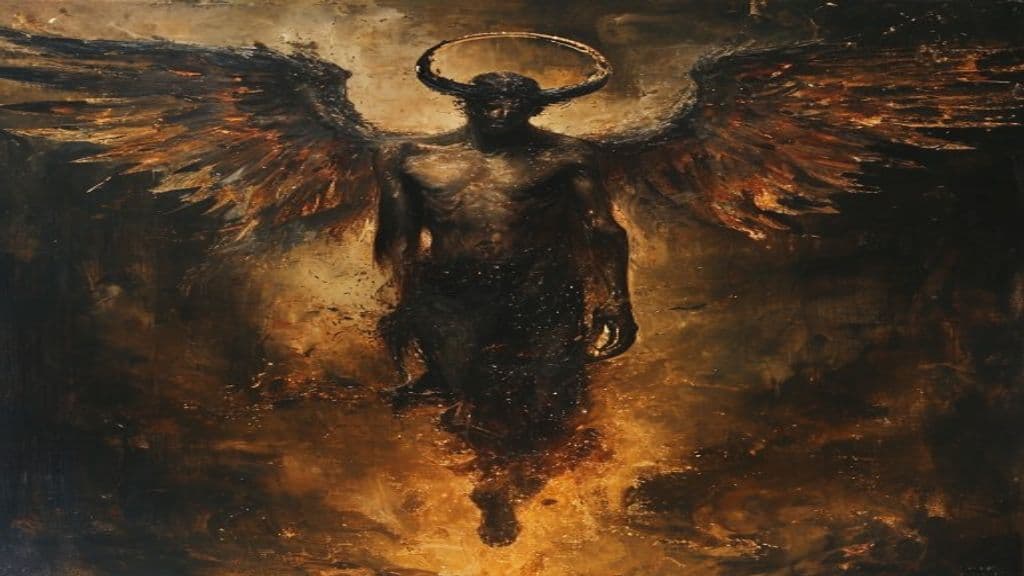
Literary and folkloric accounts rarely supply a detailed anthropomorphic description. Esoteric manuscript imagery (notably Kitab al-Bulhan) depicts him under the epithet Abu al-Walid (Father of the Newborn) holding a naked infant upside down and surrounded by sigils and the Khatam Sulayman (Seal of Solomon) hexagon. Some modern summaries and fandom/esoteric sources also call him al-Tayyar, 'the Flyer,' implying flight in iconography and description.
Shamharush functions as a supreme judicial figure among the jinn, presiding over a tribunal of jinn kings and associated in tradition with law, justice, abundance, and early childhood. He is described as very old, wise, merciful, and as having the authority to offer opportunities for redemption. Tradition links him with the planetary/weekday network (Thursday, Jupiter) and with symbolic attributes such as the color purple and the metal tin. He is said to travel the human world frequently; some sources call him 'the Flyer.' Later folkloric rumors associate him with the lineage of Aicha Kandisha, depicting more morally ambiguous or malign connections, a portrayal that scholars attribute to later demonizing narratives promoted by theologians opposing his cult. Sources associate phenomena such as thunder, lightning, and appearances of shadows with activities at his shrine, which served as a site for resolving human–jinn disputes.
Weaknesses
- otherSources do not list specific vulnerabilities
Wards
- otherShrine visitation and mosque adjacency as local institutional means of addressing disputes (sources record shrine as judicial seat but do not provide explicit ritual ward texts)
Community Record
- [1]Shamharush (Wikipedia). Wikipedia: Shamharushwiki
- [2]Friends of Morocco — News in review (Sidi Shamharush reference). Friends of Morocco: 'Sidi Shamharush the Flyer' mentionother
- [3]Kitab al-Bulhan imagery (as summarized in sources). Esoteric manuscript tradition summarized in provided notes (Kitab al-Bulhan depiction: Abu al-Walid holding infant with sigils/Khatam Sulayman)literary
- [4]DjinnUniverse / fandom references (al‑Tayyar; seven jinn kings listings). DjinnUniverse summary; fandom cross-references (djinn wiki / powerlisting fandom) cited in notesfolk
- [5]Zār (Wikipedia) — comparative mention. Wikipedia: Zār (includes brief mention of Shamharush in related spirit-name lists)wiki