Su İyesi is described in Turkic sources as the localized guardian spirit (iye) of particular waters. Some accounts note that the water personification can be female or male and one source indicates she/he may be considered a child of Yer Tanrı in certain genealogical framings; however, detailed unified cosmogonic narratives are not provided in the available materials. Overall Su İyesi belongs to the wider category of iyes — tutelary spirits associated with elements and places in a Turko‑Mongolian folk ontology.
Although essentially incorporeal, Su İyesi is reported to assume anthropomorphic or zoomorphic forms. The female Su Ana is attested as a naked young woman with a fairy-like face and long yellow hair often described as covered in black fish scales, possessing a fish's tail and eyes that 'burn like fire', and she is said to travel along her river on a half-sunken log. The male Su Ata is described as an old man with a frog-like face, greenish beard, a body covered in algae and muck, and webbed paws instead of hands. Occasional accounts note other forms (e.g., a bull) as variant depictions.
Su İyesi is associated with control or influence over local water phenomena: floods, storms, shipwrecks and drownings are attributed to it when angered. It is said to break dams, wash away water mills, and drag people and animals down to underwater dwellings to serve or be drowned. Conversely, traditions also ascribe beneficent roles such as bringing rain. Some named types (e.g., Su Dedesi) are said to cause a malady described as 'Water Disease' (watery bubbles in the body) in folkloric descriptions.
Weaknesses
- substancesalt (used in remedy for 'Water Disease' by throwing salt into rivers or fountains)
Wards
- ritualoffering of whole bread (to please Su Ata by throwing a whole bread into the water)
- ritualintroduction of a bride to Su Ata (ritual acknowledgment before a bride travels far)
Naga
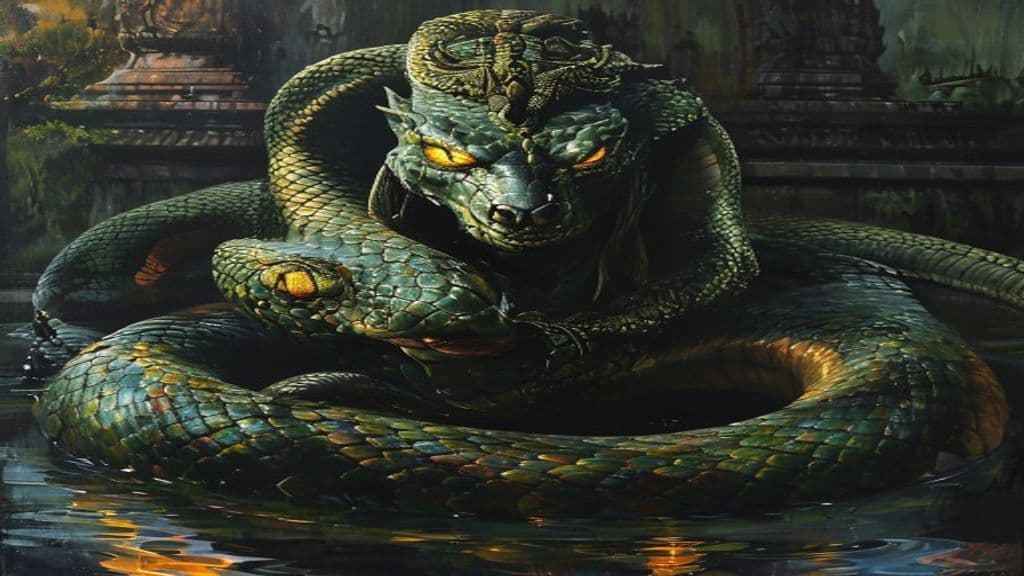
Divine serpent beings of Hindu, Buddhist, and Jain cosmology — powerful guardians of water, earth, and underground treasures. Revered as deities in South and Southeast Asia.

Mermaid
An aquatic folkloric being with the head and upper body of a female human and the tail of a fish, appearing across many cultures as both omen of maritime danger and occasional benefactor or romantic partner to humans.
Community Record
- [1]Su İyesi — Wikipedia. Wikipedia contributors, 'Su İyesi', Wikipedia, The Free Encyclopediawiki
- [2]Su İyesi — Wikidata. Wikidata entry Q4774440 'Su İyesi'wiki
- [3]Water spirit — Wikipedia. Wikipedia contributors, 'Water spirit', Wikipedia, The Free Encyclopediawiki
- [4]Iye: The Guardian Spirits Hidden in Every Corner of Nature | Mythlok. Mythlok, 'Iye: The Guardian Spirits Hidden in Every Corner of Nature'other
- [5]historytr.txt (excerpted folkloric listings). Compiled notes on Turkic folklore (historytr.txt)other