
As presented in the surveyed sources, Teke Teke is framed as the onryō (vengeful spirit) of a schoolgirl whose body was split in half by a train after she became stuck. The spirit is an aggrieved, personified revenant whose mutilation and neglect at death (sources link neglect by station staff in one telling) motivate her vengeful activity in modern urban settings.
Core descriptions identify her as a young woman or schoolgirl who is bisected at the waist or otherwise lacks lower limbs. She travels by propelling her upper body with her hands or elbows and thus has no normal locomotion. Variant accounts (notably the Kashima Reiko form) emphasize that she is legless and specifically haunts bathroom stalls. Some tellings add implements such as a scythe, but that is described as a variant attribute rather than a consistent or core feature.
Teke Teke pursues people in urban night settings—notably around train stations in the canonical telling—and kills by slicing victims in half at the waist in a manner that mimics her own disfigurement. Because she lacks lower limbs, she moves by dragging her torso on hands or elbows, producing the signature scraping sound. Variant behavior (Kashima Reiko) involves approaching occupants of bathroom stalls, asking where her legs are, and ripping or slicing those who give unacceptable answers. Some versions include a folkloric mechanic where learning Kashima's story brings an appearance within a month unless the story is spread.
Weaknesses
- mantraReplying that 'her legs are on the Meishin Expressway' (Kashima Reiko variant)
- mantraReplying with the phrase 'kamen shinin ma' (Kashima Reiko variant)
- conditionSpreading the story (a described folkloric practice said in some versions to stop or delay Kashima's appearance)
Wards
- mantraSay 'her legs are on the Meishin Expressway' in response to Kashima Reiko's question
- mantraSay 'kamen shinin ma' in response to Kashima Reiko's question
- ritualSpread the story (verbal transmission framed in one version as a way to prevent Kashima from appearing to the teller)
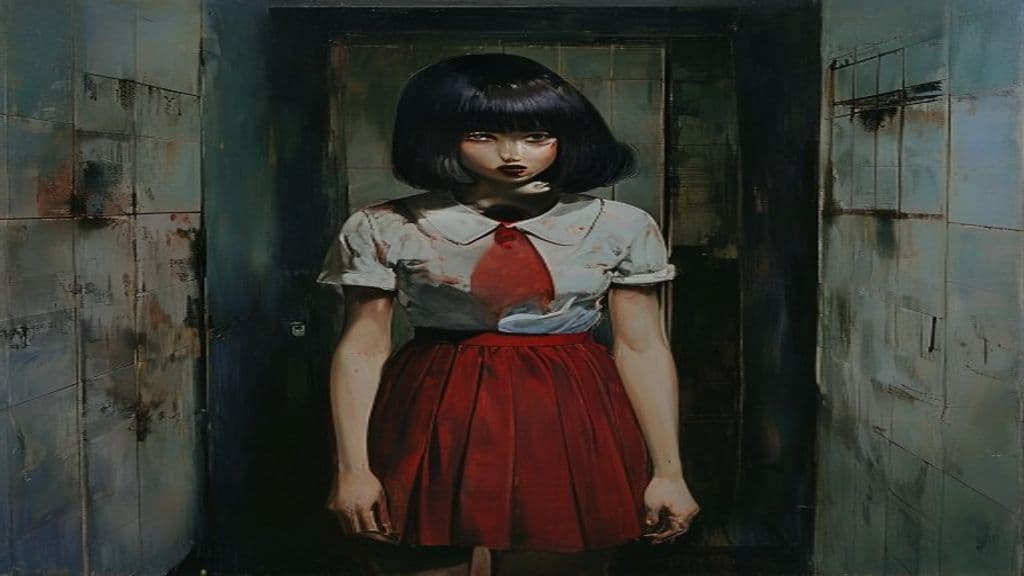
Hanako-san
Hanako-san (Toire no Hanako-san) is a modern Japanese urban-legend spirit said to haunt school toilets. Commonly framed as the ghost of a young girl associated with a particular stall/floor of a school lavatory, the figure is transmitted chiefly in school settings and popular media and is described variously as a yūrei or a yōkai.
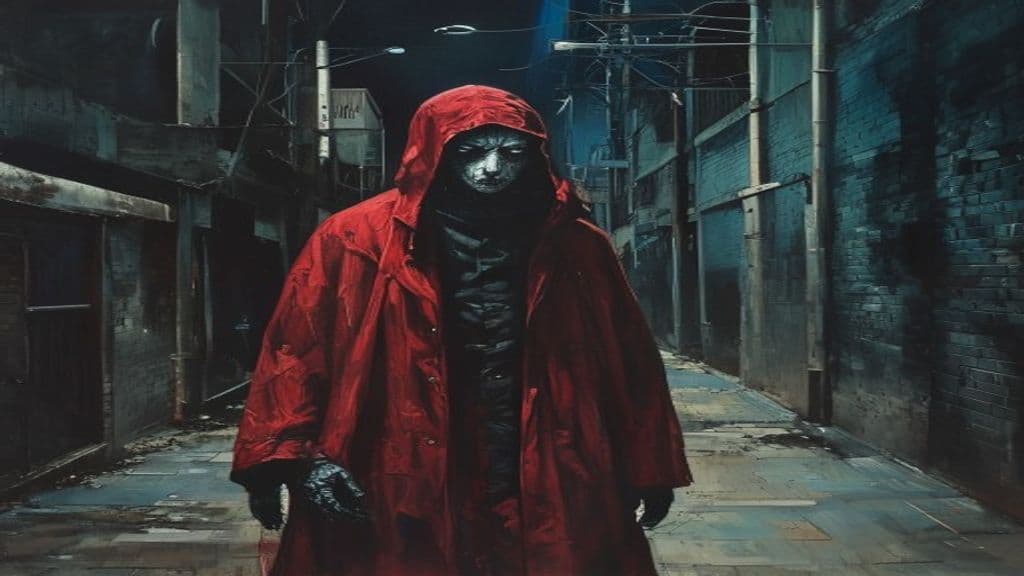
Aka Manto
Aka Manto (赤マント, "Red Cloak") is a Japanese urban legend and schoolyard ghost-story about a masked, cloaked figure who appears in public or school toilet stalls and forces occupants to choose between colored toilet paper; each choice in the tale produces a violent supernatural consequence. The legend is part of modern popular folklore recorded in school contexts from the 1930s onward rather than a formal religious myth.
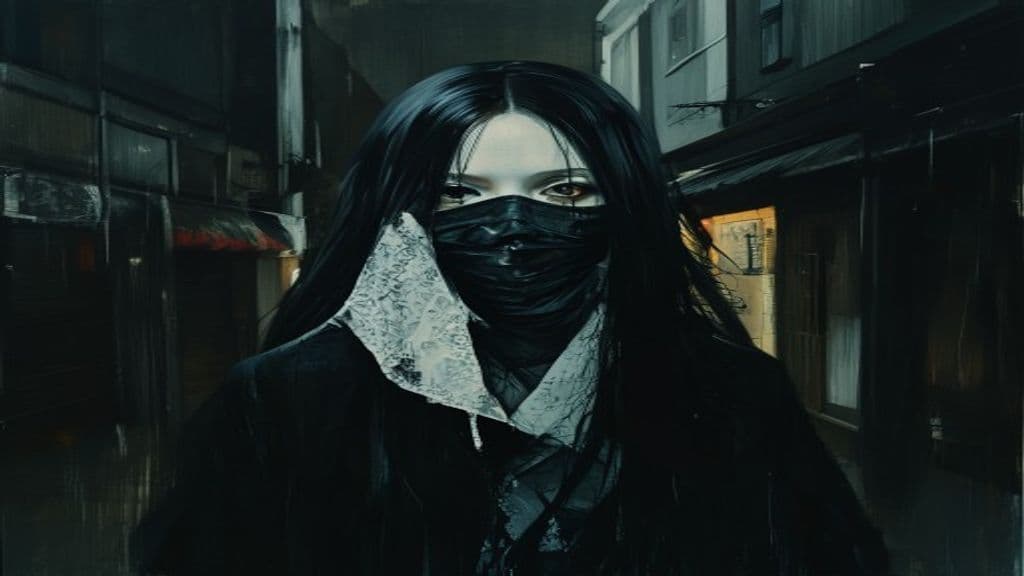
Kuchisake-onna
Kuchisake-onna (口裂け女, "mouth-slit woman") is a Japanese urban-legend figure and modern folkloric yōkai/onryō: a mutilated woman who asks victims whether she is beautiful and whose revealed slit mouth leads to killing or mutilation in variant accounts. The legend emerged in the late 1970s and circulates with multiple survival tactics reported in popular sources.

Madam Koi Koi
Madam Koi Koi is a Nigerian urban-legend apparition — a vengeful, site-bound female ghost associated with boarding schools, known for the distinctive clicking of red high heels. Tales present her as a punitive presence that haunts dormitories, hallways and toilets at night and as a cultural warning about nocturnal transgressions and unresolved injustice.
Aka Manto
Aka Manto (赤マント, "Red Cloak") is a Japanese urban legend and schoolyard ghost-story about a masked, cloaked figure who appears in public or school toilet stalls and forces occupants to choose between colored toilet paper; each choice in the tale produces a violent supernatural consequence. The legend is part of modern popular folklore recorded in school contexts from the 1930s onward rather than a formal religious myth.
Kuchisake-onna
Kuchisake-onna (口裂け女, "mouth-slit woman") is a Japanese urban-legend figure and modern folkloric yōkai/onryō: a mutilated woman who asks victims whether she is beautiful and whose revealed slit mouth leads to killing or mutilation in variant accounts. The legend emerged in the late 1970s and circulates with multiple survival tactics reported in popular sources.
Te Wakaringaringa
A legendary great ocean-going canoe in Māori tradition, significant to the migrations that settled New Zealand. (Note: 1. Power tier should be "Ancient" based on its significant role in human migration and settlement. 2. Origin story is missing entirely; it would be helpful to include a brief explanation of how it cam)
Te Whata-uira-a-Tangawa (Tangaroa)
Tangaroa is described in Māori mythology as the great atua of the sea, lakes, rivers, and the creatures that live within them, especially fish. An aspect called Tangaroa-whakamau-tai is said to exercise control over the tides, and he is sometimes depicted as a whale.
Te Whatuiāpiti
Te Whatuiāpiti was a Māori rangatira (chieftain) of Ngāti Kahungunu from the Heretaunga / Hawke's Bay region of Aotearoa/New Zealand and the eponymous ancestor of the hapū Ngāti Te Whatuiāpiti. Remembered in oral and recorded genealogies, his life—feuds, battles, marriages and reoccupation of lands—functions as a foundational narrative for hapū identity and territorial claims.
Tefnut
Tefnut is an ancient Egyptian goddess of moisture (moist air, dew, and rain), a leonine and solar-associated member of the Heliopolitan Ennead. She is a primordial offspring of the creator (Atum/Ra), twin and consort of Shu, and mother of Nut and Geb, functioning both as a life-giving moisture deity and as one of the leonine 'Eye of Ra' goddesses who can assume a fiery protective or wrathful aspect.
Teiresias
Teiresias is a blind mortal seer of the Theban cycle in Greek myth who serves as a prophetic advisor associated with Apollo and who figures across multiple generations of Theban narrative, including roles advising Cadmus and appearing in tragedy.
Telamon
Telamon (Ancient Greek: Τελαμών) is a mortal heroic king and warrior from archaic Greek myth, son of Aeacus and the nymph Endeïs in many accounts, father of Ajax and Teucer, and a participant in pan‑Hellenic episodes (Argonauts, Calydonian Boar hunt, allied actions with Heracles). He functions primarily as an ancestor‑hero who links civic lineages (Aegina, Salamis, Megara) into the epic heroic world.
Telecleia
Telecleia (Ancient Greek: Τηλέκλεια, 'glory from afar') is a mortal mythological figure recorded in Greek genealogical tradition as a Trojan princess, daughter of King Ilus, wife of Cisseus of Thrace, and mother of Theano; some sources list her as a possible mother of Hecuba. She is attested only within lineage lists and has no independent cult or narrative of deeds in the supplied sources.
Teledice
Teledice (Ancient Greek: Τηλεδικη, Tēledikē) is an Argive Naiad nymph in Greek mythology, named as a consort of the culture-hero Phoroneus and mother of early descendants such as Apis and Niobe in genealogical accounts. Her name is glossed as "Far-Reaching Justice," and she functions primarily as a mythic ancestress linking local nature-divinity to royal lineage in Argos/Peloponnese.
Telemachus
Telemachus (Ancient Greek: Τηλέμαχος) is a human figure of Greek epic tradition, the son of Odysseus and Penelope and a central character in Homer's Odyssey. He undertakes a coming-of-age quest to discover news of his missing father, is guided by the goddess Athena, and later assists Odysseus in reclaiming their household; later, post‑Homeric tradition (the lost Telegony) attaches further episodes to his life, including a marriage to Circe.
Teleon
Teleon (Ancient Greek: Τελέων) is the name of two distinct mortal figures in Classical Greek mythic genealogies: an Athenian son of Ion, eponym of a tribe (Teleontes/Teleonites), and a Locrian father of the Argonaut Eribotes. Sources present Teleon as a human ancestral/progenitorial figure rather than a supernatural being.
Community Record
- [1]Teke Teke (Wikipedia). Wikipedia, 'Teke Teke' article (as provided in research notes)wiki
- [2]Teke Teke (Wikidata Q111569774). Wikidata entry referenced in research notesother
- [3]Archive listings (name-collision references). Archive audio listing noted in research notes (not used for folkloric claims)other