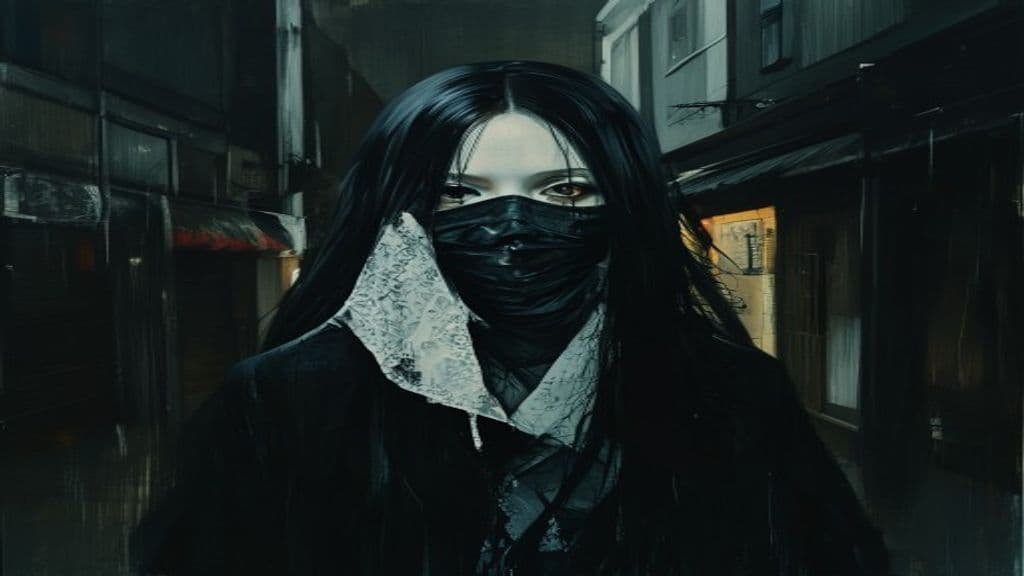
The most accepted origin in the provided sources places the modern legend in Gifu Prefecture, Japan, emerging in 1978 and spreading nationally in 1979 via newspapers and magazines. In modern accounts she is variously framed as the onryō (vengeful spirit) of a wronged woman and as a yōkai incorporated into contemporary catalogs of uncanny beings. Some commentators trace similar motifs to earlier (Edo-period) tales, but that suggestion is presented as interpretive rather than definitively documented in the supplied materials.
Typically described as a pale, long straight black–haired woman who hides a mouth slit from ear to ear and often covers her face with a surgical mask, handkerchief, or folding fan until revealing the mutilation. Many accounts present her as otherwise attractive and notably tall — commonly cited around 175–180 cm (5'7"–5'9"), though some tellings report much greater heights (claims up to ~244 cm appear in variants). She is frequently depicted holding a sharp implement (scissors, knife, machete, scythe or similar). Some versions add numerous sharp teeth within the slit mouth.
Her defining folkloric action is to approach potential victims and ask an appearance-related question (commonly rendered as "Watashi, kirei?" — "Am I beautiful?"). If the respondent answers "no" in many versions she kills them on the spot; if they answer "yes," she reveals her mutilated mouth and repeats the question — subsequent answers can lead either to immediate killing, nocturnal murder later that night (in some variants), or to having the respondent's mouth cut to resemble hers. Some accounts describe her possessing supernatural speed. Different tellings disagree about exact outcomes for particular responses, and survival often depends on ad-hoc conversational tricks or distractions.
Weaknesses
- conditionwalking in groups / adult accompaniment
- otherrespond with a noncommittal answer such as 'average' to buy time
- mantrasay 'pomade' three times (folkloric trick)
- substancedistract with hard candies (especially bekko ame) or money
- conditionclaim to be running late and bow/apologize (reported to cause her to move on)
Wards
- conditionwalking in groups / adult accompaniment
- otheranswering 'average' (noncommittal response) to her beauty question
- mantrasaying 'pomade' three times
- substancethrowing bekko ame or hard candies / offering money as a distraction
- otherclaiming to be late and bowing/apologizing
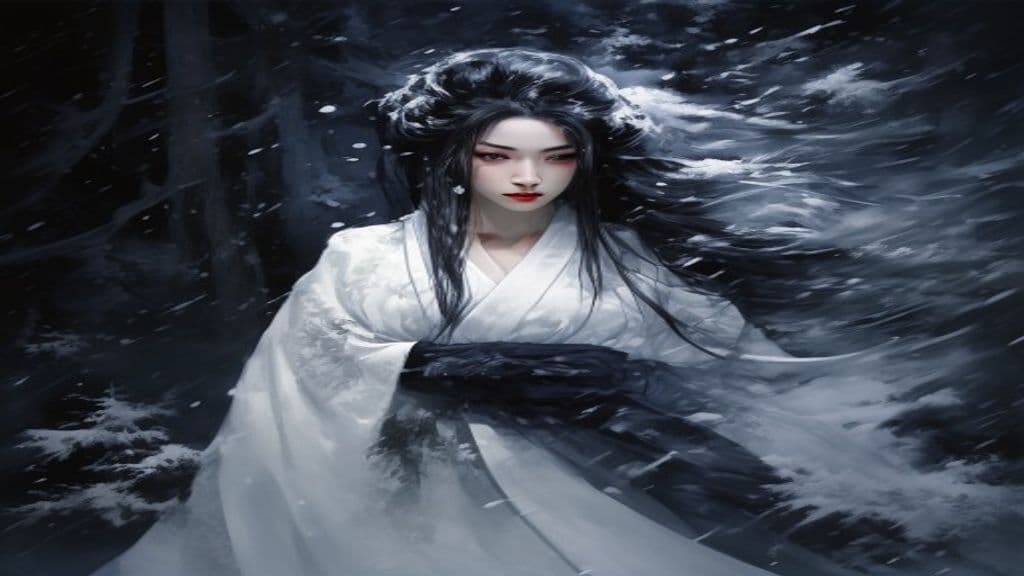
Yuki-onna
The Snow Woman of Japanese folklore — a spirit born of blizzards who appears to travelers lost in snowstorms. Beautiful and lethal, she can show mercy or bring death depending on her mood.
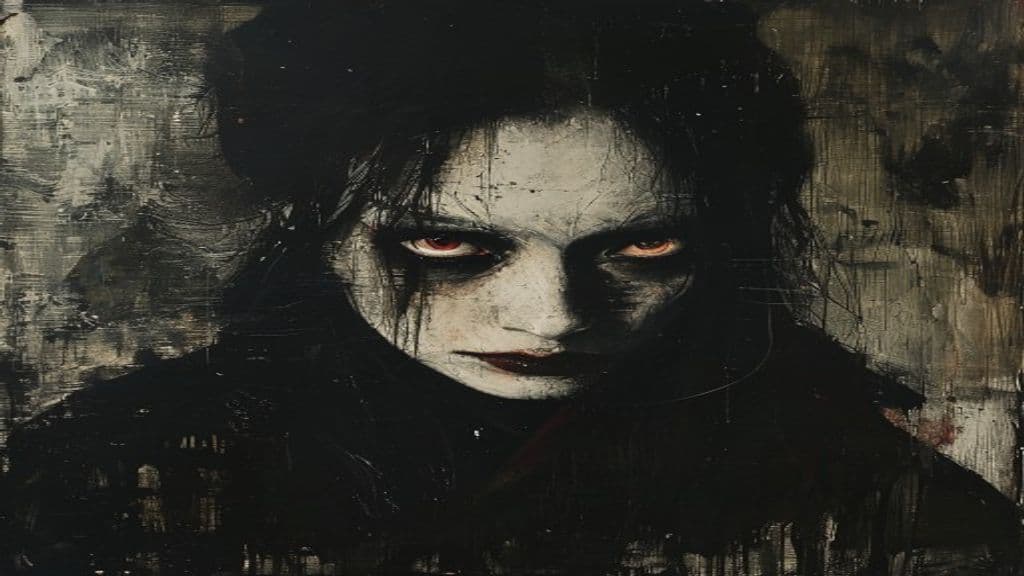
Onryō
Onryō are vengeful spirits in Japanese folklore who return after death to redress wrongs suffered in life by harming the living; they are commonly portrayed in literature and film as wronged individuals—frequently women—whose resentment manifests as lethal retribution, and in some accounts as causing wider calamities.
Aka Manto
Aka Manto (赤マント, "Red Cloak") is a Japanese urban legend and schoolyard ghost-story about a masked, cloaked figure who appears in public or school toilet stalls and forces occupants to choose between colored toilet paper; each choice in the tale produces a violent supernatural consequence. The legend is part of modern popular folklore recorded in school contexts from the 1930s onward rather than a formal religious myth.
Teke Teke
A Japanese urban-legend onryō of a young woman split in half by a train; she moves by dragging her upper body and produces a scratching 'teke teke' sound while attacking victims, often by slicing them in half to mirror her own injury. A named variant, Kashima Reiko, haunts bathroom stalls and questions occupants about her missing legs.
Kshetrapala
Fierce guardian deity of fields, village boundaries, and agricultural territory — an aspect of Shiva or Bhairava who punishes trespass with epidemic illness and crop failure. Every North Indian village once had a Kshetrapala shrine at its boundary stone; his is the first rite performed before plowing season.
Kuafu (夸父)
Kuafu is a mythic giant in Chinese tradition known for attempting to chase and capture the Sun; his pursuit is used etiologically to explain landscape features (drained rivers, a peach forest, and in some versions a mountain range) and proverbially as an emblem of audacious but ultimately futile striving.
Kubai (Kübey)
Kubai (Turkish: Kübey) is a maternal birth and child-protecting figure in Turkic mythology. Traditionally described as a daughter of Kayra who lives in the Ulukayın (world tree) and draws life-water (Bengisu), she bestows souls, gives healing milk to newborns, eases birth pains, and guards infants until key developmental milestones.
Kubera
Kubera is the Hindu deity associated with wealth and the lord-king of the semi-divine yakshas, serving as the regent (dikpala) of the north and a protector of the world. His character evolves in textual history from a chief of evil spirits in Vedic sources to a respected lokapala and patron of wealth in later Puranic and epic literature.
Kubikajiri
Kubikajiri (首かじり) is a head-eating ghost from Japanese folklore described as a headless spirit that haunts graveyards at night seeking and consuming heads of the living or the dead. Its presence is often associated with the smell of fresh blood and with searching graves for its own missing head.
Kui (Māori mythology)
Chthonic demigoddess in Māori mythology associated with the underworld and natural world. (Note: * Origin story: none provided in source material * Appearance: no physical description mentioned * Abilities: fertility/protection not explicitly stated; connection to underworld implies association w)
Kuino
In Guinean (West African) folklore, a kuino is described as an evil spirit whose life or heart is placed in a material object called a sambio; destruction of that sambio by a wizard is said to cause the death of the spirit.
Kuippana (Tapio)
Kuippana, also attested as Tapio or Hippa, is a Finnish forest spirit attested in Finnish tradition as the named sovereign or 'King of the Forest.' Hunters in the tradition addressed him ritually before hunts; he is represented as bodily merged with forest vegetation.
Kujata (Arabian Tradition)
Cosmic bull supporting the weight of the world and its angelic counterpart, standing on the back of Bahamut in a medieval Muslim cosmography. (Note: 1. Power tier should be Primordial. 2. Additional information about Bahamut's relation to Kujata is needed for the description. 3. The entity's ability to carry additional celestial structures on its )
Kukudh
Kukudh (definite Kukudhi) is an Albanian undead revenant variably depicted as the restless soul of a miser haunting his house, a disease-carrying female demon, or a chain-borne January corpse in some regional accounts. The term also functions as a moral label for an evil person and as a name for a severe sickness in southern traditions.
Community Record
- [1]Kuchisake-onna — Wikipedia. Wikipedia: Kuchisake-onnawiki
- [2]Kuchisake-onna — Wikidata. Wikidata entry Q482610other
- [3]#13 - Creep me out! Eine Reise ins schone Japan (archive). Archive.org: podcast episode listingother
- [4]Kaiki Toshi-Densetsu - Kuchisake-Onna (2008) (DVDrip) 怪奇都市伝説 口裂け女 (archive). Archive.org: film listingother