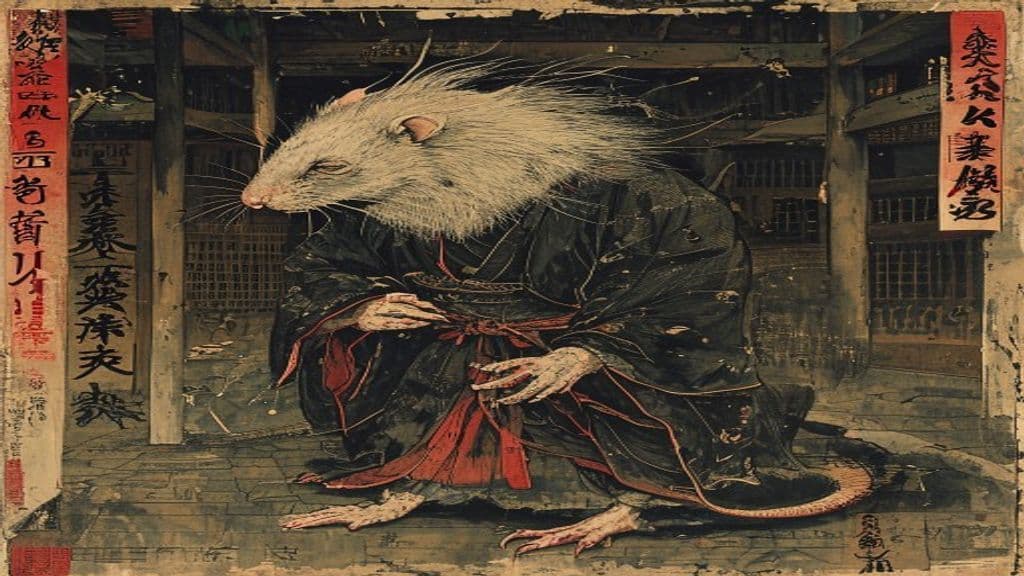
In medieval narratives Raigō was a Heian-period monk whose request for construction of an ordination platform (kaidan) at Mii-dera was opposed by Enryaku-ji on Mount Hiei. After prolonged ascetic practice and death, sources relate that Raigō's grudge manifested as a harmful spirit: Heike Monogatari describes his posthumous haunting of Prince Atsufumi (an ominous white-haired priest apparition associated with the prince's subsequent illness and death), and later accounts and pictorial traditions identify that grudge with a rat-form linked to the monk, producing the names Raigō-nezumi and Mii-dera-nezumi. Institutional responses (see wards) turned the dangerous grudge into an object of local cultic attention.
Descriptions vary by source. Heike Monogatari records an ominous white-haired old priest apparition associated with Raigō's grudge. Other narratives depict a giant rat that eats sacred books. The Taiheiki describes the grudges of Raigō as transforming into "84,000 rats with stone bodies and metal teeth," emphasizing multiplicity and hard/mineral or metal qualities. Edo-period picture-books (e.g., Toriyama Sekien's Gazu Hyakki Yagyō) applied the name Tesso to rat-yōkai imagery, fixing the rodent-shaped visual identity in popular culture.
Sources attribute a set of destructive and uncanny behaviors to Raigō's grudge. Heike Monogatari presents an onryō that appears beside Prince Atsufumi's pillow, bringing illness that culminates in the prince's death. Tale variants state the grudge "became a giant rat" that ate sacred books at Enryaku-ji (Heike Monogatari / related summaries). The Taiheiki depicts massed assaults in which "84,000 rats with stone bodies and metal teeth" climbed Mount Hiei and consumed sacred texts and Buddha statues. In late-Edo yomihon (Takizawa Bakin's Raigō Ajari Kaisoden) Raigō appears in dreams to instruct a human in rat sorcery, enabling the summoning or direction of rats for narrative purposes. Each attributed ability is tied to the specific textual source that records it.
Weaknesses
- ritualplacation by enshrinement (Nezumi no Hokura)
Wards
- ritualNezumi no Hokura (鼠の秀倉) — shrine-enshrinement at Higashisakamoto / Hiyoshi Taisha area
Onryō
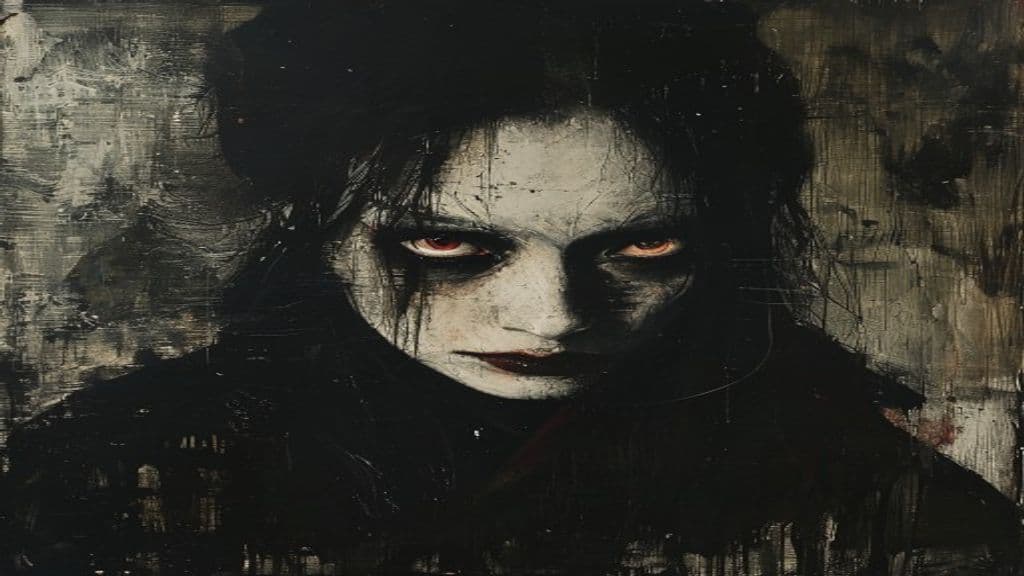
Onryō are vengeful spirits in Japanese folklore who return after death to redress wrongs suffered in life by harming the living; they are commonly portrayed in literature and film as wronged individuals—frequently women—whose resentment manifests as lethal retribution, and in some accounts as causing wider calamities.
Will-o'-the-Wisp
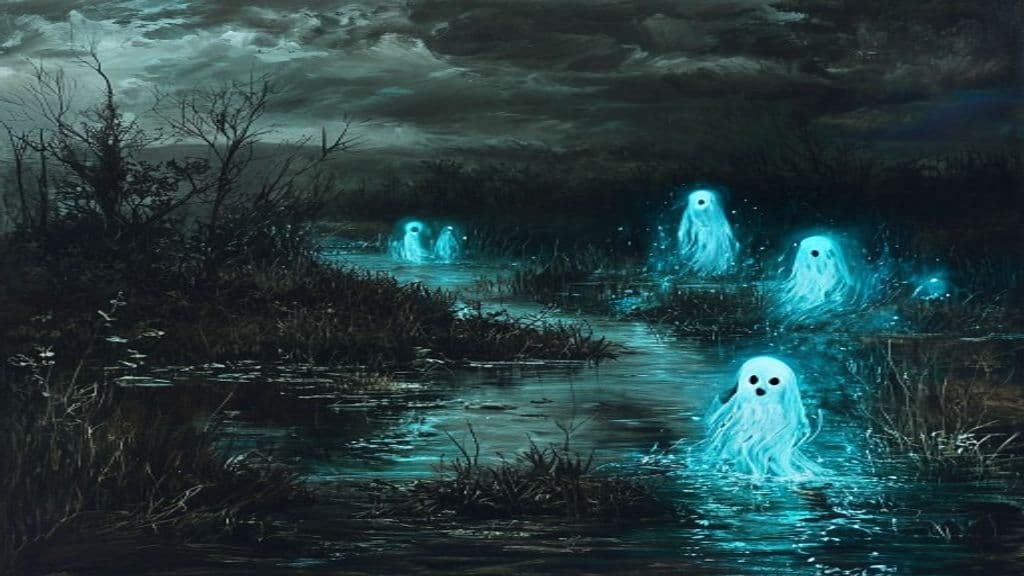
A wandering light seen over marshy ground at night, leading travellers astray into bogs and fens. Possibly a spirit, possibly the soul of the unbaptised dead, possibly the devil himself.
Tennin
Tennin (天人) are celestial, person-like beings in the Japanese Buddhist framework who serve as heavenly attendants, dancers, and companions to Buddhas and bodhisattvas. The concept derives from an Indo-Chinese-Buddhist lineage (compare apsaras) and appears widely in Japanese religious art, Noh theater, and local narrative motifs such as the hagoromo (feather-robe) story.
Tenome
A Japanese yōkai first popularized as an image in Toriyama Sekien's Edo-period emaki tradition, depicted as an old humanoid whose eyes are located on the palms of its hands. Later regional setuwa elaborate it as a revenant of a wronged blind person; one anecdote links it to the removal of victims' bones.
Tentōki and Ryūtōki
Tentōki (天燈鬼) and Ryūtōki (龍燈鬼) are small demon‑like attendant figures in Japanese Buddhist temple iconography. Typically shown as oni‑like beings carrying lanterns, they function as subjugated attendants who offer light to the Historical Buddha and symbolize the Shitennō’s power to repel evil.
Tereanini
Tereanini is an ancestral ocean-going voyaging canoe (waka) in Māori tradition, cited in accounts of the migrations that settled Aotearoa (New Zealand). It is associated in the sources with Ngāti Porou and the captain Rongomaituaho, linking it to the foundational migration narratives from Hawaiki.
Tereis
Tereis (Ancient Greek: Τηρηίς, Tērēís) is a personal name recorded in Greek mythographic tradition as the slave- or concubine-mother, by Menelaus, of the illegitimate son Megapenthes. She is attested only in later mythographic compilations and functions as an ancillary human figure within heroic-household genealogies rather than as a supernatural being.
Terpsichore
Terpsichore is one of the nine Muses in ancient Greek tradition, the divine personification and patron of dance and choral song. She is named from Greek roots meaning "delight in dancing" and is conventionally depicted seated with a lyre, accompanying dancers and choruses.
Tethys
Tethys is attested in the provided materials primarily as a Titaness of Greek mythic tradition who in a modern children's retelling is presented as an elderly storyteller and mediator among gods. The name is also widely reused in scientific and cultural contexts (a Saturnian moon, a gastropod genus, the ancient Tethys Ocean, and various institutions), usages which are naming transfers rather than continuations of the mythic figure.
Teucer
Teucer (Greek: Τεῦκρος, Latinized Teucer/Teucrus) is a mythic human hero of the Homeric age: an accomplished archer, son of King Telamon and Hesione, half‑brother of Ajax, a participant in the Trojan War and later an eponymous founder (most commonly credited with founding Salamis on Cyprus). He appears in epic (Homer) and tragic (Sophocles, Euripides) traditions and functions as a legendary warrior‑founder in Greek mythic genealogies.
Teutamides
Teutamides (Ancient Greek: Τευταμίδης), also attested as Teutamus (Τεύταμος), is a mytho-historical king of Larissa in Thessaly known from classical genealogical accounts. He appears in Greek mythographic traditions as son of Amyntor, father of Nanas and Lethus, and as a great-grandson of Pelasgus, linking autochthonous ancestry to later heroic generations.
Teuthras
Teuthras (Ancient Greek: Τεύθρας) is a legendary king of Mysia in the Greek mythic-historical tradition, eponymous for the district or town Teuthrania/Teuthraea. He appears in genealogical and epic-cycle narratives as a local ruler who hosts Auge and provides refuge and succession to the hero Telephus, with variant accounts of familial relations across sources.
Thalassa
Thalassa (Ancient Greek: θάλασσα, 'sea') is the divine female personification of the sea in Greek mythographic, poetic, and visual traditions. Treated variably as a primordial sea-principle, a mother of certain sea-beings, and as an emblematic figure in Roman-era mosaics, she functions more as the sea made person than as a narrowly characterized cult-deity.
Thalia
Thalia is not a single supernatural being in the supplied sources but a personal name applied to multiple distinct figures in Greek myth (a Muse, a Grace, a Nereid, and a nymph/minor vegetation goddess) and to various modern secular persons, places, and institutions. The provided materials are disambiguation and archival records and do not present a unified cosmology or ritual system for a single entity named Thalia.
Community Record
- [1]Tesso (Wikipedia). Wikipedia entry 'Tesso' summarizing Heike Monogatari, Taiheiki, Takizawa Bakin, Toriyama Sekien, and shrine records.wiki
- [2]Wikidata: Tesso (Q37443735). Wikidata entry for Tesso (listed but provided little substantive material for these notes).other