
Teucer is presented in classical sources as the son of Telamon, king of Salamis, and Hesione, daughter of Laomedon of Troy. He fights with the Achaeans in the Trojan War alongside his half‑brother Ajax the Great, serving notably as Ajax's archer. After Ajax's suicide and the ensuing dispute over the proper burial and the recovery of Ajax's arms, Teucer is judged by his father (accused of negligence for not returning the arms/body) and is disowned or exiled; he then sails away and is credited in classical tradition with founding the city of Salamis on Cyprus. Later local legends (not canonical Homeric tradition) place wanderings or foundation claims elsewhere (e.g., Pontevedra, Galicia) but these are treated as later appropriations.
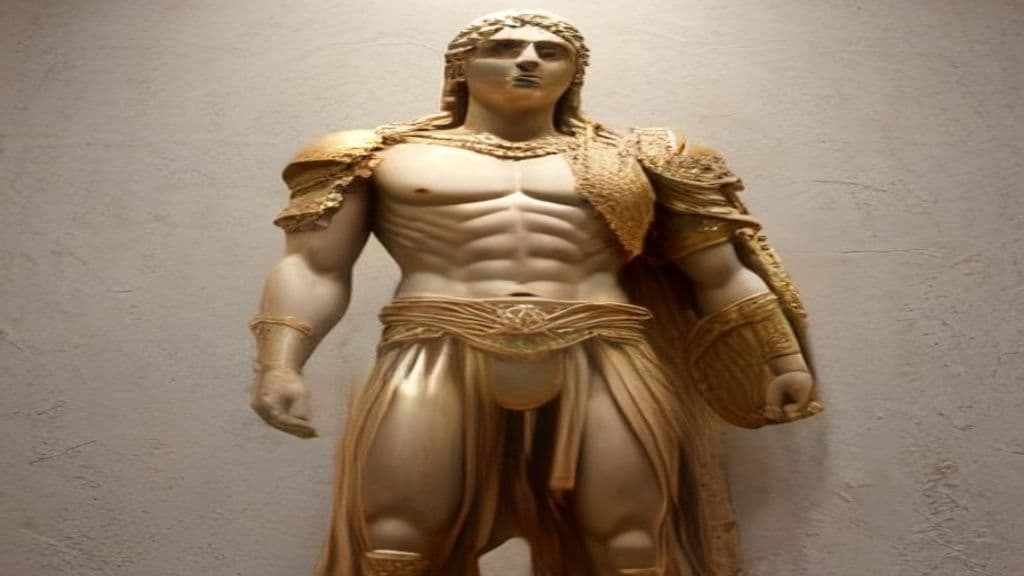
Classical texts and summaries do not supply an extended physical portrait; Teucer is characterized in narrative by his equipment and battlefield posture. He is repeatedly described as an archer who shoots from behind the giant shield of his half‑brother Ajax and is depicted onstage in Greek tragedies as the armed warrior entering scenes (e.g., stage directions in Euripides' Helen and Sophocles' Ajax). No specific bodily features beyond martial dress, bow, arrows and shield‑borne fighting posture are recorded in the cited sources.
Teucer is consistently noted as a skilled archer: Homeric tradition and later summaries record him loosing shafts from behind Ajax's shield, slaying many Trojans (traditionally counted as thirty), and being one of those who entered the Trojan Horse. Narrative episodes also record divine interference: Apollo at times frustrates his shots (e.g., shots aimed at Hector), and Zeus is said to have broken his bow at another point, forcing him to take up a spear. He exhibits loyal filial and fraternal conduct—guarding Ajax's corpse to ensure burial and confronting Achaean leaders who sought to prevent burial—then departs to found a new polis when repudiated by his father.
Weaknesses
- othersubject to divine intervention (Apollo and Zeus thwarting his missile effectiveness)
- conditionfamilial dishonor/exile (narrative consequence when judged by father for failing to return Ajax's arms/body)
Wards
None recorded.
Telamon
Telamon (Ancient Greek: Τελαμών) is a mortal heroic king and warrior from archaic Greek myth, son of Aeacus and the nymph Endeïs in many accounts, father of Ajax and Teucer, and a participant in pan‑Hellenic episodes (Argonauts, Calydonian Boar hunt, allied actions with Heracles). He functions primarily as an ancestor‑hero who links civic lineages (Aegina, Salamis, Megara) into the epic heroic world.

Hesione
Hesione is a mortal Trojan princess in Greek myth who was exposed to a sea‑monster as an oracularly required sacrifice for her father Laomedon’s offense against the gods; rescued by Heracles, she is given in marriage to Telamon, ransoms her brother with her veil (after which he is called Priam), and in later tradition becomes a diplomatic pawn whose non‑return is cited among factors leading to Paris's taking of Helen.

Hector
Hector is a Trojan prince and the foremost warrior of Troy in the Homeric Iliad, celebrated as a devoted husband, father, son, and defender of his city. Portrayed as exemplary in duty and martial skill, his mortal fate is shaped by combat, family obligations, and the interventions of gods.

Odysseus
Odysseus is a legendary mortal king of Ithaca from ancient Greek epic tradition, best known as the protagonist of Homer's Odyssey. Celebrated for his intellect, craft (mêtis), and long nostos (homecoming), he functions as an exemplar of heroic cunning rather than a supernatural being.

Menelaus
Menelaus is a mytho-historical king of Sparta in the Greek epic tradition, husband of Helen and a leader in the Trojan War cycle. He appears in Homeric epic (Iliad, Odyssey) and many later literary retellings and traditions; he is portrayed as a mortal royal figure whose fortunes are affected by divine intervention.

Agamemnon
Agamemnon is the legendary king of Mycenae (or Argos), head of the House of Atreus, and commander of the Achaean forces at Troy in Greek epic and tragedy. His story links dynastic guilt, ritual obligation, and political authority, culminating in the sacrifice-at-Aulis episode and his murder on return from Troy followed by juridical atonement in the Oresteia.
Community Record
- [1]Teucer - Wikipedia. Wikipedia, 'Teucer' article (summary of Homeric and later traditions)wiki
- [2]The Iliad, Book XV. Homer, The Iliad, Book XV (translations and passages concerning archer exploits and divine interventions)literary
- [3]The Iliad, Book XII. Homer, The Iliad, Book XII (context of Trojan War action involving Achaeans)literary
- [4]Helen by Euripides (Internet Classics Archive). Euripides, Helen — dramatic text with stage direction noting 'TEUCER enters.'literary
- [5]Ajax by Sophocles (Internet Classics Archive). Sophocles, Ajax — Teucer appears as a speaking/entering character in tragic retellingsliterary
- [6]Teucer (summary page by Loxias). Summary and commentary noting name interpretations and narrative details (e.g., 'name means, Trojan' interpretation presented as folk etymology)other
- [7]Wikidata: Teucer. Wikidata entry for Teucer (identifier and modern meta‑usage)other
- [8]Teucer (statue) - Wikipedia. Modern cultural afterlife: public statue and civic appropriation of the Teucer namewiki
- [9]China Mail (1879-12-10). 19th‑century newspaper use of the name 'Teucer' (shows later reuse of the classical name)other
- [10]China Mail (1880-11-04). 19th‑century newspaper use of the name 'Teucer' (maritime usage)other