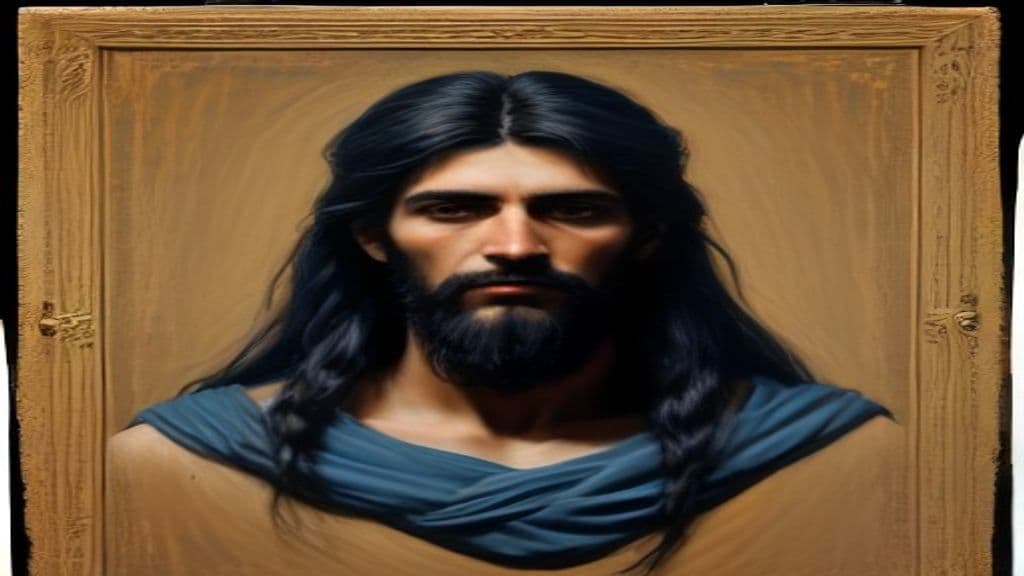
Hector is presented in the Homeric tradition as the son of King Priam and Queen Hecuba of Troy and the leading defender of Troy during the ten‑year siege by the Achaeans. The name itself is ancient (Greek Ἕκτωρ, Hektōr), an agent noun derived from the verb ἔχειν (ékhein, 'to have, to hold') and attested in Linear B (E‑ko‑to), giving the name connotations of 'holder' or 'possessor.' Scholarly proposals noted in the sources suggest layers of tradition and possible earlier local hero cults or transfers of mythic narratives, but within the primary epic account Hector is a mortal prince whose status and actions embody duties of household and city rather than a supernatural origin.
Ancient descriptions of Hector vary across sources. In Homer he is described with hair termed κυάνεος (kuaneos), often rendered blue‑black or dark. Later accounts preserve differing portraits: John Malalas calls him dark‑skinned, tall, stoutly built, wooly‑haired with beard and a speech defect; the account attributed to Dares Phrygius describes fair complexion, curly hair, an attractive blinking of the eyes and a slight lisp. These variant descriptions reflect divergent traditions rather than a single canonical physiognomy.
Hector is characterized as the chief military commander and greatest fighter for Troy in the Iliad: a bold, steadfast warrior who leads troops, fights in single combat, and kills many Greek warriors (including Patroclus). He is depicted as peace‑loving and thoughtful in domestic roles while resolute in battlefield duty. His successes and failures occur within a cosmos of divine intervention — for example, Apollo aids him during the chase with Achilles, while Athena later deceives him by assuming the form of his brother Deiphobus — but Hector himself is portrayed as a mortal exemplar of skill and leadership rather than possessing inherent supernatural powers.
Weaknesses
- conditionmortal vulnerability and fate
- conditionsusceptibility to divine deception and intervention
- otherhonor and sense of duty (choices to stand and fight)
Wards
None recorded.

Acanthus (son of Autonous)
Acanthus is a mythic human figure in a Greek metamorphosis tale (recorded by Antoninus Liberalis) who, with his family, was transformed by Zeus and Apollo into a bird named after him. The story functions etiologically, explaining the origin and behaviors of certain birds by linking them to formerly human persons and their experiences.
Acessamenus
Acessamenus (Ancient Greek: Ἀκεσσάμενος, Akessamenos) is attested in Greek sources as a mortal king of Pieria and the eponymous founder of a Macedonian place called Akesamenai. He appears in Homeric genealogy as the father of Periboea, whose union with the river-god Axius links Acessamenus into the ancestry of the hero Asteropaios.
Achaeans (Homer)
In Homeric epic, 'the Achaeans' (Ancient Greek: Ἀχαιοί, Akhaioí) is a collective ethnonym used to refer to the Greek peoples as a single grouped human contingent—the army of Greeks in the Trojan War narratives such as the Iliad and the Odyssey. The term functions as a poetic designation for human actors within the moral, social, and military universe of Homeric poetry rather than as a supernatural class of beings.
Admetus
Admetus is a mortal king of Pherae in Thessaly in the Greek tragic tradition (notably Euripides' Alcestis). His life becomes the subject of a divine bargain in which Apollo intervenes to delay his appointed death, a bargain that requires another to die in his stead — most famously his wife Alcestis.
Admetus of Pherae
Admetus of Pherae is a mortal king of Thessaly in Greek myth whose household and fate intersect with Olympian gods (notably Apollo and Artemis), the Fates, the personification of Death (Thanatos), and the hero Heracles. He is celebrated for hospitality and justice and is best known from the tragic cycle surrounding his wife Alcestis, who dies in his stead and is later recovered.
Aegiale
Aegiale is a mortal woman in Greek mythic tradition, best known as the wife of the hero Diomedes. In post‑Trojan War nostos narratives she is depicted in several accounts as unfaithful and as plotting against her husband; some traditions attribute her conduct to the vengeance of the goddess Aphrodite.
Aeolus
Aeolus is a name applied to multiple related figures in Greek myth: an eponymous son of Hellen (founder of the Aeolian people), a son of Poseidon who led colonial ventures to Tyrrhenian islands, and a son of Hippotes depicted in epic as a ruler or keeper of the winds. Ancient mythographers note confusion and overlap among these persons.
Aeopolus
Aeopolus (Ancient Greek: Αἰπόλος, gen.: Αἰοπόλου, romanized Aipolus or Aiopólos, lit. 'goatherd') is a mortal figure in Greek mythic genealogical tradition recorded only in brief scholia and summaries. He is named as the father of Cleobule, who in one variant is cited as a possible mother of Myrtilus by Hermes; some sources note he was also called Aeolus. Attestations are limited and no cult, deeds, or narratives are preserved for him.
Aerope
Aerope (Ancient Greek: Ἀερόπη) is a mythological mortal woman of Greek tradition, a Cretan princess connected to the royal house of Mycenae (the Atreidai). In surviving accounts she functions as a human agent whose sexual relationships and/or the transfer of a symbolic object (the "golden lamb") are narrated as catalysts in the dynastic feuds of Atreus and Thyestes; sources preserve variant and sometimes conflicting traditions about her fate and parentage.
Aesacus
Aesacus (Ancient Greek: Αἴσακος) is a mythic son of King Priam of Troy who, grieving the death of a river-nymph beloved, throws himself from a cliff and is transformed mid-plunge by the sea-goddess Tethys into a diving seabird (mergus). In some traditions (Apollodorus and Tzetzes) he is also described as a seer who learned dream-interpretation from his grandfather Merops and interprets Hecabe’s dream about Paris.
Aeëtes
Aeëtes is a mythic, semi-divine king of Aea (identified with Colchis) in the Greek heroic tradition, son of Helios and the Oceanid Perseis. He is guardian of wondrous objects—most famously the Golden Fleece—and functions as a royal task-master whose demands and possessions test visiting heroes (notably Jason and the Argonauts).
Agamemnon
Agamemnon is the legendary king of Mycenae (or Argos), head of the House of Atreus, and commander of the Achaean forces at Troy in Greek epic and tragedy. His story links dynastic guilt, ritual obligation, and political authority, culminating in the sacrifice-at-Aulis episode and his murder on return from Troy followed by juridical atonement in the Oresteia.
Community Record
- [1]Hector — Wikipedia. Wikipedia contributors, 'Hector,' Wikipedia, The Free Encyclopediawiki
- [2]Wikidata: Hector (Q1811874). Wikidata entry Q1811874other
- [3]Hector Graeme — Project Gutenberg. Evelyn Brentwood, Hector Graeme, Project Gutenberg editionliterary
- [4]Hector's Inheritance — Project Gutenberg. Horatio Alger Jr., Hector's Inheritance, Project Gutenberg editionliterary
- [5]Troilus and Cressida — William Shakespeare (online edition). William Shakespeare, Troilus and Cressida, act 4 scene 5literary
- [6]Troilus and Cressida — William Shakespeare (online edition). William Shakespeare, Troilus and Cressida, act 1 scene 2literary