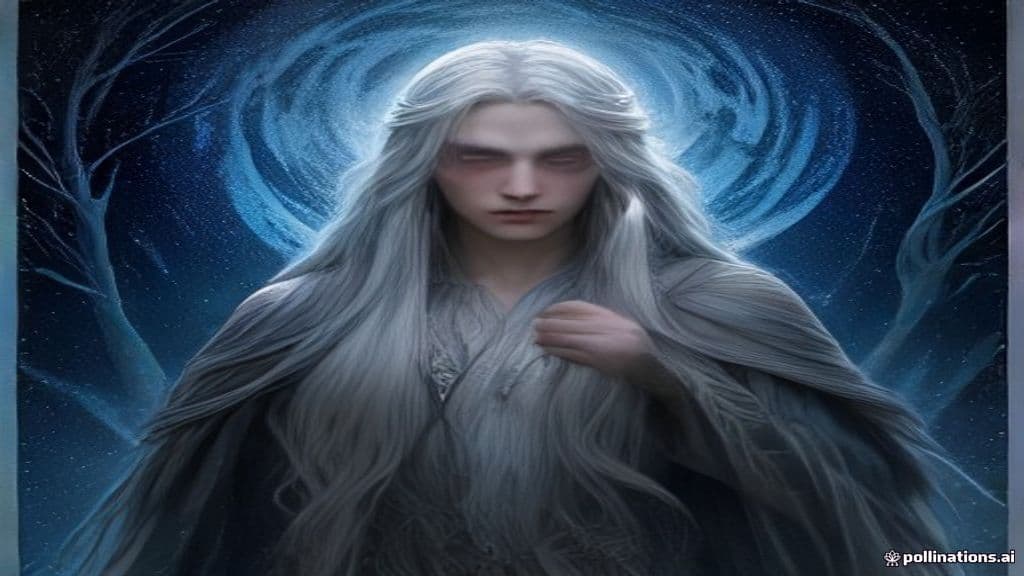
Thingol is presented in the legendarium as one of the Elves who awoke at Cuiviénen and later journeyed westward under guidance of the Vala Oromë; in this early period he is counted among the chieftains of the Teleri. He remained in Beleriand, became leader of the Sindar, and during his wanderings met and married Melian the Maia. Through that union he founded the hidden kingdom of Doriath and built the great halls of Menegroth; he was father to Lúthien and is portrayed as a central First‑Age sovereign whose decisions shaped the fate of his realm.
Canonical descriptive detail is limited. A poetic source describes him as tall, of fair Elven stature, with silver hair and a 'grim' face. Linguistically his names in Sindarin (Thingol) and Quenya (Singollo) are glossed as meaning 'grey cloak' or 'greymantle'; scholarship reads this epithet as symbolically significant (a dimming or mantling of light associated with his personal arc) rather than direct documentary evidence that he habitually wore a literal grey cloak.
Thingol's power is principally political and dynastic: he rules Doriath and commands elven hosts in the regional politics of Beleriand. His marriage to Melian, a Maia, brings an augmented protective power to his realm via Melian's enchantment of Doriath, but the sources do not grant Thingol independent Maia‑level supernatural powers. Narratively he exercises sovereign prerogatives (e.g., banning Quenya in his lands after the Kinslaying at Alqualondë, imposing conditions on Beren for marriage to Lúthien) and engages in warfare with Morgoth; scholars emphasize that his choices and refusals (notably over the Silmaril/Nauglamír episode) contribute to his kingdom's downfall.
Weaknesses
- conditionpolitical/moral misjudgment and mistrust born of the Kinslaying at Alqualondë
- conditionfailure to heed Melian's counsel regarding the Silmaril and Nauglamír
Wards
- ritualMelian's enchantment (concealment/protection of Doriath)
Beren
Beren is a named mortal man and protagonist in J. R. R. Tolkien's legendarium whose questing life and love for the Elf Lúthien form one of the central tales of the Elder Days. His story, treated largely from an Elvish perspective, exemplifies human mortality, courage, and tragic heroism within the wider cosmology of Middle-earth.
Noldor
The Noldor are a kindred (clan) of Elves in J. R. R. Tolkien's legendarium, one of the three High Elf clans who migrated to Valinor and later returned to Middle-earth. Renowned for their skill in craft, lore and warfare, their history — including the Oath of Fëanor and the Flight of the Noldor — is central to the events of The Silmarillion.
Community Record
- [1]Thingol — Wikipedia. Wikipedia entry 'Thingol'wiki
- [2]Eldamo: Sindarin: Thingol. Eldamo lexical entry for 'Thingol'/'Singollo'other
- [3]The Silmarillion (summary/archive reference). Summary and narrative material on Thingol, Melian, Doriath, Nauglamír, and related episodesliterary
- [4]Glir Thingol ar Ardh in (A Song of Thingol and His Kingdom). Poem describing Thingol ('Most tall of the fair Elven race / His hair as silver, grim of face')literary
- [5]Melian (Middle-earth) — Wikipedia. Wikipedia entry noting Melian's Maia nature and the enchantment of Doriathwiki
- [6]Why did Thingol refuse to let Luthien marry Beren? — Sci-Fi Stack Exchange. Community analysis summarizing narrative motives (ban on Quenya, political decisions)other
- [7]Did Thingol ever forgive the House of Fingolfin for the Kinslaying at Alqualondë? — Sci-Fi Stack Exchange. Discussion of Thingol's mistrust and ban on Quenya after the Kinslayingother
- [8]Silmarillion Writers' Guild — Thingol. Encyclopedic summary and community commentary on Thingol's roleother