
In legend Tiangou appears in narratives connected with Houyi and Chang'e: after Chang'e consumed an elixir of immortality, a black dog that had licked the remains of the pill grew large, chased Chang'e, and swallowed the Moon (and Chang'e). The Queen Mother of the West captured the dog, assigned it a heavenly office and the title Tiangou; the dog then spat the Moon and Chang'e back out. Separate traditions treat the name also as an asterism and as a guardian spirit in astrological contexts.
As a malign figure Tiangou is described as resembling a black dog or like a meteor; sources explicitly call it a black dog that eats the Moon. As a benevolent spirit some accounts describe it with the appearance of a white-headed fox. In astronomical-literary usage Tiangou is also the name of an asterism (an identified star-group) found in ancient Chinese sky-mapping, located in the region corresponding to Argo Navis in those sources.
Tiangou is chiefly described as the creature that 'eats' the Sun or Moon during eclipses and thus functions in myth as an explanation for lunar (and sometimes solar) disappearance. In narrative form it can swallow the Moon (and the lunar figure Chang'e) and later expel them when captured or assigned celestial duty. In astrological/astronomical usage Tiangou functions as a named asterism and is called a 'constellation guardian of welfare,' a protective or marking role in traditional celestial mapping. Iconographically and mythically Tiangou is opposed by protective figures such as the deity Zhang Xian, who is depicted aiming at the sky to drive the beast off and protect children.
Weaknesses
- otherCapture or subjugation by higher celestial authority (Queen Mother of the West)
- otherOpposition by protector deity Zhang Xian (depicted aiming bow and arrows at the sky)
Wards
- otherProtection by the deity Zhang Xian (iconographic/folk protection: Zhang Xian aims at the sky to guard children)

Bulgae (Korean Fire Dog)
A mythical Korean fire dog said to cause eclipses by biting the Sun and Moon. (Note: * The power tier is incorrect; according to the source, Bulgae cause eclipses by biting both the Sun and Moon, but there's no indication that they're on a primordial level. It should be at least Ancie)
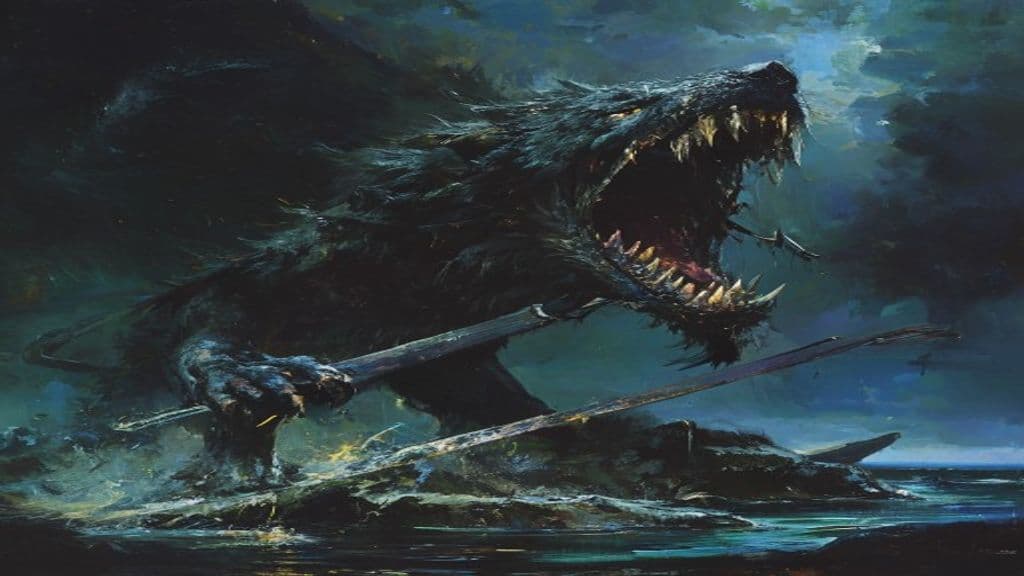
Fenrir
The monstrous wolf son of Loki, bound by the gods with a magical ribbon until Ragnarök — when he will break free and swallow Odin, and the world.
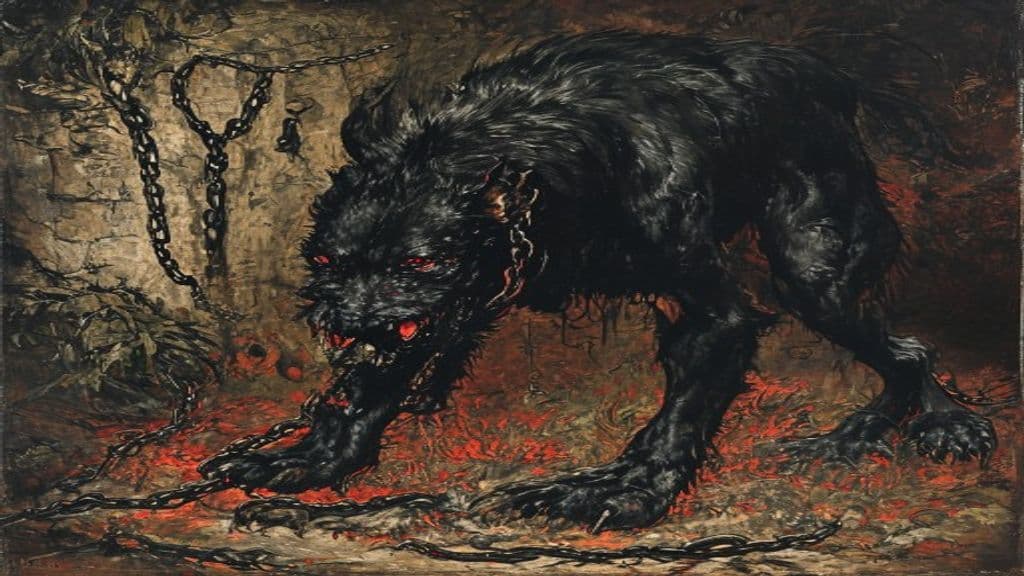
Hellhound
A class of mythic canine beings associated across many cultures with the boundary between the human world and the underworld or otherworld. Depending on tradition they function as guardians or attendants of the realm of the dead, members of spectral hunts, omens of death, or emissaries of diabolic forces.
Thánh Gióng
Thánh Gióng is a legendary Vietnamese culture-hero and sainted warrior celebrated as a symbol of national courage and patriotism. Remembered as one of the canonical 'Four Immortals' of Vietnamese spirit, he functions in folk religion and public memory as a miraculous martial figure honored in festivals and communal veneration.
Thánh Trần
Vietnamese venerated ancestor spirit and national hero associated with bravery, loyalty, protection, and national pride. (Note: - Power tier: Minor Spirit (as it is an ancestor spirit and not a deity) - Abilities: add that these qualities are believed to be bestowed upon people through his worship, such as protection from harm)
Thánh Tông di thảo
A collection of 19 tales in the truyền kỳ (traditional Vietnamese folktales) genre, written by Emperor Lê Thánh Tông during his reign in 15th-century Vietnam. (Note: 1. Power tier: Lowered to Greater, as there's no indication of Primordial-level powers. 2. Origin story: Simplified to focus on Lê Thánh Tông's promotion of Confucian learning and his writing in Liter)
Thần Trụ Trời
A Primordial deity responsible for creating the world by establishing pillars in Vietnamese mythology. (Note: 1. Power tier: Primordial (consistent with being a creator deity) 2. Add sensory cues (e.g., description of pillars, sound, or other unique characteristics associated with Thần Trụ Trời's presence) 3)
Thứ phi Hoàng Phi Yến
Legendary figure and imperial concubine from Vietnamese tradition, known for her involvement with Lord Nguyễn Phúc Ánh and the fate of their son, Prince Cải. (Note: 1. The power tier should be Primordial -> Ancient (Her abilities seem more deity-level, influencing Lord Ánh's decisions and having an impact on those around her). 2. The summary should mention that t)
Tiamat
The primordial salt-sea dragon of Babylonian creation myth — the chaos-mother from whose slain body the universe was built, and whose blood became the first humans.
Tiberinus
Tiberinus is the Roman name attested for the divine personification of the River Tiber and separately for a legendary king, Tiberinus Silvius, listed among the early kings of Alba Longa. The name thus appears in two registers of Roman tradition: as a river-god tied to Rome's central watercourse and as a figure in mytho-historical genealogies.
Tibetan Mountain Spirit (Lu / Srin)
Lu (klu) and srin (srin / srin sngon) are classes of local mountain, earth, and water-associated spirits in Tibetan cosmology. They function as site deities, ancestral/household spirits, and ambiguous local powers that may be beneficent or dangerous depending on ritual relations; tantric adepts in Buddhist tradition are recorded as subjugating or oath-binding them into protector roles.
Tibetan Rakshasa (Dämo / Takma)
Rakshasa (Sanskrit: rākṣasa) in the supplied materials appears as a class of malevolent non‑human beings — rendered in English as “demons” or “ogres” — known from South Asian epic literature and referenced in Himalayan/Tibetan geographic and popular materials. The sources do not provide a single, systematic Tibetan doctrinal account; instead rakshasas appear across epic narrative (e.g., Ravana) and place‑names (e.g., Lake Rākṣasatāla / Rakshastal), suggesting their presence in a shared South Asian–Himalayan imagination as antagonistic beings associated with danger and certain locales.
Tiddalik the Frog
Tiddalik is a giant frog figure from Australian Aboriginal Dreaming (Dreamtime) narratives whose waking thirst causes him to drink all local fresh water; other animals make him laugh and so release the water, restoring rivers and lakes. The story functions as an etiological Dreaming tale explaining drought and the distribution of water and teaches communal response to crisis.
Tieke (tīeke)
Tieke (Māori: tīeke) is the Māori name for the saddleback, a native New Zealand bird (genus Philesturnus) of the family Callaeidae. In the provided sources it is treated primarily as a species of cultural and natural-historical significance — appearing in place-names and cited in at least one account of ritual invocation for rain — rather than as a distinct supernatural personage.
Tiera
In Finnish mythology and runic songs, Tiera is a male warrior entity with unknown powers and abilities. (Note: - The power tier should be Primordial, as it's unclear what its "powers and abilities" are, but since it's described as appearing in Finnish mythology and runic songs (which are often deeply connected)
Community Record
- [1]Tiangou (Wikipedia). Tiangou. Wikipedia. https://en.wikipedia.org/wiki/Tiangouwiki
- [2]Tiangou (Wikidata). Tiangou. Wikidata. http://www.wikidata.org/entity/Q1516958wiki
- [3]Xiaotian Quan (Wikipedia). Xiaotian Quan. Wikipedia. https://en.wikipedia.org/wiki/Xiaotian_Quanwiki
- [4]Star Tales – Monoceros (context for ancient sky-mapping placement). Ridpath, Ian. Star Tales – Monoceros. http://www.ianridpath.com/startales/monoceros.htmlother