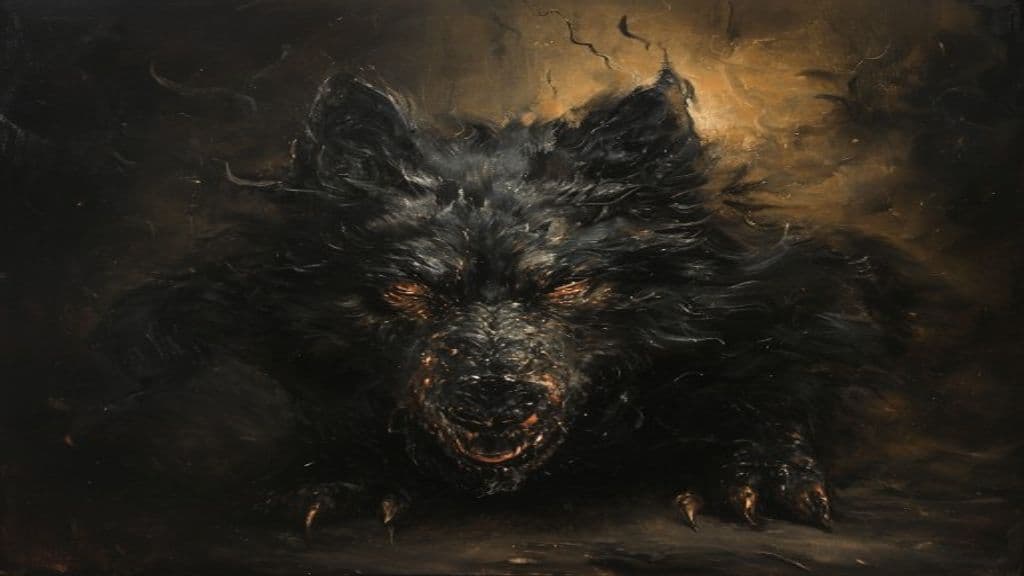
Bulgae are said to originate from the kingdom of darkness, a realm separate from human experience.
Strong and fierce dogs, possibly resembling the indigenous Korean dog breed Sapsali.
Bulgae have the ability to cause eclipses by biting both the Sun and Moon.
General Sinui
A legendary figure in Korean tradition who attempted to cheat death, but failed. (Note: 1. Power tier: Incorrectly classified as Minor Spirit. Given that General Sinui is a legendary figure who defied death, it's likely he should be categorized as a Greater (powerful regional) or at leas)
Gunungsin (War Gods)
Korean deities associated with war and conflict, possibly connected to the Jakjaegeon myth. (Note: 1. Power tier should be Primordial only if it's supported by source material; based on the provided sources, the power level is unspecified. 2. Abilities are unknown or unspecified in source material,)
Haneunim / Hananim
Haneunim (하느님) or Hananim (하나님) is the sky god in Korean mythology presented as the supreme heavenly deity. The figure functions as the Lord of Sky in older Korean cosmology, appears in the Dangun foundation myth (via the closely related Hwanin/Hwanung genealogy), and is identified in syncretic religious contexts with high deities such as Indra (Śakra), the Jade Emperor (Okhwang Sangje), and is named in modern Korean religions including Cheondoism and Jeungsanism; the terms have also been used as Korean translations for the Christian concept of God.
Onjo and Biryu's Baekje Creation Myth
The creation myth of Baekje revolves around the two brothers, Onjo and Biryu, who founded the dynasty. They possess human capabilities like decision-making and leadership skills. (Note: 1. Power tier: Greater (Onjo and Biryu's actions drove the founding of an entire kingdom) 2. Abilities: Add that their abilities also include diplomatic efforts and negotiations with other kingdoms 3.)
Samsin Halmeoni
A Korean goddess associated with childbirth and fate, revered for her connection to family lineage. (Note: * Power tier: Lesser (based on the description of being a localized spirit) * Abilities: Add that she has no specific abilities or behaviors described * Sensory cues: None listed in source material * )
Seonangshin
Korean patron deity of protection and war, guarding villages from harm. (Note: * Power tier should be Ancient, not Primordial, as the description implies a deity-level power but does not describe cosmic or universal implications. * Appearance is missing, but since it's not provi)
Sosamshin
In Korean mythology, Sosamshin is a household deity and the goddess of the birth of cattle. She occupies an important place in the cosmology of her source culture. (Note: * Power tier: Lesser (not Greater), given that Sosamshin is a household deity and not described as having deity-level powers. * Summary: While it's mentioned she occupies an important place in her sou)
Tan'gun
Legendary founder and first king of Gojoseon, considered divine with heavenly ancestry. (Note: - Power tier should be Primordial (but with caution, as it's not explicitly stated) - Appearance should note that no physical description exists - Abilities should specify that there is no information)
Bukavac
Bukavac is a demonic mythical creature from Slavic (Serbian) popular belief, attested chiefly in Syrmia. Described as an aquatic, nocturnal menace, it was said to emerge from lakes and pools to make loud noises and to jump onto people and animals, strangling them.
Bukki
Bukki (Hebrew: בֻּקִּי, Buqqī) is attested in biblical and related traditions as a personal name borne by at least two distinct human figures: a Danite prince named in Numbers 34:22 and a member of the Aaronid priestly genealogy recorded in 1 Chronicles (and echoed in Ezra-related lists). The name appears in variant forms across textual traditions (e.g., Boccas, Borith) and in modern secular usages unrelated to the ancient individuals.
Bulgasari (iron-eating monster)
Bulgasari (불가사리, also romanized Bulgasali) is a kaiju-style iron-eating monster originating in mid-20th-century Korean cinema. The creature is best known from the lost 1962 South Korean film Bulgasari, in which a martial artist (Nam Hyeong) is resurrected as the iron-eating monster to enact revenge on his murderers; a distinct later North Korean film titled Pulgasari (1985) is related in film-history discussions but is a separate production.
Bulis
No folkloric supernatural entity named 'Bulis' is attested in the provided sources. The string 'Bulis' appears in the materials as (a) the Latinized genus name for a jewel beetle species (Bulis bivittata) and (b) as a Hungarian adjectival form 'bulis' (from buli 'party') in an archive excerpt; there is no evidence in the supplied documents of a mythic being by this name.
Community Record
- [1]Bulgaewiki