
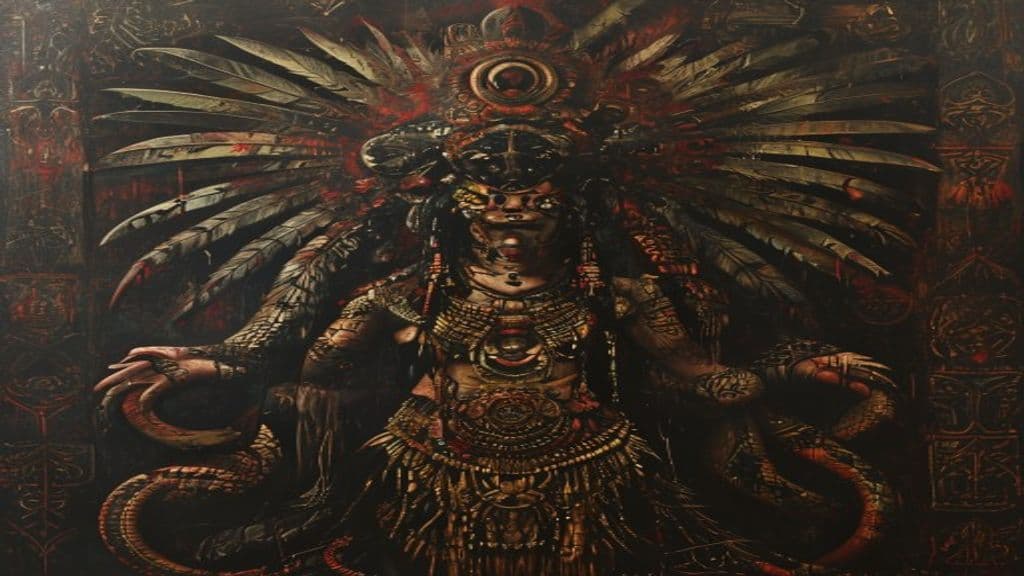
In Mexica creation myth Tlaltecuhtli is a primordial earth-being (sometimes identified with the sea-monster Cipactli) who was defeated, wounded and dismembered by creator gods (notably Quetzalcoatl and Tezcatlipoca) during the making of the fifth and current cosmos. Her body was transformed into the ordered features of the world: parts of her flesh and organs became hills, mountains, springs, plants and other landscape features. Although mythically torn apart in the creation event, she remained alive and continued to demand repayment—especially human blood—for her sacrifice so that the earth would continue to nourish life.
Iconography commonly depicts Tlaltecuhtli as a squat, toad- or sea-monster–like anthropomorphic creature with splayed arms and legs, massive claws, crocodilian skin texture, and a gaping maw often shown with a flint knife or a river of blood. Some images show multiple mouths or teeth across the body, elbows and knees adorned with skull motifs, and sometimes a skirt composed of human bones and a star border; many carved representations emphasize a body suitable for being split to form landscape. Sculptures of her are frequently placed on undersides or bottom surfaces of ritual objects and monuments.
Mythically, Tlaltecuhtli functions as the material substratum of the world—her dismembered body becomes the earth's features—and as an active, living force that demands nourishment. The Mexica believed she swallows the sun at dusk and regurgitates it at dawn, linking her to daily solar cycles; interruptions such as eclipses provoked heightened ritual activity. She is said to require regular offerings of blood (especially human hearts) so crops and the world continue; unappeased, she threatens a cessation of fertility. Audible earth noises were interpreted as her cries or calls for blood. In ritual life she received offerings and was invoked in contexts such as difficult births and in prayers related to warfare and the sun.
Weaknesses
- otherMythic defeat/dismemberment by creator gods (Quetzalcoatl and Tezcatlipoca) — a past cosmological event rather than an ongoing exploitable vulnerability
Wards
- ritualRitual appeasement with blood offerings (human hearts)
- ritualConcealment/ritual placement of images (sculptures placed on undersides or in locations not for lay viewing, managed by specialists)
Coatlicue
Coatlicue (Cōātlīcue) is an Aztec (Mexica) earth-and-mother deity identified in modern sources as the mother who gave birth to the moon, the stars, and Huītzilōpōchtli; she is also associated with maternal and mortuary aspects through identification with titles such as Toci and Cihuacōātl.

Quetzalcoatl
Quetzalcoatl is the central Mesoamerican 'Feathered' or 'Plumed Serpent' figure prominent in Aztec and broader pre-Columbian religious thought, associated with wind (Ehecatl), the planet Venus, learning, arts and crafts, merchants, and the priesthood. Represented as a hybrid serpent-and-bird emblem, Quetzalcoatl functions as both a deity and an organizing sacred principle linking sky and earth.
Titivillus
Titivillus is a medieval Christian demon associated with the collection of omitted, syncopated, or mispronounced syllables and fragments from liturgy and the errors of scribes and printers; he is depicted chiefly as an infernal agent who gathers these fragments in sacks to be counted against offenders.
Tiyanak
The tiyanak is a malevolent Philippine supernatural being typically depicted as an infant‑shaped spirit that lures people by imitating a baby’s cry and then attacks or abducts them. It is variously understood as the restless soul of an infant who died unnamed or unbaptized and, in older Spanish‑era accounts, as an obstetric spirit (patianac) that obstructs childbirth.
Tizheruk
A serpent‑like sea creature of Inuit oral tradition, reported in sources as inhabiting cold Alaskan waters (notably near Key Island / the Kenai Fjords). Traditional accounts describe it as a large, physical aquatic predator reported to seize people from piers and kayaks.
Tiʻitiʻi
Tiʻitiʻi is a Samoan mythological culture-hero, a Māui-type figure who performs transformative deeds for humans — most notably wresting the secret of fire from the earthquake god Mafuiʻe. He is presented in Samoan tradition as an extraordinary being whose exploits explain origins and important cultural goods rather than as a regularly worshipped deity.
Tjilpa
In the supplied sources the term Tjilpa is not attested as a documented supernatural being; the only concrete referent in those materials is the western quoll (Dasyurus geoffroii, common name chuditch) discussed in an encyclopedic entry. No ethnographic or mythic descriptions of a 'Tjilpa' ancestral sand-goanna or paternal ancestral being appear in the provided documents.
Tlacolotl
Tlacolotl is an Aztec-associated term linked to owls—often rendered as the 'horned owl'—and in secondary sources is portrayed as a symbol or personification of evil, darkness, sorcery, and ill-omen in central Mexican thought. Surviving references are fragmentary and vary between treating Tlacolotl as an owl-sign, an emblem of malignant forces, or (in some modern summaries) a god of evil.
Tlepolemus
Tlepolemus (Ancient Greek: Τληπόλεμος, Tlēpólemos, 'enduring war') is a mortal hero of Greek myth, a son of Heracles who leads the Rhodian contingent at Troy, wounds and is slain by Sarpedon, and—after killing Licymnius—founds the three Rhodian cities Cameirus, Ialysus, and Lindus.
Tlesimenes
Tlesimenes is a poorly attested mythic figure recorded in a modern database as related to the Greek figure Parthenopaeus. No primary literary or ritual material for Tlesimenes is provided in the available sources; any identification with the class of nymphs is tentative and inferred from database placement and general descriptions of nymphs in secondary reference material.
Tláloc
Tláloc (Classical Nahuatl: Tláloc) is the Aztec god of rain, water, and earthly fertility, venerated as a giver of life and sustenance and feared for his power over destructive weather such as hail, thunder, and lightning. He is closely associated with mountaintop shrines (notably Cerro Tláloc), caves, springs, and ritual implements and was a central focus of offerings and impersonatory ritual in central Mexican religious practice.
Tobadzischini
Navajo mythical hero and deity associated with war, agriculture, and darkness. (Note: - Power tier: Should be Primordial (due to being associated with cosmic forces and having god-like abilities) - Summary: Needs to include that he has attributes of both a hero and a deity - Abilities:)
Tohunga (Māori tradition)
A Tohunga is a respected expert and leader in Māori society, possessing specialized knowledge or skills in various areas. (Note: * Power tier should be Ancient or at least higher than Greater, considering their association with spiritual leadership, healing, and advising on various levels of Māori society. * Summary is partiall)
Toi-te-huatahi
Toi-te-huatahi (also Toi, Toi-kai-rākau) is a legendary Māori tūpuna (ancestor) associated with iwi of the Bay of Plenty and surrounding districts. Traditions link him to settlement, place-names (e.g., Te Moana-a-Toi), and genealogies (Te Tini-o-Toi), and recount episodes such as the dog story involving Uenuku and the planting of a karaka grove at Ōtara.
Community Record
- [1]Tlaltecuhtli. Wikipedia entry 'Tlaltecuhtli' (accessed source material supplied)wiki
- [2]Tlaltecuhtli (Wikidata). Wikidata item Q524654 (summary: Mexican female deity of the earth and fertility)wiki
- [3]Aspects Of Death Symbolism In Aztec Tlal (archive metadata). Archive.org item (materials on sculpture and symbolism referenced in source set)other
- [4]TLALTECUHTLI (PARTITURA) (archive metadata). Archive.org item referencing contemporary programming about the monolithother
- [5]Raíces 484 01102020 María Barajas Rochas (archive metadata). Archive.org cultural programming item referencing the monolith and restoration contextsother