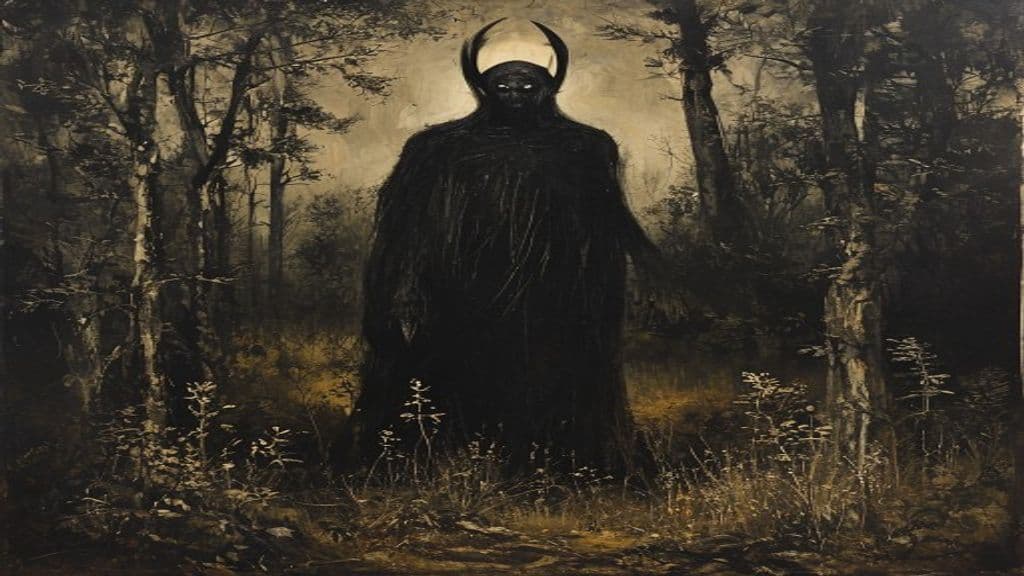
Velchanos was worshipped alongside a Mother Goddess figure, suggesting a focus on fertility and possibly matriarchal structures within Minoan society.
No specific physical description of Velchanos is provided by the source material.
Velchanos' domain includes fertility and agriculture, reflecting his role as one of the main deities in the Minoan pantheon. His connection to vegetation suggests a possible connection to the natural world and cyclical understanding of time.
Varima-te-takere
Varima-te-takere is the primordial mother-figure of southern Cook Islands cosmology (Mangaia/Rarotonga). She is the originating substrate or womb in the lowest depth of Avaiki from which the principal gods and, by extension, humankind are formed.
Vassago
Vassago is a named spirit from European grimoire tradition (notably the Lesser Key of Solomon and the Book of the Office of Spirits / Sloane MS 3824). Presented as a princely Goetic spirit who can be summoned to reveal past and future events, locate lost things, and reveal treasures, he also appears in one manuscript as angelic in appearance.
Vasupujya (Vāsupūjya)
Vasupujya is the twelfth tirthankara in Jainism's present age (avasarpini). Tradition presents him as an exemplar of renunciation who attained Kevala Jnana (omniscience) after ascetic practice and later achieved moksha, becoming a siddha; his five major life events (kalyanakas) are located at Champapuri.
Vegoia
Vegoia (Etruscan: Vecu) is a prophetic female revealer in Etruscan tradition credited in later Roman commentary as the author of portions of the sacred book-collection (the Libri Vegoici). She functions as the authoritative source of rules connecting divine order to human practices of surveying, law, ritual, and calendar, and is especially associated with the city of Chiusi (Clusium).
Vehuiah
Vehuiah is identified in the supplied sources as an angel in Kabbalistic thought and is referenced as "Angel number 1" in contemporary esoteric audio materials. The available documentation consists of a Wikidata entry labeling Vehuiah as an angel and several archive.org audio items (talks and recordings) that name Vehuiah but are not transcribed in the provided corpus.
Vel (Hindu tradition)
A divine spear associated with Murugan, the Hindu god of war. (Note: 1. Power tier should be Primordial or Ancient, given its association with a deity (Murugan). 2. Add sensory_cues that are relevant to the entity's presence or use, such as a loud whistling sound when )
Velikiy Poloz (The Great Snake)
A powerful snake-ruler from Ural miners' folklore as rendered in Pavel Bazhov's skaz "The Great Snake." Poloz is depicted as the proprietor and guardian of underground gold who can reveal or withdraw veins and who reacts to human behavior around claims.
Vellamo
Vellamo is a named water-being in Finnish traditional belief, a personified 'Mistress of Water' associated with lakes, seas, shores and fish. She appears in runic songs and in fishermen's spells as the being who presides over aquatic resources and is petitioned to bring fish into nets.
Velnias (Veles/Velinas)
Velnias (also attested as Veles in Slavic sources and Velinas/Velinas in Baltic references) is a chthonic figure associated with the underworld, cattle and animals, the boundary between life and death, and domains of magic, knowledge, divination and poetry. In pre-Christian contexts he functions as a powerful underworld deity and guarantor of oaths; in later Christianized materials he is sometimes reinterpreted in demonological terms.
Vengeful ghost
A cross-cultural category for spirits of deceased persons who return to the living world to seek redress for a wrong suffered in life. Commonly tied to violent, unjust, or improperly handled deaths and addressed by culturally specific rites of appeasement, exorcism, or corrective funerary treatment.
Vengeful spirit
A vengeful spirit is the spirit of a dead person who returns from the afterlife to seek revenge for a cruel, unnatural, or unjust death; in some cultures the form taken by an 'unhappy ghost' denied proper funerary rites. It functions in narrative as an agent of retribution against those perceived responsible for the original injustice.
Venus
Venus refers to two distinct but historically linked referents in the supplied sources: (1) the astronomical planet Venus, the second planet from the Sun with a dense CO2 atmosphere, extreme surface temperatures and thick sulfuric-acid clouds; and (2) Venus, the Roman goddess associated in summary form with love, sexuality, procreation and pleasure. The sources treat the planet with detailed physical and observational data and give only a brief statement of the goddess's domains.
Community Record
- [1]