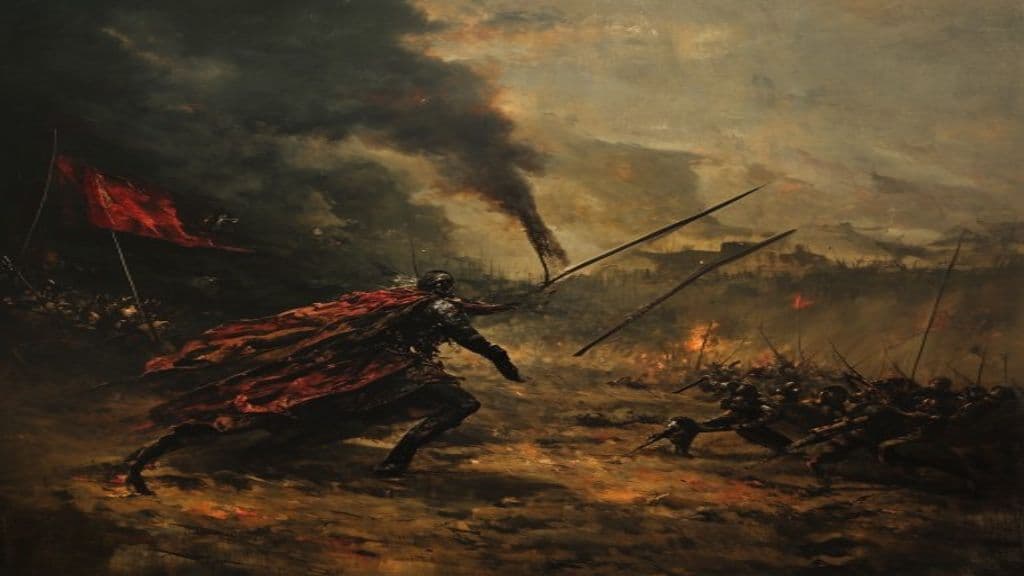
Zarmayr appears to be a descendant of Hayk and is associated with the Trojan War, specifically on behalf of the Trojans.
No physical description exists in sources.
Zarmayr was a military leader commanding a small army during the Trojan War. No evidence suggests he possessed extraordinary abilities beyond leadership.
Weaknesses
- historical eventkilled in the Trojan War
Wards
None recorded.
Zagovory
Magical entities invoked through incantations in Eastern Slavic folklore, capable of controlling reality with the power of words. (Note: - Summary: Add that they are not directly "invoked" through incantations, but rather the power of words is leveraged for magical effects. - Power tier: Based on source material, it seems more accurate)
Zagzagel
Zagzagel is an attested proper name appearing once in the supplied materials as an item in a syncretic, list-like litany. The sources supply no descriptive, ritual, linguistic, or functional information about the name; it is recorded only as a lexical item within a parade of names and terms.
Zakar-Baal
Zakar-Baal is attested in modern scholarship as a named actor in Late Bronze Age Near Eastern diplomatic and exchange contexts. The name appears in discussions (notably by Mario Liverani) that use Zakar-Baal alongside Un-Amón to examine whether inter-polity transfers were ceremonial gifts or commercial transactions.
Zanam Zindé
Mythical king of Tibet, the 16th Tsenpo in Tibetan mythology. (Note: 1. The power tier should be Greater, not Ancient (Ancient is deity-level), given the described abilities imply significant authority but not necessarily cosmic in scope. 2. The origin story section sh)
Zangbeto
Zangbeto are the traditional Vodún guardians of the night among the Ogu (Egun) people of Benin, Togo, and Nigeria. Treated as members of a secret society and as sacred beings in local tradition, they patrol at night to protect communities from thieves, witches, and social evils and appear publicly in ritual festivals wearing dense raffia costumes.
Zarik (Daeva)
Malevolent entity in Persian mythology serving Ahriman, embodying evil and chaos. (Note: - Power tier: Primordial seems excessive; considering Daevs are associated with chaos and disorder but also serve as intermediaries between humans and Ahriman, a Greater power tier might be more fitti)
Zarpanit
Zarpanit (also Sarpanit; sometimes listed as Beltia) is a Mesopotamian goddess worshiped originally at Zarpan and later at Babylon, regarded as the consort of the chief Babylonian god Marduk and associated in late texts with pregnancy, childbirth, and fertility. Hymnic literature presents her in luminous, cosmic imagery, and she is connected functionally to midwifery goddesses in the Mesopotamian corpus.
Zarpanitu
Zarpanitu (also Sarpanit) is a Mesopotamian goddess principally attested as the consort of the Babylonian chief god Marduk. Late sources associate her with pregnancy and describe her in roles parallel to her husband, including a queenly status among the gods; her cult centers were the village of Zarpan and the city of Babylon.
Zarqa al-Yamama
A pre-Islamic Arabian figure with exceptional intuition, sharp eyesight, and prophetic abilities. (Note: 1. Power tier: Lower the power tier to Ancient (deity-level) since her abilities are described as prophetic but not on a cosmic level. 2. Abilities: Add that her prophecies were often linked to omens )
Zartai-Zartanai
Zartai-Zartanai is a demonous denizen of the World of Darkness in Mandaean cosmology, encountered during Hibil Ziwa's descent in the Right Ginza. The entity is named in Classical Mandaic and is reported in secondary reference sources as an underworld adversary whose spouse is given as Amamit (an epithet of Libat/Venus).
Zasa Mergen Baatar
Zasa Mergen Baatar is a figure in Buryat mythology described in sources as the 'tornado-god' and as the eldest son of the sky-deity Han Hormasta; he is attested riding a brown hawk-horse and is described in a marriage episode in which he wrestled the three sons of Atai Ulaan and thereby obtained Sesegen Nogoon as his bride.
Zashiki-warashi
A class of domestic yōkai from Tōhoku folk belief described as childlike house spirits that inhabit parlors or inner rooms; their presence is traditionally linked to household prosperity and they are known for playful mischief. Scholarly accounts also connect some origin theories to historical practices such as infanticide and craft-related grudges.
Community Record
- [1]Wikipedia: Zarmayr. H. Avkerianwiki
- [2]Movses Khorenatsi's historical work. Historical estimates of the Trojan War timelineliterary