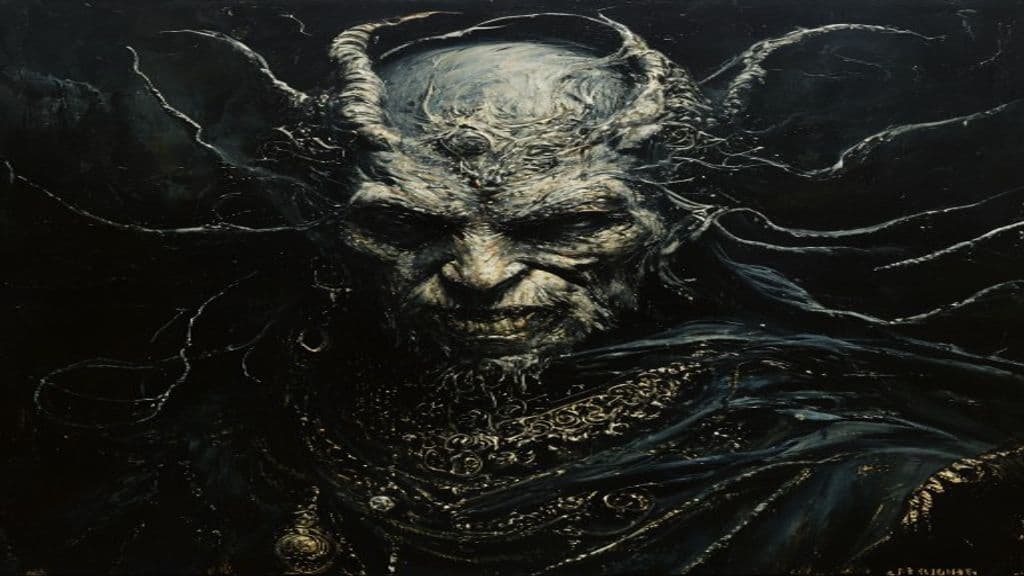
No description of physical appearance is provided.
Zanam Zindé's powers and behaviors are limited to its role as a king, creator of government positions (Dalun, Premier, and Anben), implying significant authority and influence in the Tibetan kingdom.
Yeti
A Himalayan legendary apelike humanoid—large, hairy, bipedal—embedded in pre‑Buddhist and local Himalayan folklore and later incorporated into Tibetan Buddhist classificatory schemes; it is variably described in local terms as a 'man‑bear' or 'wild man' and has been reinterpreted in modern popular culture as the 'Abominable Snowman.'
Zaebos
Zaebos is a named infernal spirit recorded in European demonological catalogues (notably the Dictionnaire Infernal). He is presented as a high-ranking infernal noble — described as a 'Grand Count' or duke — and is traditionally said to appear as a handsome soldier mounted on a crocodile. Modern adaptations sometimes expand or reassign additional functions to the figure.
Zafar Jinni
An unattested or fragmentary name appearing in the supplied source excerpts; no traditional entity explicitly called "Zafar Jinni" is documented in the provided materials. The excerpts contain isolated occurrences of the word "jinni" and the lexical item "Zafar" (glossed in one footnote as "victory"), but do not combine them into a coherent folkloric being.
Zafarnamah (Mustawfi)
Persian epic poem written by Hamdallah Mustawfi, exploring Iranian history and culture. (Note: 1. Power tier should be Ancient (deity-level) does not fit; Primordial is typically reserved for entities related to the creation of the world or fundamental forces. 2. Appearance section is missing 3)
Zagovory
Magical entities invoked through incantations in Eastern Slavic folklore, capable of controlling reality with the power of words. (Note: - Summary: Add that they are not directly "invoked" through incantations, but rather the power of words is leveraged for magical effects. - Power tier: Based on source material, it seems more accurate)
Zagzagel
Zagzagel is an attested proper name appearing once in the supplied materials as an item in a syncretic, list-like litany. The sources supply no descriptive, ritual, linguistic, or functional information about the name; it is recorded only as a lexical item within a parade of names and terms.
Zakar-Baal
Zakar-Baal is attested in modern scholarship as a named actor in Late Bronze Age Near Eastern diplomatic and exchange contexts. The name appears in discussions (notably by Mario Liverani) that use Zakar-Baal alongside Un-Amón to examine whether inter-polity transfers were ceremonial gifts or commercial transactions.
Zangbeto
Zangbeto are the traditional Vodún guardians of the night among the Ogu (Egun) people of Benin, Togo, and Nigeria. Treated as members of a secret society and as sacred beings in local tradition, they patrol at night to protect communities from thieves, witches, and social evils and appear publicly in ritual festivals wearing dense raffia costumes.
Zarik (Daeva)
Malevolent entity in Persian mythology serving Ahriman, embodying evil and chaos. (Note: - Power tier: Primordial seems excessive; considering Daevs are associated with chaos and disorder but also serve as intermediaries between humans and Ahriman, a Greater power tier might be more fitti)
Zarmayr (Armenian tradition)
A legendary patriarch in Armenian tradition, associated with the Trojan War and descended from Hayk. (Note: - Power tier should be Primordial, as it's associated with the Trojan War, a pivotal event in ancient history. - Abilities description needs to mention that he commanded an "Ethiopian army" and note t)
Zarpanit
Zarpanit (also Sarpanit; sometimes listed as Beltia) is a Mesopotamian goddess worshiped originally at Zarpan and later at Babylon, regarded as the consort of the chief Babylonian god Marduk and associated in late texts with pregnancy, childbirth, and fertility. Hymnic literature presents her in luminous, cosmic imagery, and she is connected functionally to midwifery goddesses in the Mesopotamian corpus.
Zarpanitu
Zarpanitu (also Sarpanit) is a Mesopotamian goddess principally attested as the consort of the Babylonian chief god Marduk. Late sources associate her with pregnancy and describe her in roles parallel to her husband, including a queenly status among the gods; her cult centers were the village of Zarpan and the city of Babylon.
Community Record
- [1]Zanam Zindéwiki