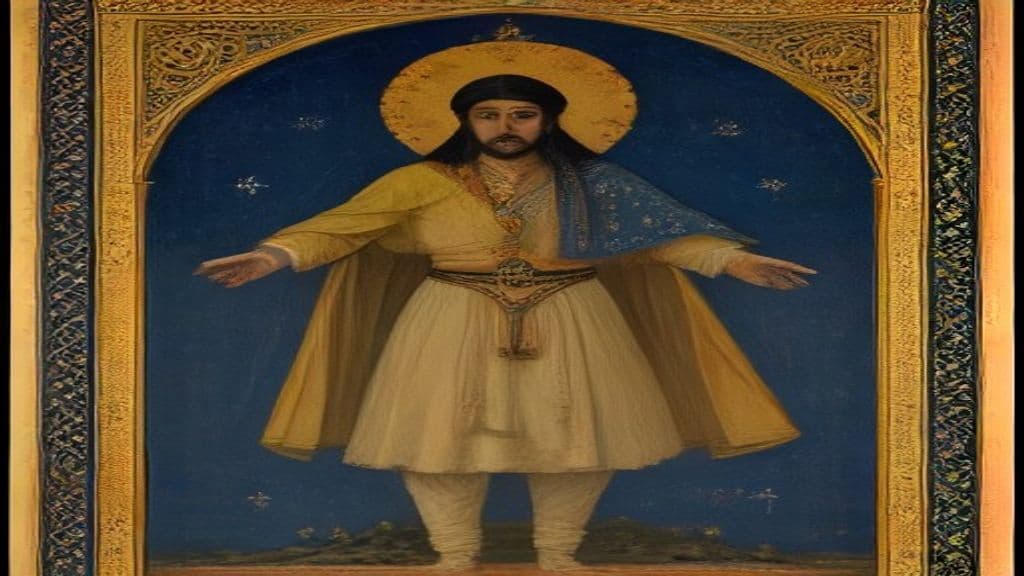
In Avestan tradition Abtin/Athwya is named among a brief sequence of formative human-like figures who assisted Ahura Mazda in making the world fit for corporeal life: Jamshid is listed first, Abtin (Athwya) second, and Thrita third. In later Persian epic genealogies (the Shahnama) Abtin is presented as the father of Fereydun, situating him within the heroic-royal lineage of Iran. Comparative etymological commentary in the provided sources links his name to the Indo-Iranian title Āptya attested in the Rigveda, indicating an older shared mythic category of water-affiliated or water-born titular figures across Vedic and Iranian materials.
The provided sources do not record any consistent physical or iconographic description of Abtin. He is known primarily through textual genealogies and cosmological listings (Avestan lists and the Shahnama genealogy) and comparative etymological discussion rather than through descriptive portraiture or cultic imagery in the cited materials.
Sources ascribe to Abtin a formative, cosmogonic role: he is presented as the 'second man' in a short Avestan sequence of world-preparers, implying participation in preparing the corporeal world for life. In the Shahnama he functions genealogically as the father of the hero-king Fereydun. The supplied materials do not ascribe specific ongoing magical powers, hostile behaviors toward humans, or ritual offices to Abtin; no active agency beyond these cosmogonic and genealogical roles is recorded in the provided excerpts.
Weaknesses
- othernone attested in sources
Wards
- othernone attested in sources
Abrahel
Abrahel is a demonological entity attested in early modern sources (notably Nicholas Rémy's Demonolatria as summarized in modern reference) portrayed as a female sexual spirit who seduced a man in 1581, induced him to kill his son, then restored the child to life in exchange for worship; the revival produced a diminished, foul-smelling corpse that later died again.
Abraun
Abraun is an attested name in German-language plant-legend scholarship (Der abraun, ein beitrag zur pflanzensagenkunde, 1916) and a short database entry (Wikidata) labels it as a spirit from German mythology. Surviving accessible documentation is extremely limited: the principal academic treatment is a 1916 contribution to pflanzensagenkunde (plant-saga studies), but the excerpts available here contain only bibliographic metadata and do not record tales, descriptions, or rituals.
Abraxas
Abraxas (Abrasax) is a late‑antique Gnostic and magical name attested as a high-ranking cosmic power in heresiological summaries and as a potent name engraved on amulets (so-called Abraxas stones) in the Greco‑Roman magical milieu. Heresiologists associate Abraxas with rulership of 365 heavens and note the name's numerological value, while archaeological and papyrological contexts show its use as an amuletic formula.
Absolute Green Lantern (tradition)
A modern comic-book reinterpretation in DC's Absolute Universe in which a giant green lantern-shaped vessel appears above Evergreen, Nevada, generates an impenetrable green dome, judges townspeople and sends the judged into the Lantern to await further adjudication in OA (Omega‑Alpha). The story reframes Green Lantern mythos as cosmic/religious horror with an "Enlightenment Spectrum" of flames (Qard, Rao, Sur, Aur) stewarded by Oans such as Abin Sur.
Absorbing Man
A fictional Marvel Comics character (Carl "Crusher" Creel) whose body acquires the physical properties of materials or energies he touches. Debuting in Journey into Mystery #114 (March 1965), created by Stan Lee and Jack Kirby, he is presented as a mortal supervillain/occasional antihero who challenges heroes such as Thor, Hulk, Spider-Man, and the Avengers.
Absyrtus
Absyrtus (Ancient Greek: Ἄψυρτος) is a Colchian prince in the Greek Argonautic cycle, son of King Aeëtes and brother or half-brother of Medea. He appears in variant traditions either as a companion taken by Medea during her flight with Jason and murdered/dismembered to delay pursuit, or as a pursuer sent by Aeëtes who is overtaken and slain by Jason; his death functions as a key narrative device in the escape from Colchis.
Abu
Abu is a poorly understood Mesopotamian god attested in modern reference summaries. Secondary literature tentatively links him with vegetation and snakes and records that he was often paired with a deity written gu2-la2, but primary details about his cult, iconography, and myths are lacking in the cited sources.
Abumi-guchi
A Japanese yōkai classed as a tsukumogami: an animated stirrup (abumi) depicted in Sekien Toriyama's Gazu Hyakki Tsurezure Bukuro. Traditional accounts say it is formed from a stirrup that belonged to a soldier who fell in battle and that it waits where the stirrup lies for its dead owner to return.
Abundantia
Abundantia is the Roman divine personification of abundance and material plenty, used primarily in imperial propaganda and public iconography to signify secure grain supplies, wealth, and the promise of a 'Golden Age' under the emperor. She also appears in later medieval European folklore as Domina Abundia / Dame Habonde, a household benefactor in accounts condemned by ecclesiastical writers.
Abundia
Abundia is a sparsely attested name found in modern secondary sources as a beneficent, abundance-associated female supernatural figure; the name occurs in a Wikidata gloss as a "beneficent fairy who brings abundance" and is listed among goddesses in a modern Dutch lecture about historical witchcraft. No primary medieval or early-modern texts documenting her lore were provided in the sampled material.
Abura-akago
An Edo-period yōkai depicted as an oil‑licking infant or a ball of flame. First recorded in illustrated compendia (notably Toriyama Sekien's Konjaku Gazu Zoku Hyakki), the Abura-akago is tied to tales of oil‑stealing fires and functions in part as an etiological warning about wasting or stealing oil.
Abura-sumashi
A yōkai spirit from the Amakusa region of Kumamoto Prefecture, Japan, said to inhabit mountain passes. Traditionally explained as the ghost of a person who stole oil, it appears to surprise travelers and is represented in modern media with a straw-coat body and a potato- or stone-like head.
Community Record
- [1]Abtin (Wikipedia). Wikipedia, 'Abtin' (entry summarizing Avestan and Shahnama attestations and etymological links to Āptya).wiki
- [2]Abtin (Wikidata). Wikidata item for Abtin / Athwya.other