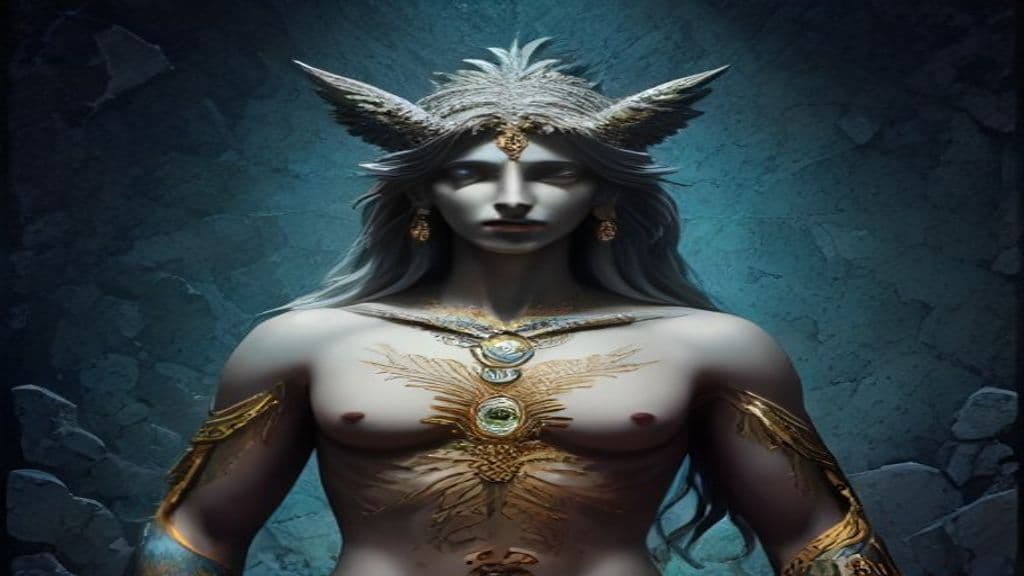
In late‑antique heresiological summaries (notably reports of Basilidian teaching preserved by orthodox critics), Abraxas is presented as a supreme intermediary figure associated with a layered cosmos: the name is said to 'contain within himself 365 numbers' and to be 'the ruler' of 365 heavens. The exact doctrinal role in Basilidian systems remains uncertain because surviving heresiologies report the association secondhand; independently, the name appears in Gnostic texts (e.g., the Holy Book of the Great Invisible Spirit; Apocalypse of Adam) and in the Greek Magical Papyri, reflecting its parallel life as a theological figure and as a potent magical name engraved on gemstones.
Abraxas is principally known from engraved gemstones (Abraxas stones) used as amulets. Surviving gematic iconography commonly combines mixed attributes—examples in published catalogues and summaries include composite figures such as a human torso with animal heads (often bird/rooster), serpentine legs, and attributes like a whip, shield, staff, or the radiate solar disc—together with the name written in Greek letters. Primary Gnostic scriptures in the supplied material do not provide a consistent anthropomorphic textual description; the archaeological record of engraved gems supplies the typical visual vocabulary associated with the name.
Sources attribute to Abraxas two linked registers of efficacy. Doctrinally (in heresiological summaries) Abraxas is associated with cosmic rulership—specifically linked to the number 365 and presented as a ruling power over many heavens—placing the name at archon/planetary scale within some Gnostic cosmologies. Practically, the name functions as a 'potent name' in the Greco‑Roman magical milieu: it occurs in the Greek Magical Papyri and was engraved on amulets, indicating historical use as an invoked or worn formula for protection, empowerment, or other magical ends. The supplied sources do not record narrative actions or individualized behaviors performed by Abraxas in the manner of a mythic agent; efficacy is attested via textual and material invocation rather than detailed behavioral accounts.
Weaknesses
None recorded.
Wards
- ritualamuletic inscription (Abraxas stone)
Anguipede (motif)
The anguipede is a Greco‑Roman visual motif depicting a human torso above serpentine lower limbs, found widely on magical gems, amulets, coins, and architectural reliefs. It functions primarily as an apotropaic or symbolic image in varied contexts rather than as a named mythic personage with a single coherent cult or narrative.
Abraham (Ibrāhīm) in Islam
Ibrāhīm (Abraham) in Islam is a human prophet and messenger chosen by God, a paradigm of pure monotheism (hanīf), patriarchal ancestor to later peoples and prophets, and traditionally regarded as having helped establish the Kaʿbah with his son Ismāʿīl. He is called Khalīl Allāh ('Friend of God') and is central to rites commemorated in Hajj and Eid al‑Adha.
Abraham Cornelius
Abraham Cornelius is a fictional human scientist in Marvel Comics, a senior Weapon X technician who helped develop the technique to bond adamantium to bone and who features in Wolverine's origin and later storylines, including Death of Wolverine.
Abraham of Farshut
Abraham of Farshut was a sixth‑century Coptic monastic leader and abbot associated with the Pachomian federation in Upper Egypt, venerated as a saint in the Coptic Church (feast day February 12). He is remembered for monastic leadership, founding a monastery and convent at Farshut, copying monastic rules, refusing imperial pressure to accept the Council of Chalcedon, and receiving a late‑life vision of earlier monastic fathers announcing his death.
Abraham of Scetis
Abraham of Scetis is an early Egyptian desert monk remembered in Coptic Christian tradition as a holy ascetic (a Desert Father). He is venerated as a saint with a feast day on January 4; his cell (Dshabih) later became a local Christian shrine.
Abrahel
Abrahel is a demonological entity attested in early modern sources (notably Nicholas Rémy's Demonolatria as summarized in modern reference) portrayed as a female sexual spirit who seduced a man in 1581, induced him to kill his son, then restored the child to life in exchange for worship; the revival produced a diminished, foul-smelling corpse that later died again.
Abraun
Abraun is an attested name in German-language plant-legend scholarship (Der abraun, ein beitrag zur pflanzensagenkunde, 1916) and a short database entry (Wikidata) labels it as a spirit from German mythology. Surviving accessible documentation is extremely limited: the principal academic treatment is a 1916 contribution to pflanzensagenkunde (plant-saga studies), but the excerpts available here contain only bibliographic metadata and do not record tales, descriptions, or rituals.
Absolute Green Lantern (tradition)
A modern comic-book reinterpretation in DC's Absolute Universe in which a giant green lantern-shaped vessel appears above Evergreen, Nevada, generates an impenetrable green dome, judges townspeople and sends the judged into the Lantern to await further adjudication in OA (Omega‑Alpha). The story reframes Green Lantern mythos as cosmic/religious horror with an "Enlightenment Spectrum" of flames (Qard, Rao, Sur, Aur) stewarded by Oans such as Abin Sur.
Absorbing Man
A fictional Marvel Comics character (Carl "Crusher" Creel) whose body acquires the physical properties of materials or energies he touches. Debuting in Journey into Mystery #114 (March 1965), created by Stan Lee and Jack Kirby, he is presented as a mortal supervillain/occasional antihero who challenges heroes such as Thor, Hulk, Spider-Man, and the Avengers.
Absyrtus
Absyrtus (Ancient Greek: Ἄψυρτος) is a Colchian prince in the Greek Argonautic cycle, son of King Aeëtes and brother or half-brother of Medea. He appears in variant traditions either as a companion taken by Medea during her flight with Jason and murdered/dismembered to delay pursuit, or as a pursuer sent by Aeëtes who is overtaken and slain by Jason; his death functions as a key narrative device in the escape from Colchis.
Abtin
Abtin (Persian: آبتین), attested also as Athwya, is a mythic ancestral figure in Iranian tradition described in Avestan and later epic literature as one of a small set of formative human-like figures involved in preparing the corporeal world and as the father of the epic hero-king Fereydun in the Shahnama.
Abu
Abu is a poorly understood Mesopotamian god attested in modern reference summaries. Secondary literature tentatively links him with vegetation and snakes and records that he was often paired with a deity written gu2-la2, but primary details about his cult, iconography, and myths are lacking in the cited sources.
Community Record
- [1]Abraxas (Wikipedia). Wikipedia: Abraxaswiki
- [2]Abraxas (Wikidata). Wikidata: Q2056201other
- [3]Abraxas — Biblical Cyclopedia. Biblical Cyclopedia entry on Abraxasliterary
- [4]Selected archive and cultural reuse references (indexed in research notes). Archive and cultural references listed in research notes (music, modern uses, taxonomy)other