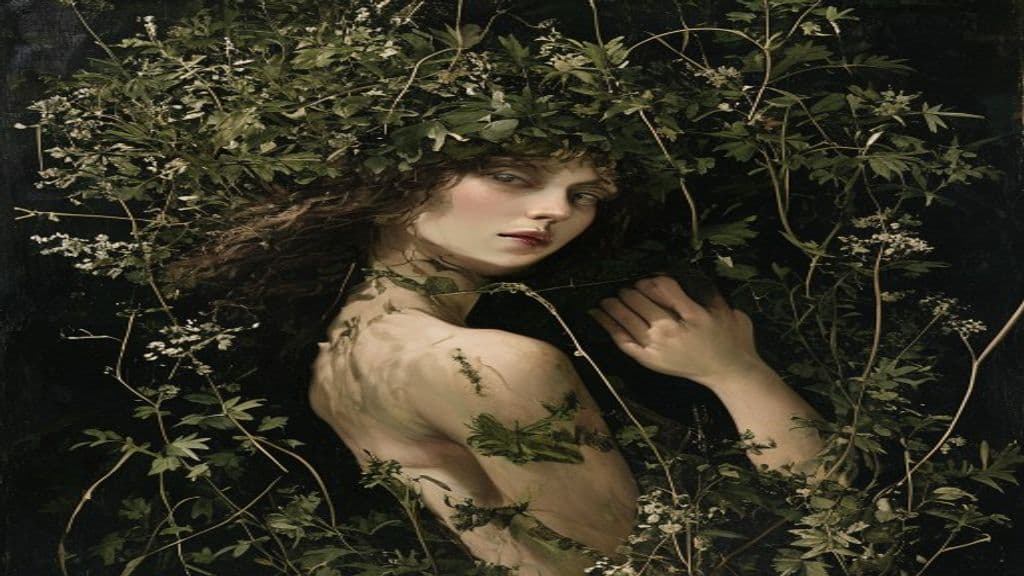
In modern compilations the aition runs that Acantha was a nymph loved by Apollo who rebuffed his advances and scratched his face; in response Apollo transformed her into the acanthus (a plant with spiny leaves). The sources compiled for this entry emphasize that this specific metamorphosis story "does not appear in any classical source" (absent from the Thesaurus Linguae Graecae and Thesaurus Linguae Latinae and absent from major classical reference works), and so the narrative likely arose in later mythographic compilations rather than in securely attested ancient texts. A separate, fragmentary ancient attestation cited by modern compilers (a Cicero reference) names an "Acantho" as mother of a 'fourth sun' in Rhodes; this is a distinct, sparse onomastic occurrence and not confirmation of the metamorphosis tale. Comparative motifs—most notably elements similar to the Oenone–Apollo episode in Ovid's Fasti—exist in classical literature and were likely sources from which later retellers adapted or conflated material when composing the Acantha aition.
Primary classical sources give no physical description of Acantha; the figure is absent from major ancient-text repositories. Modern retellings therefore reconstruct her as a nymph—a young female nature-being—whose resisting action (scratching Apollo) precipitates metamorphosis. In the compiled tale she is pictured human until transformed into the Acanthus plant, thereafter represented by spiny leaves that align with the literal meaning of her name ('thorn'). Scholarly notes emphasize that these visual and narrative details derive from later compilers rather than surviving classical descriptions.
Surviving documentary material records only the single aitionary metamorphosis attributed to Acantha: resistance to Apollo and subsequent transformation into the Acanthus plant. The sources contain no evidence of ongoing agency, magical powers, cultic functions, or interactions with humans beyond the origin tale. Modern scholars and encyclopedic compilers further note that elements of the story mirror motifs from the Oenone–Apollo narrative (a nymph scratching Apollo), suggesting literary borrowing rather than an independently attested set of supernatural abilities specific to Acantha.
Weaknesses
- otherNo attested weaknesses — sources record none
Wards
- otherNo attested wards — classical and modern sources do not record protective rituals or wards related to Acantha

Acacallis
Acacallis (Ancient Greek: Ἀκακαλλίς; also Acalle) is a mythological princess of Crete in Greek tradition, daughter of King Minos and Pasiphae. She functions primarily as a dynastic and etiological figure: in varying accounts she is mother, by gods such as Hermes (Mercury) or Apollo, of eponymous or founder-figures like Cydon (founder of Cydonia), Miletus, or Lydon/ Lydus.
Acacus
Acacus (Ancient Greek: Ἄκακος) is, in Arcadian Greek tradition, a mortal eponymous founder-king of Acacesium and is remembered as the foster-father who reared the infant Hermes (Mercury) in that local tradition. He is presented in genealogies as a son of Lycaon and functions as a local ancestral/onomastic figure rather than a supernatural spirit.
Academus
Academus (Greek: Akádemos / Hekádemos) is an Attic hero-eponym tied to a sacred grove (Akademeia) on the Cephissus near Athens. In myth he revealed where Helen was hidden to the Dioskouroi, an act said to have saved the city, and the place bearing his name became a long-lived sacred precinct, later the site of Plato's Academy.
Acala
Acala (Sanskrit: अचल, 'The Immovable') is a wrathful protective deity (dharmapala) in Vajrayāna and East Asian esoteric Buddhism, classed among the Wisdom Kings (Vidyārāja). He functions as a ritual focus for visualization and mantra practice intended to remove obstacles and bind or destroy hostile forces.
Acalanātha (Acala / Achala)
Acalanātha (also Acala or Achala) is a wrathful deity and dharmapāla — a protector of the Dharma — prominent in Vajrayana and East Asian Mahayana Buddhist contexts. Presented as a fierce, non‑human or semi‑divine protector-figure, Acalanātha functions to defend the teaching and practitioners by removing obstacles and confronting threats to the transmission and practice of Buddhism.
Acamas
Acamas (Ancient Greek: Ἀκάμας) is a personal name recurrent in ancient Greek narrative traditions applied to multiple human characters (warriors, princes, suitors), once to a Cyclops, and once as a hound's name. Rather than a single supernatural entity, bearers of the name appear episodically across the Trojan War, Theseid, and Theban cycles as mortal actors whose deeds intersect with gods and fate.
Acanthis
Acanthis is a young woman in Greek myth, daughter of Autonous and Hippodamia, who is transformed into a thistle finch by the gods as an etiological explanation for the bird's name. The story is preserved chiefly in Antoninus Liberalis' Metamorphoses and summarized in modern reference works.
Acanthus (son of Autonous)
Acanthus is a mythic human figure in a Greek metamorphosis tale (recorded by Antoninus Liberalis) who, with his family, was transformed by Zeus and Apollo into a bird named after him. The story functions etiologically, explaining the origin and behaviors of certain birds by linking them to formerly human persons and their experiences.
Acarnan
Acarnan (Ancient Greek: Ἀκαρνάν) is an anthroponym attested in Greek mythic and epic tradition as the name of at least two distinct mortal figures: a son of Alcmaeon and Callirrhoe, and a human suitor of Penelope from Dulichium. The lexical form also appears adjectivally/ethnically (Acarnanian), linking the word to the region Acarnania; etymologically the name is reported as derived from a Greek fish-name (akarnan).
Acaste
Acaste (Ancient Greek: Ἀκάστη) is a named Oceanid — one of the daughters of the Titans Oceanus and Tethys — recorded among the companions of Persephone at the moment of her abduction; the name also appears separately as a nurse of the daughters of King Adrastus of Argos in later genealogical lists.
Acastus
Acastus is a mortal heroic figure of ancient Greek tradition: son of Pelias who became king of Iolcus, an Argonaut who sailed with Jason, and an actor in the post-Argonautic cycle involving Medea, Peleus, and the aftermath of Pelias’s death. He is attested as performing civic and ritual actions (burying Pelias, instituting funeral games, purifying Peleus) and as a participant in vendetta episodes that end in violent reprisals.
Acat
Acat is a Maya deity associated with the craft and ritual of tattooing, described in the cited sources as being invoked in relation to the tools, inks, and workspaces of tattoo artists and as steadying the artists' hands so tattoos made in the image of gods could confer those gods' power.
Community Record
- [1]Acantha. Wikipedia, 'Acantha' (article summarizing modern retellings and philological cautions; notes absence from classical sources and parallels with Oenone).wiki
- [2]Acanthaceae (Wikidata entry cited for botanical linkage). Wikidata: Acanthaceae (used to link the mythic aition to the plant family name).other
- [3]Archive references to modern usages of the name 'Acantha'. Archive: 'Acantha LLC v. Stryker Corporation' (demonstrates modern personal/institutional use of the name; unrelated to the mythic narrative).other
- [4]Archive: Eddie Roberts Live at Blue Nile on 2024-04-25 (Acantha Lang credit). Archive item crediting 'Acantha Lang' as a modern personal name; not a classical source for the myth.other
- [5]Archive: Giroscopio Musical :: Your Love (Acantha Lang credit). Archive item showing contemporary use of the name 'Acantha'; demonstrates modern usage but not ancient attestation.other