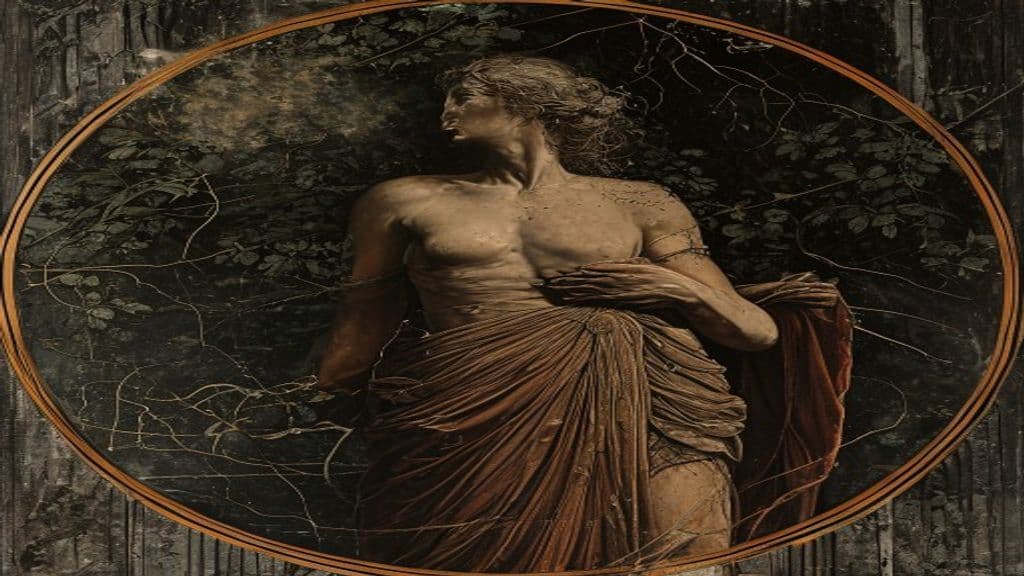
Achlys does not possess a single canonical origin story in the surviving Greek corpus but appears in multiple literary roles. In Homeric epic the term ἀχλύς denotes the mist that is 'shed' over mortals' eyes at grievous wounding or death, functioning as a poetic symptom of the soul's failing. In the Hesiodic/Shied of Heracles tradition Achlys is personified and pictured among the Moirai and Keres as a dread figure associated with sorrow and the visible signs of dying. A later Roman mythographic reception (Hyginus) identifies a like-named Caligo as a primordial obscuring principle linked to cosmogony, placing her as mother of Chaos and, with Chaos, producing Night, Day, Darkness, and Aether — a receptional expansion rather than a direct reflection of Homeric or Hesiodic genealogies.
Descriptions vary by source. In Homeric passages Achlys is not anthropomorphic but a mist or dark vapour 'shed over' the eyes of the injured or dying. The Shield of Heracles gives a vivid anthropomorphic portrait: Achlys stands 'gloomy and dread, pallid, parched, cowering in hunger, thick-kneed' with long claws beneath her hands; mucus flows from her nostrils, blood drips from her cheeks to the ground, she grins dreadfully, and 'much dust, wet with tears, lay upon her shoulders.' Nonnus's Dionysiaca does not elaborate a comparable physical portrait but presents her as a Thessalian source of treacherous flowers and magical ointments.
Across the attestations Achlys performs three related functions. Lexically/Homerically she is the mist that 'sheds' over eyes at the brink of death, producing blindness, loss of consciousness, or the appearance of death. In the Hesiodic iconography she embodies sorrow and death's bodily signs, implying an associational power to accompany or signify mortal demise and grief. In Nonnus (Dionysiaca) Achlys supplies 'treacherous flowers,' 'poisoned drugs,' and a 'magical ointment' used to induce sleep, to anoint victims, and to effect transformative or corrupting results when applied — a narrative role as a supplier of pharmaka within Thessalian-associated witchcraft. The Roman Hyginus reception (Caligo) attributes a cosmogonic generative power in one late tradition.

Achelous
Achelous is the personified river-divinity of the Achelous River in ancient Greek religion and mythology. Regarded among the potamoi (river-gods), he is portrayed as a shape-changing elemental deity associated with springs, naiads, and the production of abundance (the horn/cornucopia motif); he appears in myths chiefly as suitor to Deianeira and as Heracles' opponent.
Achelous and Heracles
Achelous is a Greco‑Roman river god who provides life‑giving irrigation yet can become destructive at floodtime; in later mythic retellings Heracles (Heracles/Hercules) wrestles the river‑god, snapping a horn that becomes the cornucopia and symbolically represents the taming of water for agriculture. The episode is attested in mythological compilations and was later reused in modern art to allegorize flood control and civic bounty.
Achilles
A legendary Greek heroic figure of epic poetry, son of the sea‑nymph Thetis and the mortal Peleus, celebrated as the greatest of the Greek warriors at Troy whose anger and fate shape events in the Trojan War cycle.
Achilles (son of Zeus)
A minor figure in Greek myth named Akhilleus (Ancient Greek: Ἀχιλλεύς), presented in some traditions as a son of Zeus and the Lamia who was famed for irresistible beauty, won a beauty contest judged by Pan, and was transformed into ugliness by Aphrodite. This Akhilleus is distinct from the Homeric hero of the Trojan War.
Achiroe
Achiroe (variants Anchirrhoë, Anchinoë/Ankhinoe) is a minor Greek mythological figure: a Naiad associated with the river Nile, daughter of the river-god Nilus, who becomes the wife of the Egyptian king Belus and mother of mythic progenitors such as Aegyptus and Danaus (with some accounts also naming Cepheus and Phineus). She functions primarily as a genealogical link between river-divinity and royal lineages rather than as an active agent in surviving myths.
Achish
Achish (Hebrew: אָכִישׁ, translit. ʾāḵīš) is a personal name or royal designation used in the Hebrew Bible for Philistine rulers associated with the city of Gath and is attested in extrabiblical West-Semitic and Akkadian inscriptions (rendered as ʾākayūš / Ikausu). Sources treat Achish as a human king (or a dynastic title) who interacts with Israelite figures such as David and appears in narratives concerning asylum, military service, and inter-polity politics.
Achtland
Achtland is a figure from Irish tradition who, according to the surviving account, was a mortal woman famed for rejecting mortal suitors who married a member of the Tuatha Dé Danann and crossed into the síde to become immortal as his wife.
Achuar nonhuman persons (including kuntiniu nukuri)
In Achuar cosmology many animals, plants, and other nonhuman beings are persons with human-like souls who communicate and form long-term, kin-like relationships with people. A specifically named class are the game guardians called kuntiniu nukuri ('game mothers'), whose relations with hunters shape hunting success and ethical obligations.
Achuhucanac
Achuhucanac is a rain-associated deity attested in brief sources on the pre‑contact religion of the Guanche people of Tenerife. The name is reported to derive from a Guanche compound meaning “that is in the rain,” and at least one source identifies Achuhucanac with the supreme Guanche god Achamán.
Achyuta
Achyuta (Sanskrit: अच्युत, acyuta) is primarily an epithet/theonym in Vaishnava Hindu tradition applied to Vishnu and Krishna, signifying the divine quality of being 'not fallen' — immutable, infallible, and imperishable. It functions as a devotional name in scripture, liturgy, and Pancharatra lists of divine emanations rather than as an autonomous folkloric spirit.
Acintya
Acintya is an Indonesian Hindu theological-symbolic representation of the ineffable supreme divine principle. In Balinese and Javanese practice it functions as a way to make ultimate reality present in ritual and art—often aniconically as an empty throne (padmasana) or anthropomorphically as a naked, flame-surrounded figure—rather than as a narrative, intervening deity.
Acionna
Acionna is a local Gallo-Roman water goddess attested by a single votive inscription found at a spring in the Orléanais region. The inscription, discovered by Jollois in 1822 and datable by style to the 2nd century CE, dedicates a portico and ornaments "AUG(ustae) ACIONNAE" and was recovered from the Fontaine de l'Étuvée in Orléans; archaeological work in 2007 uncovered remains of a Gallo-Roman temple and a section of an aqueduct at the site.
Community Record
- [1]Achlys (Wikipedia). Wikipedia entry 'Achlys' summarising Homeric uses, Shield of Heracles passage, Nonnus' Dionysiaca, and Hyginus' Fabulae.wiki
- [2]Homer, Iliad and Odyssey (lexical citations). Homeric uses of ἀχλύς: 'down over his eyes a mist [ἀχλύς] was shed' (Iliad, Sarpedon); 'a mist [ἀχλύς] was shed over his eyes' (Odyssey, Eurymachus) — cited in the summary to demonstrate lexical use.literary
- [3]Shield of Heracles (Hesiodic tradition) — quoted description. Shield of Heracles description quoted in secondary summaries: Achlys 'gloomy and dread, pallid, parched... long claws... mucus... blood... dust, wet with tears' (as cited in the compiled notes/Wikipedia summary).literary
- [4]Nonnus, Dionysiaca (summary). Summary of Nonnus' Dionysiaca: Hera procures from 'Thessalian Achlys treacherous flowers of the field' and 'distilled poisoned drugs over their hair and smeared a magical ointment over their faces' (as reported in the compiled notes/Wikipedia summary).literary
- [5]Hyginus, Fabulae (Caligo identification) — summary. Hyginus' Fabulae reports Caligo as parent in a cosmogonic genealogy: 'Caligo being the mother of Chaos... and, with Chaos, was the mother of Night (Nox), Day (Dies), Darkness (Erebus) and Ether (Aether)' — cited as a Roman identification with Achlys in later mythography.literary