
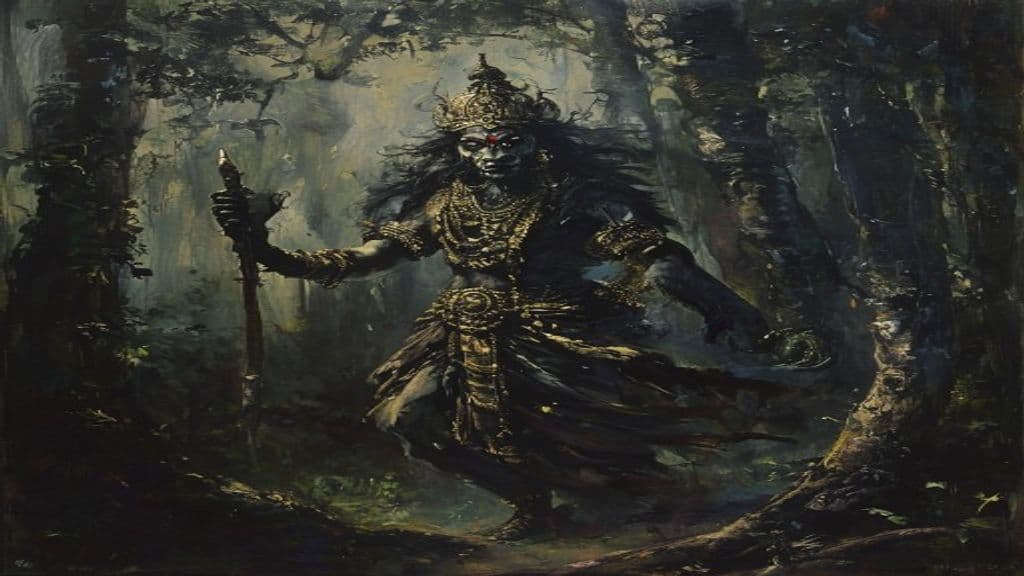
In the Bhagavata Purana narrative cycle of Kṛṣṇa’s childhood pastimes (līlā), Aghasura appears as an asura allied to the tyrant Kamsa and is presented as brother to hostile beings such as Putana and Bakasura. Sent by Kamsa to slay the child Kṛṣṇa after his siblings had been killed, Aghasura takes action during a pastoral picnic in the forests of Vṛndāvana: he conceals himself against a mountain, presenting his enormous open mouth as a cave so that the cowherd boys and their calves will enter and be suffocated.
Narrative and pictorial sources describe Aghasura as manifesting in the form of a vast, cavernous serpent whose open maw is indistinguishable from a mountain cavern. Artistic depictions (for example, a Pahari/Garhwal painting cited in museum documentation) show a giant snake with an enormous open mouth into which the boys and Kṛṣṇa enter. Sources emphasize scale and a gaping, cave-like mouth rather than fine anatomical detail; one modern summary (Wikipedia) cites an "8-mile-long" figure, while primary narrative descriptions use terms meaning enormous or vast.
In the canonical story Aghasura’s principal tactic is disguise and ambush: he assumed serpent form and positioned his open mouth as a fatal trap, intending to suffocate the cowherd boys. The episode depicts a contest of expansion when Kṛṣṇa enters the serpent; Kṛṣṇa enlarged his form faster, causing Aghasura to suffocate internally, his life‑force to be unable to escape, and finally to burst out through the demon’s head, resulting in Aghasura’s death. The account frames these abilities as episodic: the shape assumed (serpent) and the ambush by suffocation are the demonstrated behaviors in the text.
Weaknesses
- conditionsusceptibility to divine intervention (defeated by Kṛṣṇa entering and expanding within him)
Wards
- conditionassociation with and protection by Kṛṣṇa (narrative protection rather than a procedural ritual ward)
Agenoria
Agenoria is a minor Roman personification attested in modern summaries and late-antique citation as the faculty or divinity associated with activity, the capacity to respond and to act. She appears in at least one allegorical tableau (the wedding of Labor and Agenoria) and is reported in secondary sources to have had a sanctuary on Rome's Aventine Hill.
Agent Liberty
Agent Liberty is a fictional human operative persona in DC Comics and its television adaptation (Arrowverse). The identity—most prominently used by Benjamin 'Benjy/Ben' Lockwood—functions as a costumed, paramilitary/enforcer role tied to political movements (Sons/Children of Liberty) or official security details, driven by ideological 'liberty' rhetoric rather than supernatural agency.
Agents of Atlas
Agents of Atlas is a fictional superhero team published by Marvel Comics, retroactively presented as a 1950s era group of operatives and reconstituted in modern storylines; the roster mixes human, nonhuman, mythic and technological characters and has served as an operative body connected to the Atlas Foundation.
Ages of Man (Roman tradition)
In the Roman tradition, the Ages of Man are a series of stages or periods in human existence, representing growth and development. (Note: * Power tier: Remove "Minor Spirit" as it implies a level of agency or power that doesn't align with the description in the draft article. * Abilities: Clarify or remove the phrase "in the classical s)
Agetor
Agetor (Ancient Greek: Ἀγήτωρ; alt. Hegetor) is not an independent being but a theonymic epithet applied to multiple Greek gods—primarily Zeus in Lacedaemon, and also Apollo and Hermes—emphasizing a leading or ruling function of the deity in cult and literature.
Aggi and Ebbi (lexical occurrences)
Aggi and Ebbi are not attested as folkloric beings in the supplied sources; they appear only as isolated word-forms in an Italian poetic excerpt and as capitalized letter-strings in a puzzle/solution transcript. No mythic identity, powers, or rituals are documented for these tokens in the provided materials.
Aghrirat
Aghrirat is a named Turanian noble and peacemaker in the Shahnameh and Iranian mythic tradition, presented as a son of Pashang and brother of Afrasiab and Garsivaz. He is notable for his kind and gentle character and for attempting, largely unsuccessfully, to end the hostilities between Iran and Turan.
Agilaz (Egil)
Agilaz (reconstructed Proto-Germanic) — commonly recorded in medieval sources as Egil or Ægil — is a legendary archer attested in Germanic heroic tradition. He appears as the brother of Völund (Wayland/Weland) in the Old Norse poem Völundarkviða and in the Thidreks saga, and his name is also inscribed on early medieval objects (Franks Casket, Pforzen buckle). The attested material presents him as a named heroic human archer within saga and inscriptional contexts rather than as a recurrent supernatural species.
Agiya Baital
The fire-form of the Vetala — a cremation ground spirit of UP and Bihar that manifests as a wandering flame rather than a corpse-inhabitor, leading night travellers off roads and into marshland or flames with a dancing fire that seems always just ahead.
Aglaia (Grace)
Aglaia (Ancient Greek: Ἀγλαΐα) is one of the Charites (the Graces) in classical Greek myth, the personification of splendor, brilliance and festive radiance. She appears in poetic narratives as an attendant of Aphrodite, a dancer of Orchomenus in Nonnus's Dionysiaca, and in some traditions as the wife of Hephaestus and mother of personified social virtues.
Aglaonoe
Aglaonoe is named in modern catalogs as one of the Sirens of Greek mythology, a group of female, song-bearing beings whose alluring voices threaten seafarers. The sources supplied identify her only as a named member of the Sirens and do not record attributes, rituals, or iconography unique to her.
Aglaope
Aglaope is one of the Sirens of Greek myth, a female sea-associated figure whose enchanting song lured sailors toward shipwreck. Her name etymologically emphasizes a bright or 'lambent' voice and she is variously attested as daughter of the river-god Achelous and either a Muse (Melpomene or Terpsichore) or Sterope.
Community Record
- [1]Aghasura (Wikipedia). Wikipedia. "Aghasura."wiki
- [2]Śrīmad‑Bhāgavatam Canto 10, Chapter 12 (Vedabase). Śrīmad‑Bhāgavatam, Canto 10, Chapter 12 (Vedabase).literary
- [3]Śrīmad‑Bhāgavatam 10.12.14 (Vedabase excerpt). Śrīmad‑Bhāgavatam verse commentary (Vedabase).literary
- [4]Srimad Bhagavatam: Canto 10 - Chapter 12 (gita.srimadbhagavatam.org). Srimad Bhagavatam: Canto 10, Chapter 12 (online edition).literary
- [5]Prabhupada/Nugāsa translation - Chapter Twelve. Prabhupada/Nugāsa translation and retelling of SB Canto 10, Ch.12.literary
- [6]Cleveland Museum — Krishna Returns with the Cowherds to Braj (painting description). Cleveland Museum object description of a Pahari/Garhwal painting depicting Aghasura.other
- [7]Myth & Folklore encyclopedia entry: Aghasura. MythFolklore.net entry on Aghasura.folk
- [8]Hare Kṛṣṇas — Kṛṣṇa's Vṛndāban Pastimes — Aghasura Demon. Devotional retelling and summary of the Aghasura pastime (Hare Kṛṣṇas).folk
- [9]Archive: Радха Говинда Госвами Махарадж — Агхасура‑катха. Devotional audio/text retelling of the Aghasura kathā.folk
- [10]Chandana Yatra Mahotsava ISKCON Mayapur (Aghasura vesa reference). Documentation of Chandana Yatra festival practices referencing an Aghasura costume (vesa).other