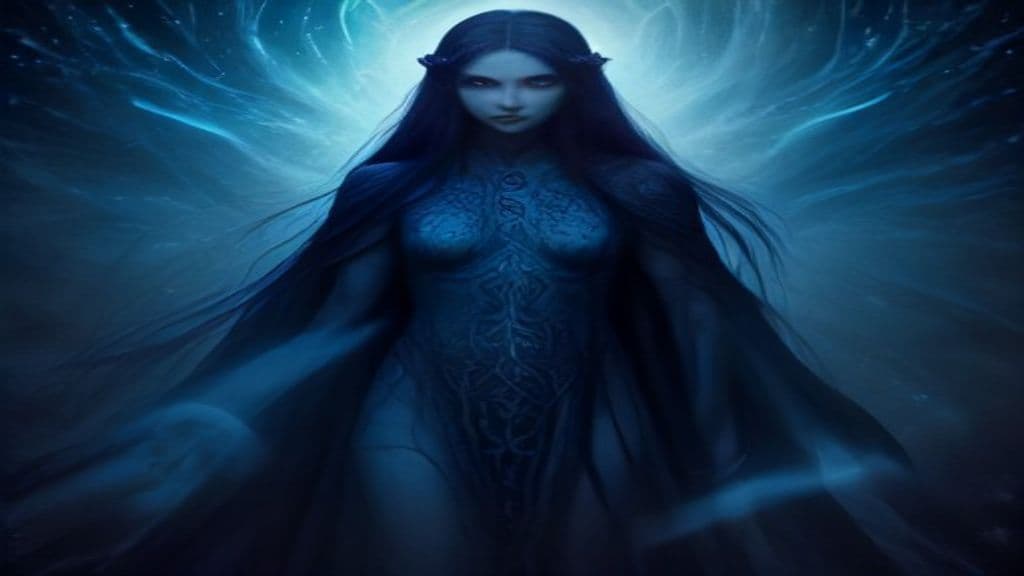
According to the Ainulindalë within Tolkien's cosmology, Eru Ilúvatar first conceived the Ainur, immortal spirits 'made of the thought of Eru'. The Ainur responded to themes introduced by Ilúvatar by singing the Music of the Ainur; when Ilúvatar gave being to that music it brought Eä, the created universe, into existence and shaped Arda. Some Ainur who 'felt concern for the Creation' entered Eä to take part in its governance and care; these entrants are named in the narratives as the Valar (the greater Powers) and the Maiar (the lesser Powers).
As described in the sources, the Ainur are fundamentally spirits and thus lack a single, consistent physical form prior to entering the world. The accounts emphasize their immaterial, 'immortal' nature rather than detailed bodily description. When Ainur enter the created world they may assume forms appropriate to their office: the Valar and Maiar are represented in the stories by figures such as Manwë, Melkor/Morgoth and Tulkas among the Valar, and Gandalf, Sauron and the Balrogs among the Maiar, but the supplied material stresses there is no uniform physical template for all Ainur and that their primary mode is spiritual rather than corporal.
The Ainur's defining activity is their participatory creativity: the Music of the Ainur shaped the fabric of reality and, when given being by Eru, became the universe. Those Ainur who entered Eä serve as guardians and shapers of Arda, exercising providential influence, governance, and craftsmanship. They possess genuine moral agency and free will and so are capable of goodness or of rebellion and corruption (the chief example being Melkor/Morgoth). Valar and Maiar are powerful but limited: they can influence the course of events and pattern fortune or providence without wholly negating the free choices of Elves and Men. Although fundamentally immortal spirits, many Ainur may assume embodied forms; in such incarnations Maiar in particular can be slain in bodily form (examples in the narratives include Gandalf and Balrogs), while sources note the ultimate fate of a slain Maia is left unclear in the supplied materials.
Weaknesses
- otherMoral fallibility (free will and potential for corruption)
- otherLimits to power (cannot wholly override free will; may make mistakes)
- conditionEnvironmental limitation (Arda's marring by evil may affect beings who remain there; sources present this as debated/uncertain)
Wards
None recorded.
Ar-Pharazôn
Ar-Pharazôn is the twenty-fifth and last King of Númenor in J. R. R. Tolkien's legendarium; a mortal ruler whose political and military leadership, and whose acceptance of Sauron's counsel, precipitated the rebellion of Númenóreans against the Valar and the Downfall of Númenor.
Avari (Middle-earth)
The Avari are identified in the provided sources as a subgroup of Elves in J. R. R. Tolkien's fictional legendarium. The supplied materials (Wikipedia and Wikidata entries) classify them as fictional Elven people but contain no extended narrative, descriptive, or ritual detail about them.
Balrog
In J. R. R. Tolkien's legendarium, a Balrog is a Maiar spirit corrupted into a warlike, fire-associated servant of the Vala Melkor (Morgoth). Balrogs appear as towering, shadowed figures wreathed in fire and wielding fiery whips and weapons; in Tolkien's later conception they are rare, exceptionally powerful beings whose defeat generally required opponents of comparable metaphysical order.
Barliman Butterbur
Barliman Butterbur is a human resident of Bree in J. R. R. Tolkien's Middle-earth. Source material classifies him simply as a man in Tolkien's legendarium and situates him within Bree-land, the village region where Hobbits and Men live side by side.
Beren and Lúthien
Beren and Lúthien are the central protagonists of a foundational First‑Age tale in J. R. R. Tolkien’s legendarium about the love between a mortal Man (Beren) and an immortal Elf‑maiden (Lúthien), their quest to take a Silmaril from Morgoth’s crown, Beren’s death and unique return, and Lúthien’s choice to become mortal.
Children of Ilúvatar
In J. R. R. Tolkien’s legendarium, the Children of Ilúvatar are the two principal kinds of sentient, created beings—Elves and Men—brought into being by the supreme creator Ilúvatar (Eru) and occupying a central place within Tolkien’s cosmology.
Company of the Ring
A fictional constituted questing body in J. R. R. Tolkien's Middle-earth, formed to escort the Ring-bearer and destroy the One Ring. Composed of nine members drawn from diverse Free Peoples, it functions as a communal, multi-cultural alliance opposed to Sauron's Nine Riders.
Círdan
Círdan is a named Elf in J. R. R. Tolkien's legendarium, portrayed as a shipwright and leader associated with the Grey Havens (Mithlond) who prepares vessels for the westward departure of the Elves from Middle-earth.
Dáin II Ironfoot
Dáin II Ironfoot is a named Dwarven king and military leader of the Iron Hills in J. R. R. Tolkien’s legendarium, presented in sources as a kinsman of Thorin Oakenshield who brings reinforcements to the Lonely Mountain and who is reported to have warned that Moria remained dangerous because of Durin's Bane.
Edain (Men)
The Edain, rendered in sources as Man or Men, are the human peoples of J. R. R. Tolkien's Middle-earth. They are the 'second' or younger people, created after the Elves and distinguished chiefly by their mortality; they are counted among the 'free peoples' of Middle-earth alongside other autonomous races.
Elendil
Elendil is a human Númenórean leader in J. R. R. Tolkien’s legendarium: a refugee of Númenor who founded the northern realm of Arnor, led the Faithful, and fought in the Last Alliance against Sauron. He is remembered as a dynastic founder whose proclamation and heirlooms shaped later kingship in Middle-earth.
Ent
An Ent is a fictional, tree-like, sentient humanoid from J. R. R. Tolkien's Middle-earth who serve as ancient 'Shepherds of the Trees', guarding forests and vegetation and reacting when those they tend are harmed.
Community Record
- [1]Ainur in Middle-earth (Wikipedia). Wikipedia, article 'Ainur in Middle-earth'.wiki
- [2]Would the Ainur fade if they remained in Middle-earth? (Sci-Fi.Stackexchange Q&A). Sci-Fi & Fantasy Stack Exchange Q&A discussing Ainur and the marring of Arda.other
- [3]Gandalf (Istari wizard) — Marvun App. Entry on Gandalf as an Istari (a Maia) and related notes on incarnation and being slain.other
- [4]Valar and Maiar - Tolkien Gateway. Tolkien Gateway summary of Valar and Maiar (Ainur who entered Arda).other
- [5]The Silmarillion (archive materials). Archive edition of The Silmarillion (part II) referenced for Ainulindalë and Ainur entering Eä.literary