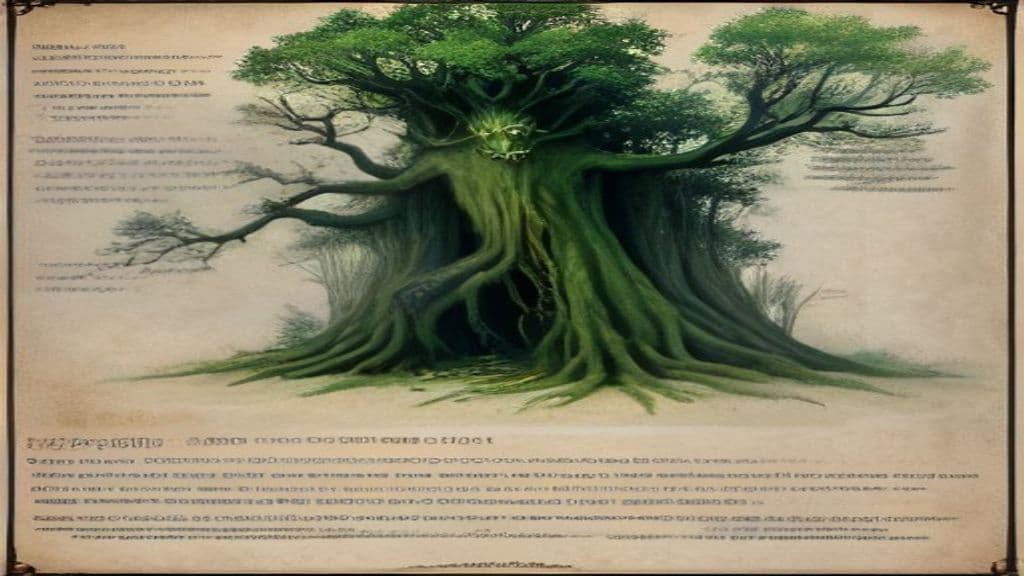
In Tolkien's legendarium Ents are an ancient order of living beings tied into the created world of Arda. Their existence is framed by the cosmology in which the Vala Yavanna (appealing to Manwë and the Valar) sought protection for growing things; Ents stand as shepherds of trees within that scheme and are recognized as part of the created order rather than as later spirits or spirits of dead trees.
Ents are described as giant, humanoid and tree-like, yet distinct from ordinary trees. Individual Ents vary in appearance according to the kinds of trees they shepherd: some resemble oak or beech, others chestnut, ash, fir, birch, linden, or rowan. Treebeard, the chief Ent of Fangorn, is given as an example: about 14 feet (4 m) tall, 'man-like, almost troll-like', clad in what might be tree-bark, with a bushy 'almost twiggy' beard and deep penetrating eyes; he is noted to have seven toes, a trait specific to him rather than universal to all Ents. Ents possess extraordinarily tough, somewhat treelike skin and variable limb proportions reflecting their arboreal affinities.
Ents are very long-lived, patient, and deliberative beings who shepherd trees and forests. They were taught speech by the Elves, a formative cultural gift. When enraged or 'roused', Ents can display great physical power: accounts describe them tearing rock and stone and, in the Last March of the Ents, ripping down the walls of Isengard 'like bread-crust'. They are portrayed as more powerful than Trolls in Tolkien's text. Ents also show complex social behavior, holding formal deliberative gatherings (Entmoots) to decide collective action. They are vulnerable to fire and to axe-strokes or cutting implements (as used by Saruman's forces) despite their tough skin.
Weaknesses
- substancefire
- othercutting implements / axe-strokes (steel axes used in tree-felling)
Wards
- othernone documented in supplied sources (no folk or magical warding practices against Ents recorded)
Ainur
The Ainur are the immortal spiritual intelligences created by Eru Ilúvatar before the physical Creation in J. R. R. Tolkien's legendarium. Through the Music of the Ainur (Ainulindalë) their themes were given being as the universe (Eä); some of the Ainur entered that world and became its guardians, the Valar and the Maiar.
Ar-Pharazôn
Ar-Pharazôn is the twenty-fifth and last King of Númenor in J. R. R. Tolkien's legendarium; a mortal ruler whose political and military leadership, and whose acceptance of Sauron's counsel, precipitated the rebellion of Númenóreans against the Valar and the Downfall of Númenor.
Avari (Middle-earth)
The Avari are identified in the provided sources as a subgroup of Elves in J. R. R. Tolkien's fictional legendarium. The supplied materials (Wikipedia and Wikidata entries) classify them as fictional Elven people but contain no extended narrative, descriptive, or ritual detail about them.
Balrog
In J. R. R. Tolkien's legendarium, a Balrog is a Maiar spirit corrupted into a warlike, fire-associated servant of the Vala Melkor (Morgoth). Balrogs appear as towering, shadowed figures wreathed in fire and wielding fiery whips and weapons; in Tolkien's later conception they are rare, exceptionally powerful beings whose defeat generally required opponents of comparable metaphysical order.
Barliman Butterbur
Barliman Butterbur is a human resident of Bree in J. R. R. Tolkien's Middle-earth. Source material classifies him simply as a man in Tolkien's legendarium and situates him within Bree-land, the village region where Hobbits and Men live side by side.
Beren and Lúthien
Beren and Lúthien are the central protagonists of a foundational First‑Age tale in J. R. R. Tolkien’s legendarium about the love between a mortal Man (Beren) and an immortal Elf‑maiden (Lúthien), their quest to take a Silmaril from Morgoth’s crown, Beren’s death and unique return, and Lúthien’s choice to become mortal.
Children of Ilúvatar
In J. R. R. Tolkien’s legendarium, the Children of Ilúvatar are the two principal kinds of sentient, created beings—Elves and Men—brought into being by the supreme creator Ilúvatar (Eru) and occupying a central place within Tolkien’s cosmology.
Company of the Ring
A fictional constituted questing body in J. R. R. Tolkien's Middle-earth, formed to escort the Ring-bearer and destroy the One Ring. Composed of nine members drawn from diverse Free Peoples, it functions as a communal, multi-cultural alliance opposed to Sauron's Nine Riders.
Círdan
Círdan is a named Elf in J. R. R. Tolkien's legendarium, portrayed as a shipwright and leader associated with the Grey Havens (Mithlond) who prepares vessels for the westward departure of the Elves from Middle-earth.
Dáin II Ironfoot
Dáin II Ironfoot is a named Dwarven king and military leader of the Iron Hills in J. R. R. Tolkien’s legendarium, presented in sources as a kinsman of Thorin Oakenshield who brings reinforcements to the Lonely Mountain and who is reported to have warned that Moria remained dangerous because of Durin's Bane.
Edain (Men)
The Edain, rendered in sources as Man or Men, are the human peoples of J. R. R. Tolkien's Middle-earth. They are the 'second' or younger people, created after the Elves and distinguished chiefly by their mortality; they are counted among the 'free peoples' of Middle-earth alongside other autonomous races.
Elendil
Elendil is a human Númenórean leader in J. R. R. Tolkien’s legendarium: a refugee of Númenor who founded the northern realm of Arnor, led the Faithful, and fought in the Last Alliance against Sauron. He is remembered as a dynastic founder whose proclamation and heirlooms shaped later kingship in Middle-earth.
Community Record
- [1]Ent - Wikipedia. Wikipedia, 'Ent' entrywiki