
The Company is formally constituted at the Council in Rivendell, where representatives of the Free Peoples assemble to decide the fate of the One Ring. At that council it is declared that the Company shall be Nine and the 'Nine Walkers' set against the 'Nine Riders' that serve evil. Its composition is chosen to represent an alliance of Elves, Dwarves, Men, Hobbits, and a Wizard tasked to escort the Ring-bearer on the quest to destroy the Ring.
The Company does not have a single physical form; it appears in the narrative as an assembled group of nine named individuals from different races (Hobbits, Men, an Elf, a Dwarf, and a Wizard). In plot terms their appearance is marked by travelling together — setting out from Rivendell at the beginning of winter, crossing Eriador, attempting the Misty Mountains, passing through Moria (where Gandalf falls), reaching Lothlórien, travelling down the Anduin by boat, and camping at Parth Galen where the Company is broken.
As an organized body the Company's 'abilities' derive from the complementary skills and roles of its members: leadership (notably Aragorn after Gandalf's fall), martial prowess, tracking, lore, and the moral qualities of solidarity, mutual dependence, and modesty. Behaviorally the Company functions through division of labor and shared purpose to protect and aid the Ring-bearer; it faces external hostile beings (e.g., Orcs, the Balrog) and fragments under stress into smaller groups that continue the mission in different ways.
Weaknesses
- conditioninternal strain leading to fragmentation
- otherloss of key leadership (e.g., Gandalf's fall)
Wards
None recorded.
Ainur
The Ainur are the immortal spiritual intelligences created by Eru Ilúvatar before the physical Creation in J. R. R. Tolkien's legendarium. Through the Music of the Ainur (Ainulindalë) their themes were given being as the universe (Eä); some of the Ainur entered that world and became its guardians, the Valar and the Maiar.
Ar-Pharazôn
Ar-Pharazôn is the twenty-fifth and last King of Númenor in J. R. R. Tolkien's legendarium; a mortal ruler whose political and military leadership, and whose acceptance of Sauron's counsel, precipitated the rebellion of Númenóreans against the Valar and the Downfall of Númenor.
Avari (Middle-earth)
The Avari are identified in the provided sources as a subgroup of Elves in J. R. R. Tolkien's fictional legendarium. The supplied materials (Wikipedia and Wikidata entries) classify them as fictional Elven people but contain no extended narrative, descriptive, or ritual detail about them.
Balrog
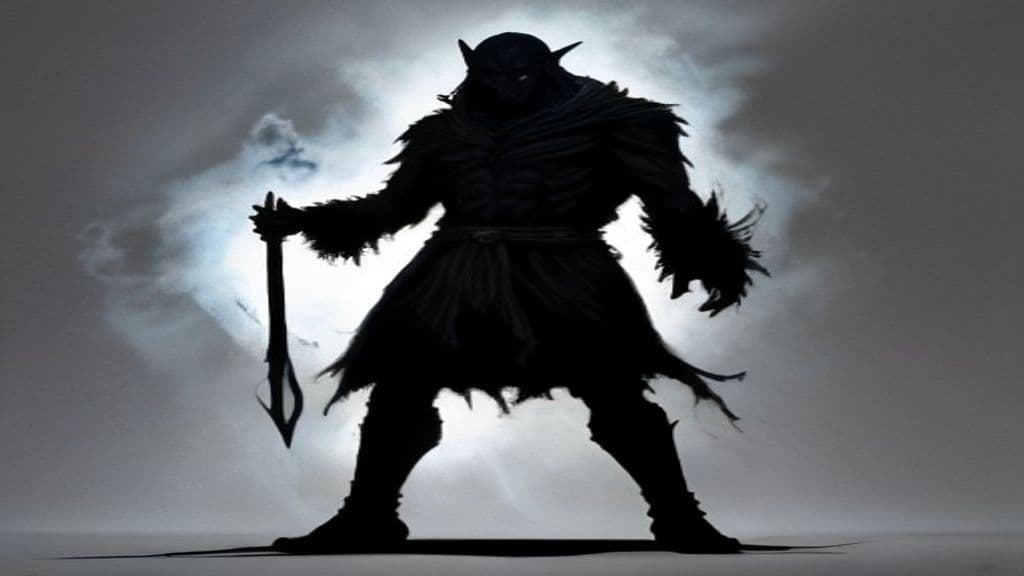
In J. R. R. Tolkien's legendarium, a Balrog is a Maiar spirit corrupted into a warlike, fire-associated servant of the Vala Melkor (Morgoth). Balrogs appear as towering, shadowed figures wreathed in fire and wielding fiery whips and weapons; in Tolkien's later conception they are rare, exceptionally powerful beings whose defeat generally required opponents of comparable metaphysical order.
Barliman Butterbur
Barliman Butterbur is a human resident of Bree in J. R. R. Tolkien's Middle-earth. Source material classifies him simply as a man in Tolkien's legendarium and situates him within Bree-land, the village region where Hobbits and Men live side by side.
Beren and Lúthien
Beren and Lúthien are the central protagonists of a foundational First‑Age tale in J. R. R. Tolkien’s legendarium about the love between a mortal Man (Beren) and an immortal Elf‑maiden (Lúthien), their quest to take a Silmaril from Morgoth’s crown, Beren’s death and unique return, and Lúthien’s choice to become mortal.
Children of Ilúvatar
In J. R. R. Tolkien’s legendarium, the Children of Ilúvatar are the two principal kinds of sentient, created beings—Elves and Men—brought into being by the supreme creator Ilúvatar (Eru) and occupying a central place within Tolkien’s cosmology.
Círdan
Círdan is a named Elf in J. R. R. Tolkien's legendarium, portrayed as a shipwright and leader associated with the Grey Havens (Mithlond) who prepares vessels for the westward departure of the Elves from Middle-earth.
Dáin II Ironfoot
Dáin II Ironfoot is a named Dwarven king and military leader of the Iron Hills in J. R. R. Tolkien’s legendarium, presented in sources as a kinsman of Thorin Oakenshield who brings reinforcements to the Lonely Mountain and who is reported to have warned that Moria remained dangerous because of Durin's Bane.
Edain (Men)
The Edain, rendered in sources as Man or Men, are the human peoples of J. R. R. Tolkien's Middle-earth. They are the 'second' or younger people, created after the Elves and distinguished chiefly by their mortality; they are counted among the 'free peoples' of Middle-earth alongside other autonomous races.
Elendil
Elendil is a human Númenórean leader in J. R. R. Tolkien’s legendarium: a refugee of Númenor who founded the northern realm of Arnor, led the Faithful, and fought in the Last Alliance against Sauron. He is remembered as a dynastic founder whose proclamation and heirlooms shaped later kingship in Middle-earth.
Ent
An Ent is a fictional, tree-like, sentient humanoid from J. R. R. Tolkien's Middle-earth who serve as ancient 'Shepherds of the Trees', guarding forests and vegetation and reacting when those they tend are harmed.
Community Record
- [1]Company of the Ring. Wikipedia, 'Company of the Ring'wiki
- [2]Fellowship of the Ring (Wikidata). Wikidata entry for Fellowship of the Ringother
- [3]The Lord of the Rings: The Fellowship of the Ring. Wikipedia, 'The Lord of the Rings: The Fellowship of the Ring'wiki
- [4]Scholarly commentary on 'company' vs 'fellowship' and Company meaning. Summaries of scholarship cited in the Wikipedia article (e.g., discussion of etymology and Tolkien's usage)wiki