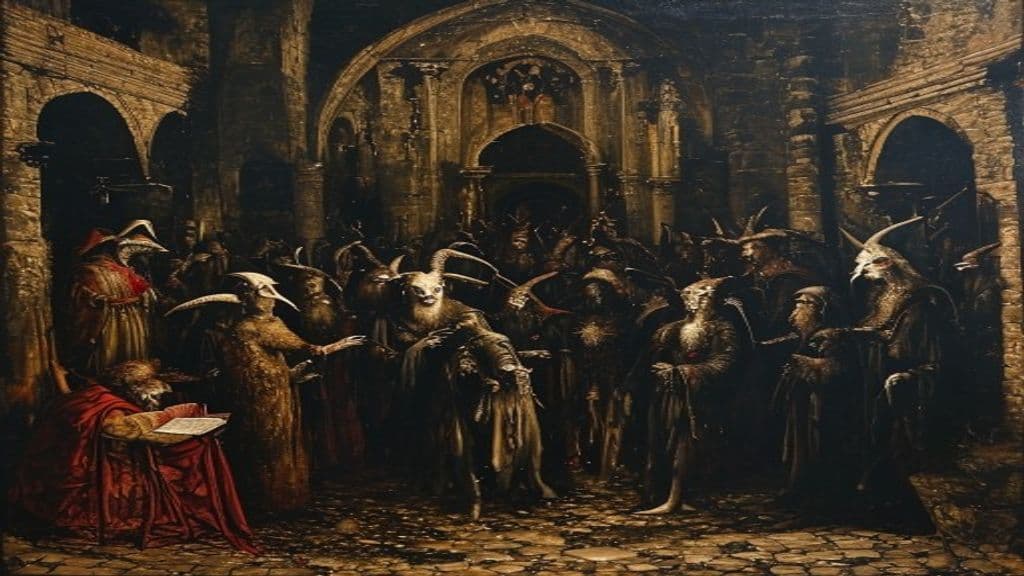
The Akelarre is not a supernatural being itself, but rather an event. The entity presiding over the gathering is described as goat-like.
Limited information; the source suggests it has some kind of supernatural or mystical power, but does not provide specifics.
Aatxe
In Basque folk mythology, Aatxe is a spirit that exists alongside humans and other entities, protecting the law-abiding and punishing malevolent individuals. (Note: 1. Power tier: The source material does not explicitly mention Aatxe as a deity-level entity, so Greater is plausible but could be clarified. 2. Abilities: While it's mentioned that Aatxe attacks male)
Jaun Zuria
Basque mythical figure, founder of the Lordship of Biscay with martial and territorial abilities. (Note: 1. Power tier: Greater (not Ancient) as Jaun Zuria's abilities are described as defeating regional invaders, not cosmic-level events. 2. Abilities: Clarify that his martial abilities are specifically )
Jentilak (the Jentil / Gentiles)
Jentilak are a Basque folkloric race of enormous, hill‑dwelling humanoids traditionally credited with shaping the landscape and building megalithic monuments. Conceptually they are framed as pre‑Christian or 'gentile' ancestors whose disappearance is associated in folklore with the spread of Christianity.
Akaname
Akaname is a Japanese yōkai associated with baths, bathtubs, toilets, and other places where scum and filth accumulate. Traditionally depicted as a child-like creature that licks grime, it functions in folklore as a cautionary figure tied to cleanliness; a few narrative variants cast it as dangerously predatory.
Akar Kessel
No documentation for an entity named Akar Kessel appears in the supplied source materials. The available corpus contains no primary or secondary information that defines the name, its attributes, cultural provenance, or associated practices.
Akashaguma
Akashaguma is presented in the available sources as a child-like house guardian spirit in the Japanese yokai tradition, closely comparable to the regional zashiki-warashi. It is associated with domestic interiors (parlors or storage rooms) and with bringing prosperity to households where it dwells.
Akashita
Akashita (赤舌, lit. “red tongue”) is an Edo-period pictorial yōkai commonly represented as a hairy, clawed face emerging from dark clouds with a wide open mouth and a conspicuous red tongue. The figure appears in yōkai emaki and Toriyama Sekien’s Gazu Hyakki Yagyō; Sekien’s plate shows it atop a sluice, but the original pictorial tradition provides no explanatory caption. Later folklorists and popular writers (Shōwa and later) have variously interpreted the image as a punitive spirit linked to irrigation/floodgate justice or as a kidnapper in evening skies, though these narrative roles are post-hoc.
Akateko
Akateko (赤手児, lit. 'red child's hand') is a yōkai from Japanese folklore commonly told as a small, red, disembodied child's hand that appears from trees—especially the Japanese honey locust—and startles travelers; in some regional variants it is accompanied by a specter of a young woman or manifests as paired foot- or leg-like apparitions. Accounts vary between mostly harmless trickster apparition and a violent variant that attacks humans.
Akenta
Akenta is attested in the provided sources only as a proper name appearing in several unrelated contexts (a listing of South Australian groups, commercial wine branding, a health company, and a parliamentary text). The sources do not describe Akenta as a supernatural being, and no mythic attributes, appearance, powers, or rituals are recorded.
Aker
Aker is an ancient Egyptian personification of the horizon and an earth and underworld deity who is described in surviving summaries as guardian of the eastern (Bakhu) and western (Manu) horizons, marking liminal boundaries between day and night and between the living world and the netherworld.
Akerbeltz
Malevolent Basque spirit associated with sexual abuses and seductive powers, likely tied to the natural environment. (Note: - Power tier: Greater (Akerbeltz's abilities are more regional in scope and do not match the description of an Ancient entity) - Abilities: While source material mentions "sexual abuses" and "seductiv)
Akh (Ancient Egyptian Conception of the Soul)
In Ancient Egyptian tradition, the Akh is one of several components making up the complex soul entity that continues to exist after death. (Note: * Power tier should be Ancient (deity-level) instead of Primordial * Abilities: specify how the Akh's immortality is achieved through rituals (e.g., "through rituals performed by priests during funera)
Community Record
- [1]wiki