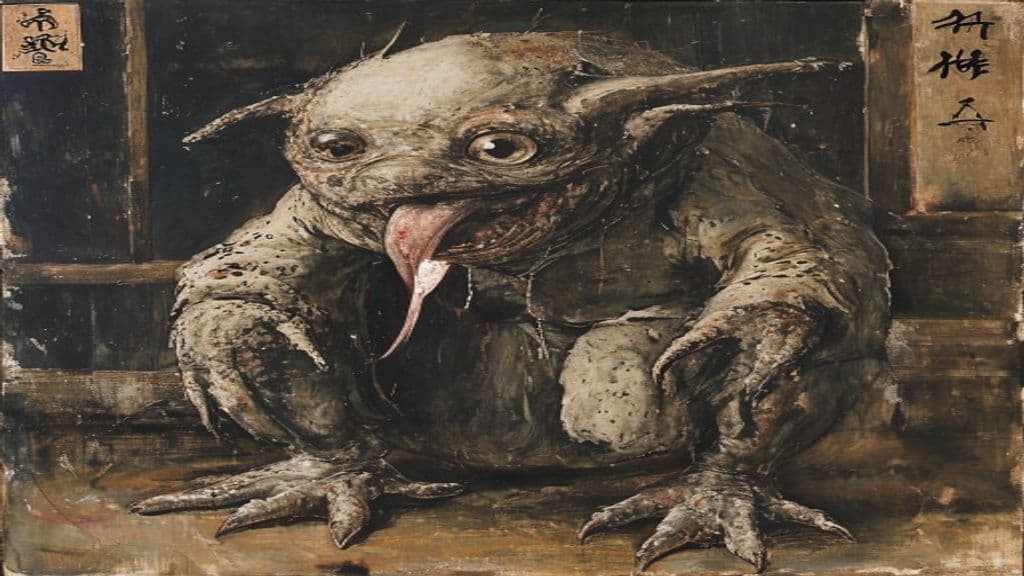
Classical and Edo-period sources present the akaname as a spirit that arises in and around neglected bathing places and accumulations of grime. Older summaries (cited in later compendia) describe akaneburi/akaname as emanating from the filth itself—a being produced by and subsisting on accumulated scum and detritus in bathhouses, outhouse-type baths, toilets, and derelict homes. Over time the creature became framed in popular commentary as a folkloric embodiment of domestic neglect, a presence generated by and attracted to unclean conditions rather than an unrelated transcendent deity.
Descriptions vary across period sources and later popularizations. Edo-period illustrations and textual summaries commonly portray the akaname as a small, child-like humanoid with a rough or pebbly-looking head, round eyes, clawed feet, and a conspicuously long tongue used for licking scum; some depictions show cropped hair. Coloration differs in the record—later popular art often renders it red (a pun on aka), while at least one nineteenth-century depiction shows a blue-black skinned figure. A few older texts record a more sinister variant that assumes the guise of a beautiful woman in specific anecdotes.
The primary behavior attributed to akaname is licking filth and scum from bathtubs, bathrooms, and toilets; it is said to subsist on the grime of its environs. Most sources emphasize that it does nothing besides consume scum, serving as a folkloric reminder to keep bathing places clean. A discrete narrative variant from Nittō honzō zusan recounts a woman-shaped akaneburi that licked a man down to his bones, presenting an isolated lethal anecdote rather than a general trait across the tradition.
Weaknesses
- conditioncleanliness / removal of aka (scum)
Wards
- ritualregular cleaning of bath places and bathtubs
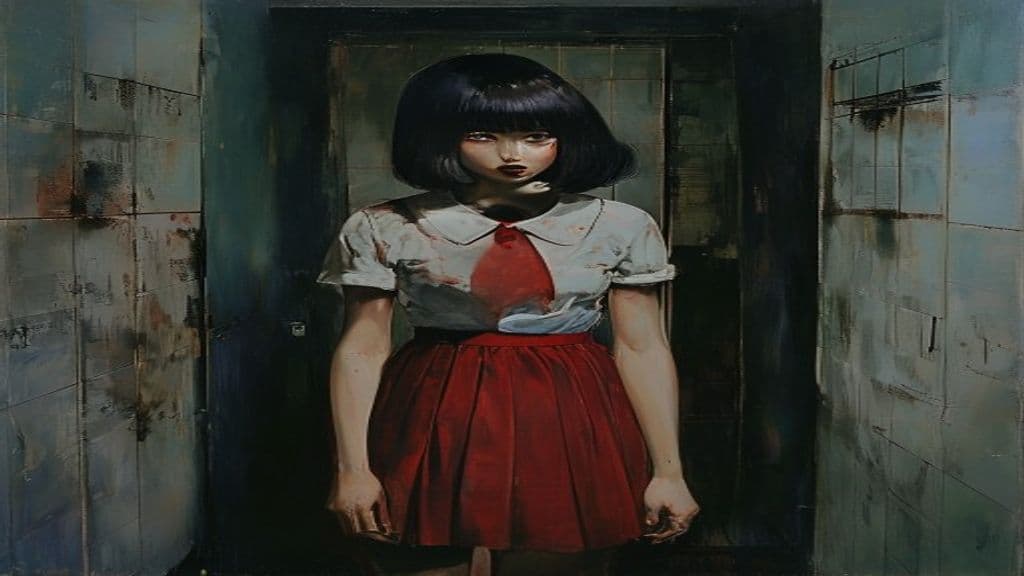
Hanako-san
Hanako-san (Toire no Hanako-san) is a modern Japanese urban-legend spirit said to haunt school toilets. Commonly framed as the ghost of a young girl associated with a particular stall/floor of a school lavatory, the figure is transmitted chiefly in school settings and popular media and is described variously as a yūrei or a yōkai.
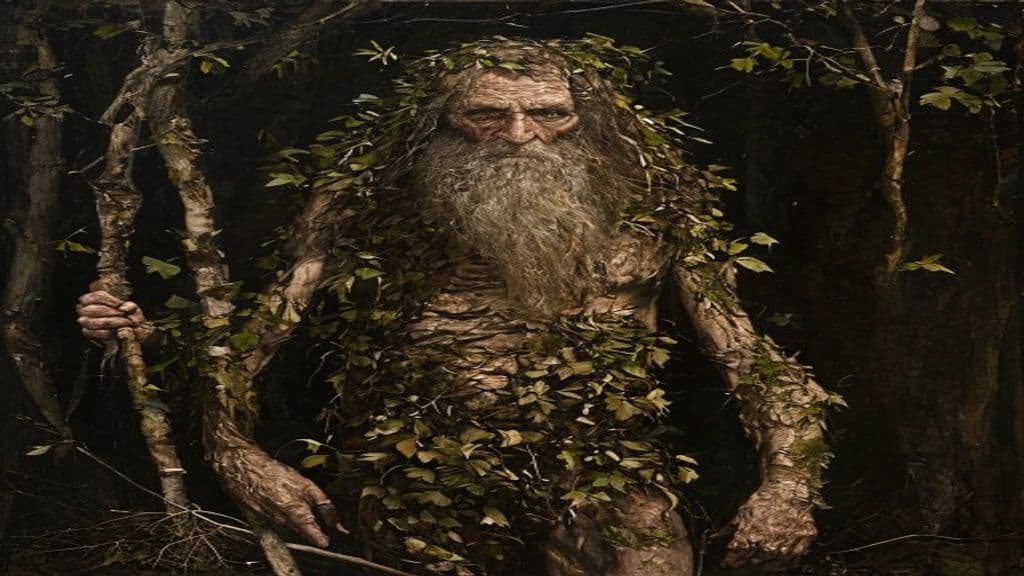
Bannik
A place-bound spirit of the Slavic banya (bathhouse) that inhabits the steam room and related spaces; he mediates divination, presides over births within the banya, and must be appeased by offerings or he may harm or otherwise vex users and the building.
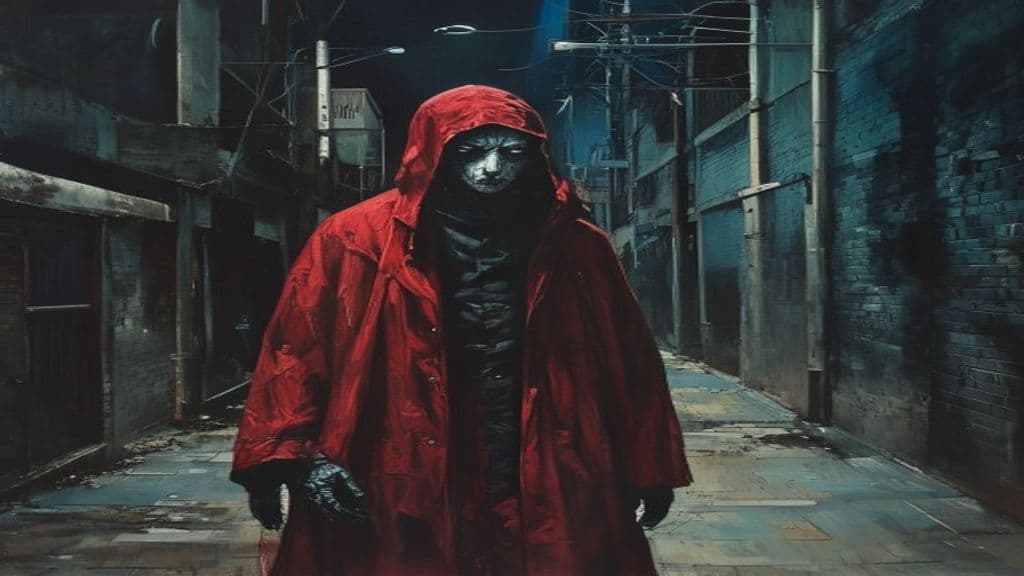
Aka Manto
Aka Manto (赤マント, "Red Cloak") is a Japanese urban legend and schoolyard ghost-story about a masked, cloaked figure who appears in public or school toilet stalls and forces occupants to choose between colored toilet paper; each choice in the tale produces a violent supernatural consequence. The legend is part of modern popular folklore recorded in school contexts from the 1930s onward rather than a formal religious myth.
Abumi-guchi
A Japanese yōkai classed as a tsukumogami: an animated stirrup (abumi) depicted in Sekien Toriyama's Gazu Hyakki Tsurezure Bukuro. Traditional accounts say it is formed from a stirrup that belonged to a soldier who fell in battle and that it waits where the stirrup lies for its dead owner to return.
Abura-sumashi
A yōkai spirit from the Amakusa region of Kumamoto Prefecture, Japan, said to inhabit mountain passes. Traditionally explained as the ghost of a person who stole oil, it appears to surprise travelers and is represented in modern media with a straw-coat body and a potato- or stone-like head.
Akateko
Akateko (赤手児, lit. 'red child's hand') is a yōkai from Japanese folklore commonly told as a small, red, disembodied child's hand that appears from trees—especially the Japanese honey locust—and startles travelers; in some regional variants it is accompanied by a specter of a young woman or manifests as paired foot- or leg-like apparitions. Accounts vary between mostly harmless trickster apparition and a violent variant that attacks humans.
Akubōzu
Akubōzu (灰坊主, Akubōzu) is a household yōkai from parts of Akita and Iwate Prefectures in northern Japan said to live in the ashes of the hearth. Sources say they appear when people (notably children) play with or dig in hearth/furnace ash; the figure is cited as part of a broader Tōhoku motif warning against disturbing ash.
Akuma
Akuma (悪魔/あくま) in Japanese sources is an evil spirit, devil, or demon associated with misfortune and mental disturbance. The term appears in Buddhist texts and Heian-period literature and was later used to translate the Christian figure of Satan, as well as the Buddhist Mara.
Akurojin-no-hi
Akurojin-no-hi (悪路神の火, "fire of the god of the bad road") is a flamelike ghost from the folklore of Mie Prefecture, Japan. It is reported to appear on rainy nights; those who encounter it and do not run away are said to become gravely ill. The phenomenon is sparsely documented and is usually compared to will-o'-the-wisp type ghost-lights.
Amabie
Amabie is a mid-19th-century Japanese yogenjū-type wondrous creature attested in kawaraban and related pamphlet culture that emerges from the sea (in canonical accounts) to prophesy about harvests and epidemics and prescribes that its image be drawn and shown to the sick as a protective measure.
Amanojaku
Amanojaku (天邪鬼 / あまのじゃく) is a Japanese yōkai-type being portrayed as a contrarian, heart-reading trickster. Treated in different contexts as a small ogre (ko-oni), a wicked demon (jaki) in Buddhist iconography, and a folkloric spirit that provokes human vice, it appears across regional tales with variable roles from malicious kidnapper to household oddity.
Amefurikozō
Amefurikozō (雨降小僧 or 雨降り小僧) is an Edo-period yōkai figure depicted in classical illustrated and popular print culture as a youthful attendant associated with rain. Classical sources (notably Sekien Toriyama's Konjaku Gazu Zoku Hyakki) present it as a kozō-type servant linked by captional wordplay to a rain deity; later popular literature elaborates its rain-producing role and playful mischief on rainy nights.
Ameonna
Ameonna (雨女, "rain woman") is a figure in Japanese folklore treated as a yōkai associated with rain. Sources depict her both as a rain-calling supernatural being (sometimes helpful in drought) and as a folk label for an unlucky person whom rain seems to follow; a key pictorial source is Toriyama Sekien's Konjaku Hyakki Shūi.
Amorōnagu
Amorōnagu (Amorōnagu / 天降女子) is a tennyo or celestial maiden figure in the folklore of Amami Ōshima (Kagoshima Prefecture, Japan). Attested sources describe her as a heavenly woman who bathes in pools and waterfalls in ravines on the island.
Aonyōbō
Aonyōbō (青女房) is a yōkai in Japanese folklore described in legend as a blue-skinned, ogre-like spirit who appears as an ancient court noblewoman and haunts the ruined houses of fallen nobles, embodying poverty, abandonment, and social decline.
Community Record
- [1]Akaname - Wikipedia. Wikipedia entry 'Akaname' (summary of classical sources and etymology)wiki
- [2]Kokon hyakumonogatari hyōban (summarized). Summaries citing Kokon hyakumonogatari hyōban describing akaneburi/akaname as emanating from and subsisting on accumulated filthliterary
- [3]Nittō honzō zusan (anecdote summarized). Summaries of Nittō honzō zusan recording an anecdote of a woman-shaped akaneburi that licked a man to his bonesliterary
- [4]Hyakushu kaibutsu yōkai sugoroku (1858) — depiction referenced. Reference to nineteenth-century depiction showing a blue-black skinned figure (as summarized in secondary sources)literary
- [5]Phoneia: The History of Akaname, the spirit of the baths. Modern secondary account summarizing traditional descriptions, etymology, and cultural contextother
- [6]Various web summaries and media references (podcasts, blogs, game adaptations). Contemporary popular summaries noting appearance, behavior, and cultural lesson; also notes adaptation in games and mediaother