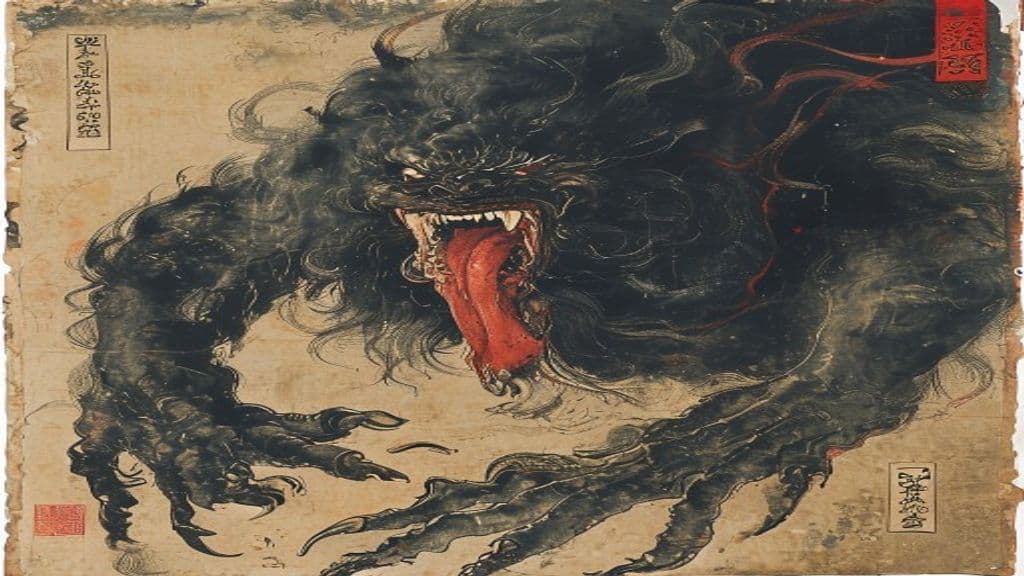
Akashita has no unified origin story in the Edo pictorial record; it appears primarily as an illustrated label in emaki and in Toriyama Sekien’s Gazu Hyakki Yagyō without a textual origin. Scholarly commentators in the 20th century have proposed interpretive etymologies and links — for example, connections to onmyōdō terms such as shakuzetsujin/shakuzetsunichi or moral-aphoristic readings of the name — but these are later, interpretive suggestions rather than original provenance narratives attached to the early pictures.
Across Edo-period emaki and in Sekien’s plate the creature is shown as a beast-like, very hairy face often set within or covered by dark/black clouding, with clawed hands and a wide-open mouth from which a large red tongue hangs (the namesake feature). The full body is generally not shown in the pictorial sources; Sekien’s image uniquely places the head/face figure atop a sluice (floodgate), while other emaki labeled akaguchi show the same facial/tongue motif without a sluice.
The original pictorial sources supply no explicit powers or behaviors. Later Shōwa-era and modern folkloric summaries attribute punitive functions — notably that an akashita/akaguchi appears at floodgates to punish those who steal excessive irrigation water by scooping them up with its large red tongue and swallowing them — and other modern accounts describe evening-sky appearances that kidnap people (some stories add that victims' families later prosper). These behavioral attributions are later interpretations grafted onto the Edo images and are not described in Sekien’s uncaptionsed plate.
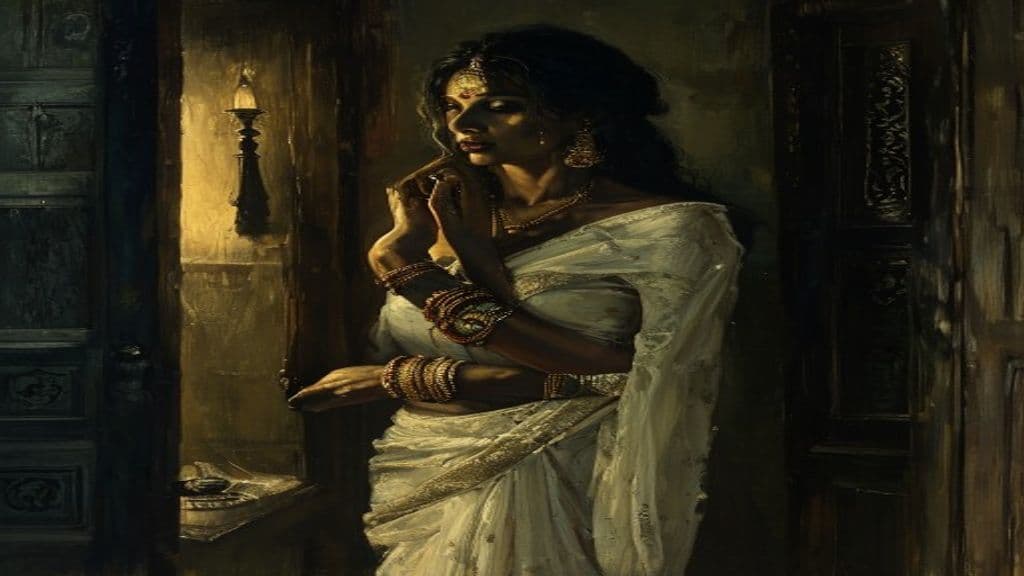
Shakchunni
Bengali ghost of a married Brahmin woman who died before her husband — identifiable by her white sari and conch-shell bangles, she possesses living married women and refuses to relinquish domestic life.
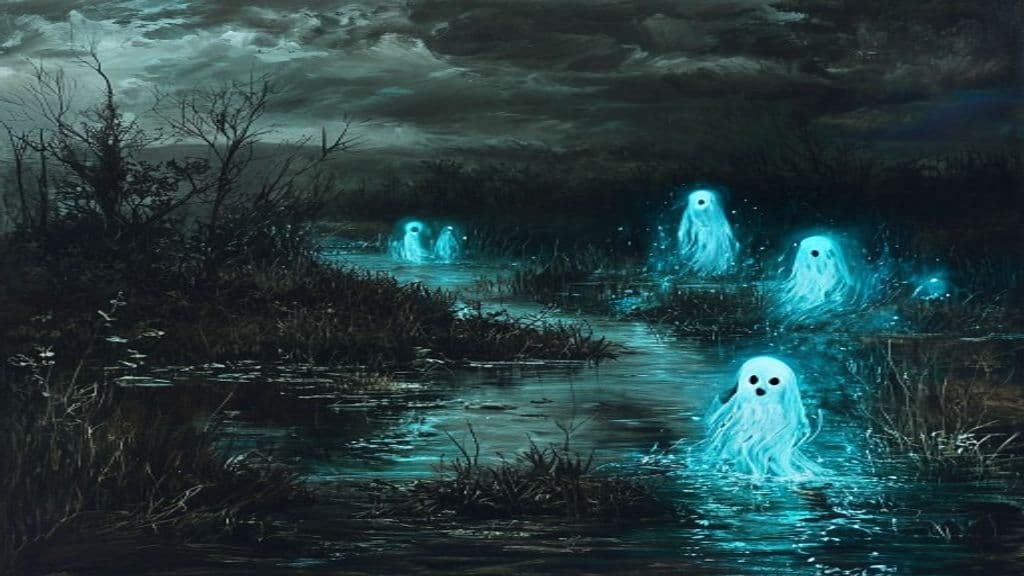
Will-o'-the-Wisp
A wandering light seen over marshy ground at night, leading travellers astray into bogs and fens. Possibly a spirit, possibly the soul of the unbaptised dead, possibly the devil himself.
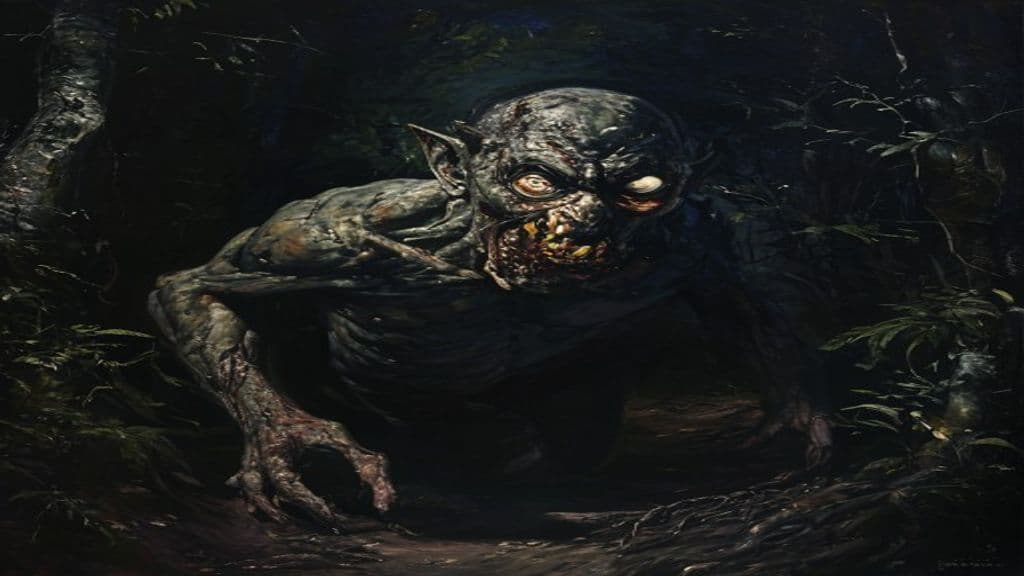
Pishacha
Flesh-eating spirits of Hindu mythology that haunt cremation grounds and are associated with disease, madness, and possession. The lowest class of demon in the Vedic hierarchy.
Yaksha
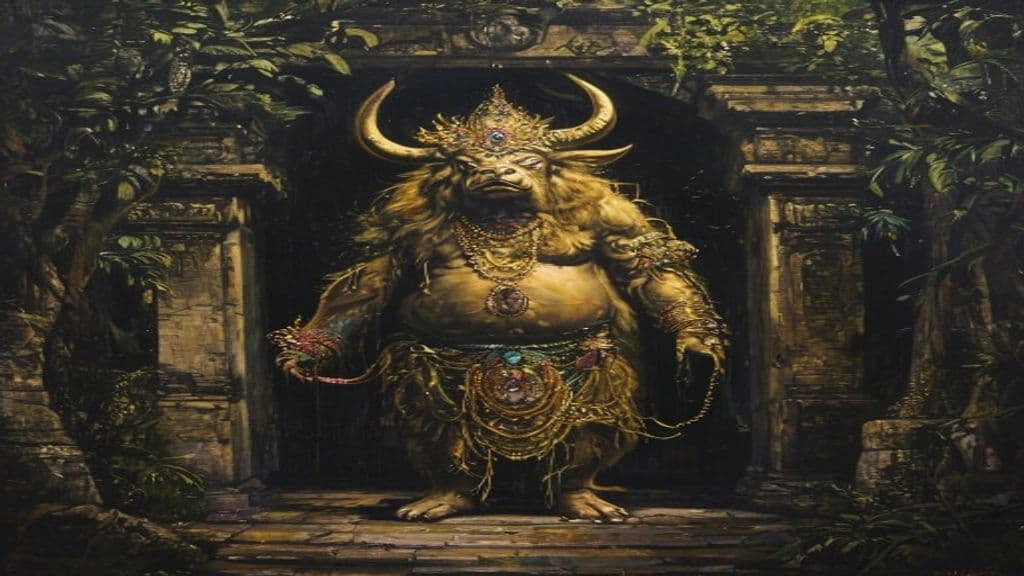
Nature spirits of Hindu, Buddhist, and Jain cosmology — guardians of forests, treasures, and wilderness. Ambivalent beings, capable of great benevolence to the respectful and terrible harm to the greedy.
Ak Ana
Ak Ana (also Ağ Ana, Ak Ene) is the primordial water-mother of Turkic and some Siberian (Khanty, Mansi) traditions: a holy maternal creator principle associated with the pre-earth expanse of water, fertility of the land, and the threshold to the spirit world.
Aka Manah
Aka Manah (Akem manah; Middle Persian Akoman, New Persian Akvan) is the personification of 'evil mind' in Zoroastrian literature. Originating as a Gathic term for corrupt thought, the figure is later reified in the Younger Avesta and Pahlavi texts as a high-ranking demonic opponent of Vohu Manah and ally of Angra Mainyu, whose activity is to pervert human thought and moral discrimination.
Aka Manto
Aka Manto (赤マント, "Red Cloak") is a Japanese urban legend and schoolyard ghost-story about a masked, cloaked figure who appears in public or school toilet stalls and forces occupants to choose between colored toilet paper; each choice in the tale produces a violent supernatural consequence. The legend is part of modern popular folklore recorded in school contexts from the 1930s onward rather than a formal religious myth.
Akaname
Akaname is a Japanese yōkai associated with baths, bathtubs, toilets, and other places where scum and filth accumulate. Traditionally depicted as a child-like creature that licks grime, it functions in folklore as a cautionary figure tied to cleanliness; a few narrative variants cast it as dangerously predatory.
Akar Kessel
No documentation for an entity named Akar Kessel appears in the supplied source materials. The available corpus contains no primary or secondary information that defines the name, its attributes, cultural provenance, or associated practices.
Akashaguma
Akashaguma is presented in the available sources as a child-like house guardian spirit in the Japanese yokai tradition, closely comparable to the regional zashiki-warashi. It is associated with domestic interiors (parlors or storage rooms) and with bringing prosperity to households where it dwells.
Akateko
Akateko (赤手児, lit. 'red child's hand') is a yōkai from Japanese folklore commonly told as a small, red, disembodied child's hand that appears from trees—especially the Japanese honey locust—and startles travelers; in some regional variants it is accompanied by a specter of a young woman or manifests as paired foot- or leg-like apparitions. Accounts vary between mostly harmless trickster apparition and a violent variant that attacks humans.
Akelarre (Basque Witches' Sabbath)
In Basque tradition, Akelarre is a gathering of witches presided over by a goat-like entity. (Note: - Power tier: Primordial (given it's a cosmic event and not a specific entity with supernatural power, but rather an event presided over by another entity) - Summary: In Basque tradition, the Akelarre)
Akenta
Akenta is attested in the provided sources only as a proper name appearing in several unrelated contexts (a listing of South Australian groups, commercial wine branding, a health company, and a parliamentary text). The sources do not describe Akenta as a supernatural being, and no mythic attributes, appearance, powers, or rituals are recorded.
Aker
Aker is an ancient Egyptian personification of the horizon and an earth and underworld deity who is described in surviving summaries as guardian of the eastern (Bakhu) and western (Manu) horizons, marking liminal boundaries between day and night and between the living world and the netherworld.
Akerbeltz
Malevolent Basque spirit associated with sexual abuses and seductive powers, likely tied to the natural environment. (Note: - Power tier: Greater (Akerbeltz's abilities are more regional in scope and do not match the description of an Ancient entity) - Abilities: While source material mentions "sexual abuses" and "seductiv)
Akh (Ancient Egyptian Conception of the Soul)
In Ancient Egyptian tradition, the Akh is one of several components making up the complex soul entity that continues to exist after death. (Note: * Power tier should be Ancient (deity-level) instead of Primordial * Abilities: specify how the Akh's immortality is achieved through rituals (e.g., "through rituals performed by priests during funera)
Community Record
- [1]Akashita. Wikipedia: Akashitawiki
- [2]Gazu Hyakki Yagyō. Wikipedia: Gazu Hyakki Yagyō (Toriyama Sekien)wiki
- [3]Akashita (pantheon.org summary). Pantheon / Encyclopedia Mythica entry on Akashitafolk
- [4]Akashita (gallery entry). Encyclopedia Mythica gallery: Akashita / Akaguchifolk