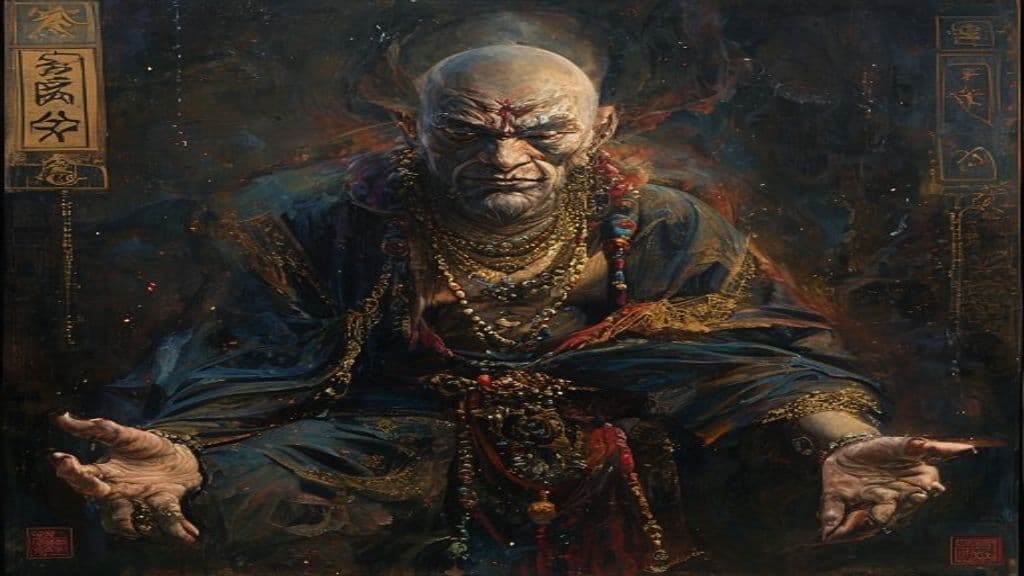
In Tibetan folklore, Akhu Tönpa is sent by Chenrezig to teach Tibetans the art of being shrewd and witty.
Akhu Tönpa outwits those in positions of power and plays harmless and not-so-harmless pranks on villagers, monks, and members of the aristocracy.
Chakravarti
An ideal universal ruler in Indian historiography and religion, holding supreme power over various geographical regions. (Note: - Power tier: Should be "Primordial" -> Incorrect; a Primordial entity would have cosmic powers. Revisit and assign a more fitting power tier based on abilities (e.g., Greater or Ancient). - Origin )
Nieh-ching-t'ai
A supernatural mirror in Diyu, revealing past existences and wicked deeds. (Note: * Power tier: Lesser (not Primordial) - "Mirror" suggests it's not an incredibly powerful being but rather a tool for revealing past existences. * Abilities: Add source material to support divination )
Rāhula
Historical figure and son of the Buddha Siddhartha Gautama, illustrating key Buddhist concepts through his story. (Note: 1. Remove "Primordial" power tier, as it implies cosmic-level abilities, which is not supported by source material. 2. Add sensory cues and weaknesses consistent with Rāhula's character in Buddhist te)
The Great Renunciation
A pivotal event in Buddhist tradition, marking Gautama Buddha's transition from a life of luxury to one of asceticism. (Note: 1. Power tier: Minor Spirit is incorrect; The Great Renunciation is not an entity with powers or behaviors, so it should be classified as none or Primordial (since it's a pivotal event). 2. Sensory cu)
Trailokyavijaya
Buddhist wrathful deity and manifestation of the bodhisattva Vajrapāṇi, associated with fierce power and protection. (Note: - Power tier: Trailokyavijaya is not described as Primordial in the source material. Given his association with Vajrapāṇi and being a Wisdom King, it would be more accurate to categorize him as Ancien)
Akhilandeswari
Akhilandeswari (Akhilandeshwari) is a major South Indian manifestation of the Hindu Goddess Adi Parashakti/Parvati, venerated as the presiding goddess of the Jambukeswarar Temple in Thiruvanaikaval. In temple tradition she is portrayed as a penitent/student of Shiva and figures in local legends, ritual schedules, and festivals that emphasize both maternal and fierce aspects.
Akhkhazu
Akhkhazu (also Ahhazu; Sumerian Dimme-kur) is an Akkadian-era Mesopotamian malignant spirit described as a demon of jaundice who 'seizes' victims, brings fever and plagues, and is cited in later summaries as one member of a triad with Labasu and Labartu. Later popular summaries also describe her as preying on nursing infants while mothers slept.
Akhlut
An Inuit composite, shape‑changing animal‑spirit described in early ethnographic accounts as an orca that can become a wolf on land (and sometimes depicted in later popular media as a wolf‑orca hybrid). Associated with the seashore and ice edge along the Bering Sea, it is portrayed as powerful and dangerous in the cited sources.
Akhty
Akhty (also read Netjer-akhty) is an ancient Egyptian deity identified with the northern bald ibis and linked to the akh (the transfigured, luminous human spirit). Attested from early 2nd dynasty inscriptions and in Old Kingdom personal names and priestly titles, Akhty was associated with the evening horizon and believed to guide the setting sun and carry the deceased's spirit into the night sky.
Akira Fudō
Akira Fudō is the human protagonist of Go Nagai’s Devilman narrative who becomes a hybrid figure — described in the story as “the Devilman, the only being who can fight demons; a being possessing the powers of a demon and a soul of a man.” He gains demonic power (notably from the demon Amon) while retaining his human moral identity and functions as the principal fighter against a re-emergent host of ancient demons within the series’ modern-Japan setting.
Akkorokamui
Akkorokamui is a titanic octopus-like sea kamuy (spirit) in Ainu tradition, described as the nushi (local lord) of Funka/Uchiura Bay in Hokkaidō. Traditional accounts portray it both as a fearsome physical monster capable of overturning or swallowing vessels and as a named supernatural presence embedded in Ainu cosmology and ritual vocabulary.
Akna
Akna is a female figure named in modern secondary sources as associated with childbirth and motherhood. The provided materials conflate brief mentions linking the name to both Maya and Inuit maternal goddesses; primary Maya iconographic or epigraphic evidence for a distinct Maya Akna is not supplied in the sources.
Community Record
- [1]Wikipediawiki