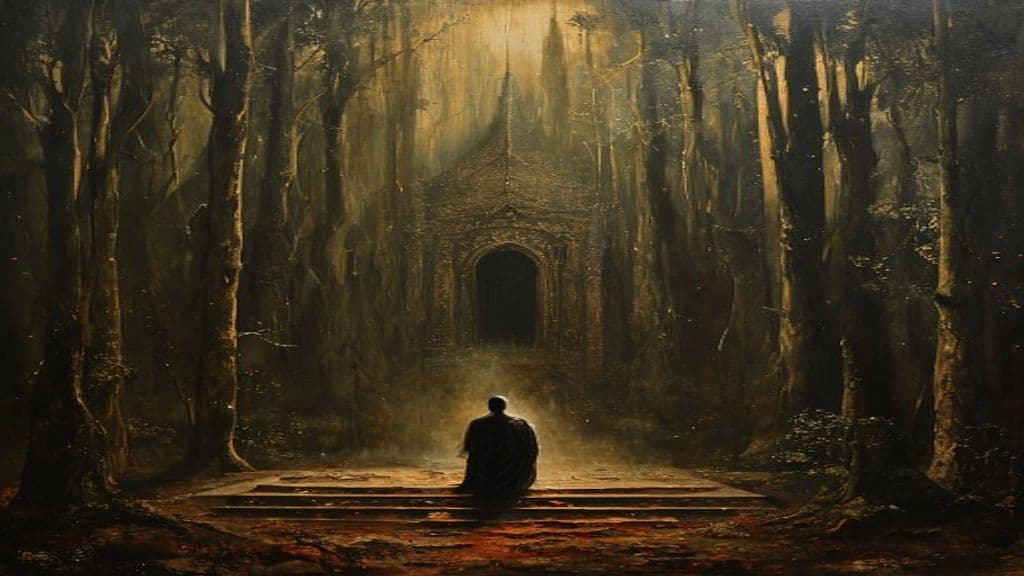
The Great Renunciation is an event in the life of Gautama Buddha that marks his transition from a life of luxury to one of asceticism. This pivotal moment in Buddhist tradition is regarded as a great sacrifice and is seen as a turning point for the Buddha's spiritual journey.
As the Great Renunciation is not a supernatural entity, it does not have a physical appearance.
The Great Renunciation has no direct powers or behaviors beyond being an event that marks the beginning of the Buddha's ascetic life.
Akhu Tönpa
A Tibetan trickster figure, sent by Chenrezig to teach the art of being shrewd and witty, while championing the common man against social hierarchies. (Note: - Power tier should be Lesser or Minor Spirit, not Ancient, as it's more aligned with local spirit level of trickster figures. - The ability to outwit those in positions of power suggests Greater or P)
Chakravarti
An ideal universal ruler in Indian historiography and religion, holding supreme power over various geographical regions. (Note: - Power tier: Should be "Primordial" -> Incorrect; a Primordial entity would have cosmic powers. Revisit and assign a more fitting power tier based on abilities (e.g., Greater or Ancient). - Origin )
Nieh-ching-t'ai
A supernatural mirror in Diyu, revealing past existences and wicked deeds. (Note: * Power tier: Lesser (not Primordial) - "Mirror" suggests it's not an incredibly powerful being but rather a tool for revealing past existences. * Abilities: Add source material to support divination )
Rāhula
Historical figure and son of the Buddha Siddhartha Gautama, illustrating key Buddhist concepts through his story. (Note: 1. Remove "Primordial" power tier, as it implies cosmic-level abilities, which is not supported by source material. 2. Add sensory cues and weaknesses consistent with Rāhula's character in Buddhist te)
Trailokyavijaya
Buddhist wrathful deity and manifestation of the bodhisattva Vajrapāṇi, associated with fierce power and protection. (Note: - Power tier: Trailokyavijaya is not described as Primordial in the source material. Given his association with Vajrapāṇi and being a Wisdom King, it would be more accurate to categorize him as Ancien)
The Game of the Gods
A pivotal moment in Norse mythology, marking a turning point in creation and destruction, associated with the golden age of the Æsir and their survival after Ragnarök. (Note: 1. The power_tier should be Primordial (correct), but consider adding "with unknown implications" as it's not clear how this entity interacts with reality. 2. Remove or rephrase the claim that it has )
The Gaze of Orpheus
A primordial force resulting from Orpheus' actions in the underworld, enforcing conditions set by Hades and Persephone. (Note: 1. The origin story doesn't specifically mention Hades and Persephone setting conditions; it was a consequence of Orpheus' actions. 2. Power tier correction: As the Gaze is more of a force or conseque)
The Gray Man
A polyvalent label applied to multiple distinct figures: a local ghost of Pawleys Island, a figure in Scottish folklore called Fear liath, and numerous modern fictional or cultural uses. The sources provided do not present a single unified supernatural being but rather several separate referents sharing the same name.
The Great Race
A cosmic event in Lakota creation stories where humans and buffalo competed to establish supremacy, resulting in humans emerging victorious through cunning and strategy. (Note: 1. The power tier should be Primordial instead of Ancient. 2. Add sensory cues: dreams, omens, visions 3. Add weaknesses: loss of trust between humans and buffalo; spiritual disconnection from the nat)
The Headmen
The Headmen are a team of supervillains appearing in American comic books published by Marvel Comics, created from earlier horror-story characters and first assembled as a team in The Defenders #21 (March 1975). They are human (or human-derived) antagonists who pursue schemes of scientific, political, and economic domination and are repeatedly opposed and defeated by superhero protagonists.
The Hook (the Hookman)
An American urban-legend figure, the Hook (or Hookman) is narrated as a violent outsider—commonly an escaped convict or patient—distinguished by a hook in place of a hand who attacks couples parked at lovers' lanes. The legend functions as a mid-20th-century cautionary tale warning against risky teenage behavior rather than as a documented supernatural being.
The Hulk
A modern fictional comic-book character from American popular culture created by Marvel Comics, the Hulk is the rage‑driven alter ego of scientist Dr. Robert Bruce Banner who transforms following exposure to gamma radiation; portrayals vary across media and continuities between a destructive, near‑mindless brute and more nuanced, intelligent personae.
Community Record
- [1]