
Alcyone (Ancient Greek: Ἀλκυόνη), a Thessalian princess and daughter of Aeolus, married Ceyx (Κῆυξ), king of Trachis. Classical narratives differ on motive and divine response: Pseudo-Apollodorus records that the couple sacrilegiously called one another 'Zeus' and 'Hera', invoking Zeus's anger; while Ovid and Hyginus present a version in which Ceyx drowns in a storm and Morpheus, the god of dreams, discloses his death to Alcyone in a vision. In both strands Alcyone throws herself into the sea in grief (Ovid) or otherwise laments, and the gods transform the pair into seabirds. The metamorphosis functions etiologically: it names certain seabirds (alkyón/halcyon) and explains a traditional period of calm seas in winter, the halcyon days, during which Aeolus is said to restrain winds so the transformed Alcyone may nest safely.
As human figures the sources give genealogical and social identities (Alcyone as Thessalian princess and later queen of Trachis; Ceyx as king of Trachis and described in tradition as son of Eosphorus, the morning star), but supply no sustained physical portrait. As avian beings the pair are described in classical accounts as transformed into 'halcyon birds' (commonly identified with the kingfisher, alkyón). Pseudo-Apollodorus presents a variant in which Ceyx becomes a gannet (a large sea-bird) while Alcyone is associated with the kingfisher; lexical comments in the tradition link Kēyx to words for sea-birds such as kaúax and láros. Thus the mythic imagery blends the personal names with vernacular bird-types: Alcyone/alkyón anchors the kingfisher image, and Ceyx is variously equated with tern/gannet/gull-like seabirds in different accounts.
The figures possess no independent magical apparatus in the provided sources; their primary role is transformative and etiological rather than actively supernatural. Narrative actions attributed to them in surviving accounts are human: Alcyone praying at Hera's altar for Ceyx's safety (Ovid), the appearance of Morpheus in a dream to reveal Ceyx's death (Pseudo-Apollodorus and Ovid/Hyginus variants), and Alcyone's throwing herself into the sea in grief. Their metamorphosis into birds signals cosmological consequence: as birds they are said to nest on the shore and, by kinship to Aeolus, are associated with a short winter respite from storms (the halcyon days). These features grant them symbolic agency over a seasonal meteorological phenomenon but not demonstrable agency beyond the transformation and its etiological function.
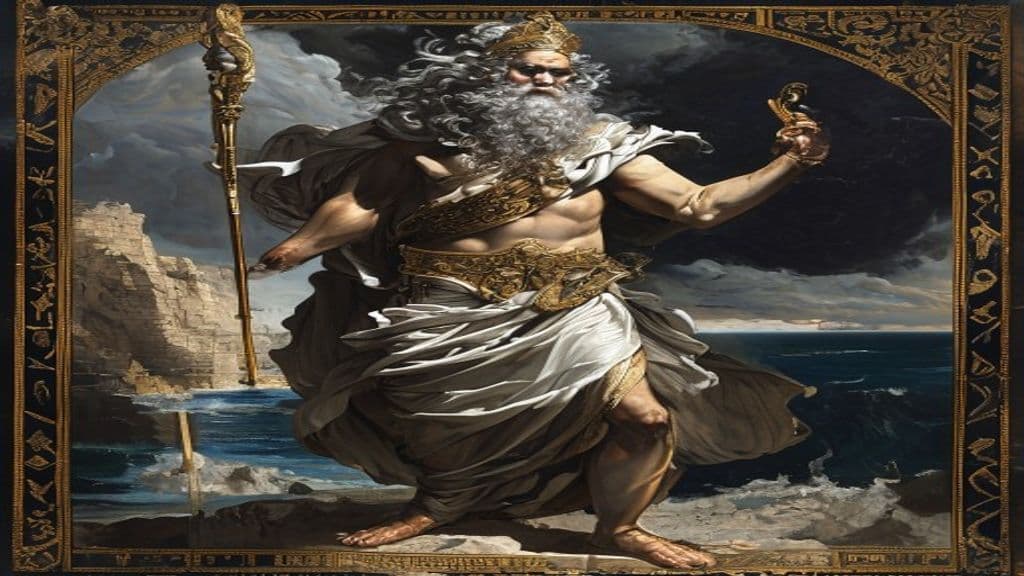
Aeolus
Aeolus is a name applied to multiple related figures in Greek myth: an eponymous son of Hellen (founder of the Aeolian people), a son of Poseidon who led colonial ventures to Tyrrhenian islands, and a son of Hippotes depicted in epic as a ruler or keeper of the winds. Ancient mythographers note confusion and overlap among these persons.
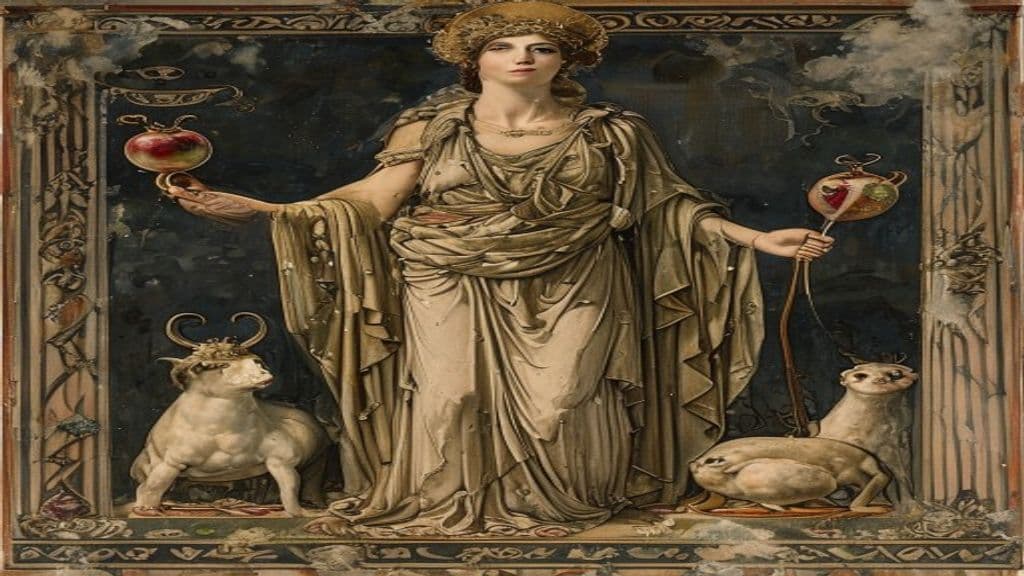
Hera
Hera is an ancient Greek goddess, queen of the Olympian gods, and a principal tutelary deity of marriage, women, and family. She functions in myth and cult as protector of lawful marriage and women in childbirth, a civic tutelary figure (notably of Argos), and a sometimes-jealous consort of Zeus with archaic fertility associations in certain local rites.

Zeus
Zeus (Ancient Greek: Ζεύς) is the supreme deity of the classical Greek pantheon, a sky-and-thunder god who rules as king of the gods on Mount Olympus and functions as a sky‑father who assigns roles among the immortals.
Abderus
Abderus (Ancient Greek: Ἄβδηρος, romanized Ábdēros) is a mortal heroic figure in Greek myth closely associated with Heracles, remembered as the youth left in charge of the Mares of Diomedes who was killed by them. He functions as an eponymous local/divine-hero ancestor for the city of Abdera and received funerary commemoration and athletic agones at his tomb.
Acamas
Acamas (Ancient Greek: Ἀκάμας) is a personal name recurrent in ancient Greek narrative traditions applied to multiple human characters (warriors, princes, suitors), once to a Cyclops, and once as a hound's name. Rather than a single supernatural entity, bearers of the name appear episodically across the Trojan War, Theseid, and Theban cycles as mortal actors whose deeds intersect with gods and fate.
Acarnan
Acarnan (Ancient Greek: Ἀκαρνάν) is an anthroponym attested in Greek mythic and epic tradition as the name of at least two distinct mortal figures: a son of Alcmaeon and Callirrhoe, and a human suitor of Penelope from Dulichium. The lexical form also appears adjectivally/ethnically (Acarnanian), linking the word to the region Acarnania; etymologically the name is reported as derived from a Greek fish-name (akarnan).
Acastus
Acastus is a mortal heroic figure of ancient Greek tradition: son of Pelias who became king of Iolcus, an Argonaut who sailed with Jason, and an actor in the post-Argonautic cycle involving Medea, Peleus, and the aftermath of Pelias’s death. He is attested as performing civic and ritual actions (burying Pelias, instituting funeral games, purifying Peleus) and as a participant in vendetta episodes that end in violent reprisals.
Acmon
Acmon (Ancient Greek: Ἄκμων, 'anvil') is a polyvalent personal name in Greek myth borne by several distinct minor figures — a Dactyl (artisan), a Phrygian eponymous king, a mischievous woodland creature, companions in epic cycles (one companion of Diomedes transformed into a bird; an Aenead), and in some brief traditions an alleged father of Uranus. The name therefore functions across artisanal, topographical, trickster, and metamorphosis motifs rather than denoting a single unified supernatural species.
Acrisius
Acrisius (Ancient Greek: Ἀκρίσιος, Akrisios) is a mythic-historical king of Argos in Greek tradition whose narrative is defined by an oracular prophecy foretelling his death by his daughter's son. He is portrayed as a mortal ruler entangled with dynastic rivalry, oracular authority, and the eventual accidental fulfillment of fate.
Aeacidae
The Aeacidae are a dynastic lineage in Greek myth and historiography descended from the hero Aeacus, son of Zeus and the nymph Aegina. The name functions as a patronymic designation for those 'of Aeacus' and is used to claim genealogical legitimacy and political prestige in regions such as Aegina and Molossian Epirus.
Aegipan
Aegipan (Αἰγίπαν / Αἰγίπανος) is an ancient Greek mythological figure associated with goat attributes and with the sea‑goat imagery of the constellation Capricornus. He appears in classical myth as a semi‑divine helper (notably in the Typhon episode) and, in later natural‑history and medieval bestiary reception, the name is applied to satyr‑like or ape‑like wild men in distant lands.
Aegisthus
Aegisthus (Greek Αἴγισθος, Aigisthos) is a mortal member of the House of Atreus in Greek myth who, born of incestuous circumstances and raised by shepherds and a goat, participates in dynastic murder and usurpation — notably the slaying of Atreus in some accounts and the conspiracy (with Clytemnestra) that results in Agamemnon's death — and is later killed by Orestes, an episode that figures in narratives about inherited guilt, vengeance, and the transition from private retribution to public justice.
Aepytus
Aepytus (Ancient Greek: Αἴπυτος, Aíputos/Aípytos, lit. 'steep, high, lofty') is a personal name in Greek myth borne by several legendary kings tied to Arcadian and Heraclid genealogies. The figures named Aepytus function as ancestral/dynastic nodes in literary genealogies and later literary receptions rather than as supernatural beings.
Aeson
Aeson (Ancient Greek: Αἴσων) is a legendary mortal king of Iolcus in Thessaly in Greek myth, best known as the father of the hero Jason. His fate—imprisonment by his half-brother Pelias and either suicide or a miraculous restoration performed by Medea—provides the dynastic and moral background for the Argonautic cycle.
Aethalides
Aethalides is a personal name borne by two distinct figures in ancient Greek myth: one listed among the Argonauts as a son of Hermes and Eupolemeia, and another named among the Tyrrhenian sailors who attempted to deceive Dionysus and was transformed into a dolphin. The sources treat Aethalides as named human mythic personages appearing in separate narrative contexts rather than as a class of supernatural being.
Community Record
- [1]Alcyone and Ceyx (Wikipedia). Wikipedia contributors, 'Alcyone and Ceyx', Wikipedia, https://en.wikipedia.org/wiki/Alcyone_and_Ceyx (summary of Pseudo-Apollodorus, Ovid, Hyginus, Virgil and etymological notes)wiki
- [2]Wikidata entry: Ceyx and Alcyone. Wikidata: Q21282358, 'Ceyx and Alcyone', http://www.wikidata.org/entity/Q21282358other
- [3]A Dreamer Lost in a Dream (archive listing including 'Ceyx and Alcyone' frontmatter). Archive listing referencing 'Ceyx and Alcyone' in frontmatter/plate captions, https://archive.org/details/fellow-dreamingother
- [4]Guga hunters (archive listing). Archive listing that names Ceyx and Alcyone among referenced cultural items, https://archive.org/details/gugahunters0000murrother
- [5]Poems and fables (archive listing). Archive listing with references to 'Ceyx and Alcyone' in reception material, https://archive.org/details/poemsfables0000drydother