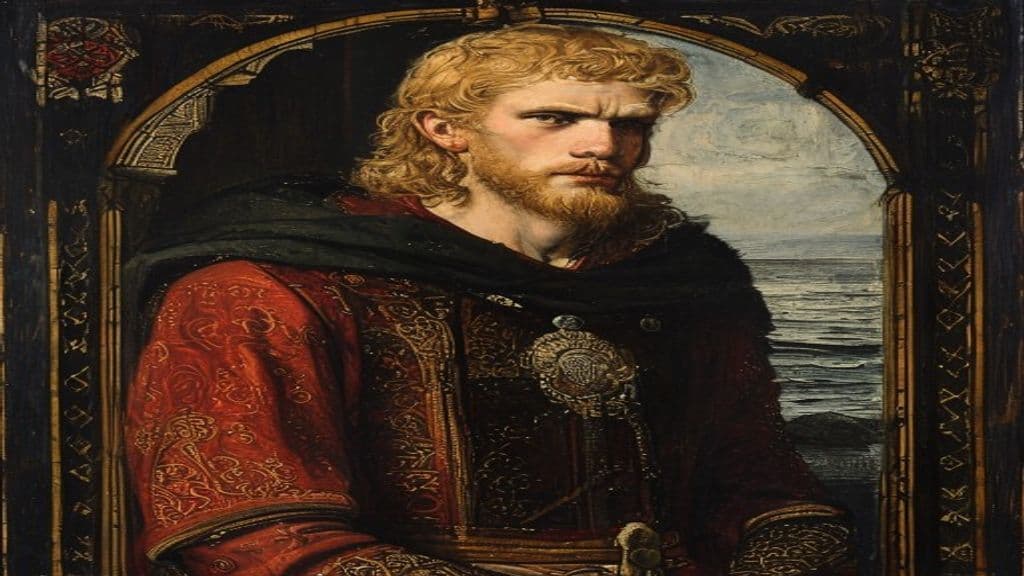
According to the chief medieval authority, Saxo Grammaticus' Gesta Danorum, Amleth is the son of Horvendill (Gervendill) and Gerutha. After Horvendill is murdered by his brother Feng, Feng marries Gerutha; the young Amleth, fearing for his life, deliberately pretends to be an imbecile to allay suspicion. Saxo recounts episodes in which Feng tests Amleth, plots against him, and sends him to Britain with attendants bearing written instructions for his death; Amleth secretly alters those wooden tablets so the British king slays the attendants and gives Amleth his daughter in marriage. He accumulates wealth abroad and ultimately returns to Denmark as part of the narrative arc of vengeance against Feng. Later medieval Icelandic and vernacular treatments preserve and adapt these motifs, and the cycle entered wider European literary transmission that influenced tales such as Havelok and, in early modern reception, Shakespeare's Hamlet.
Medieval sources concentrate on Amleth's actions and role rather than a fixed physical portrait; Saxo presents him as a young Danish prince (son of Horvendill) whose outward demeanour is that of a fool while secretly concealing cunning. The texts provide little consistent description of clothing or stature. Later cultural treatments—romantic dramas, modern films (for example The Northman), and stage portrayals—represent him visually as a Viking-age youth or warrior-prince, but these are adaptations rather than primary medieval depictions.
Amleth's 'abilities' are narrative traits and skills: deliberate feigning of madness as a strategy for survival; acute cunning and resourcefulness in anticipating and thwarting plots (e.g., responding to Feng's tests and neutralizing an eavesdropper); forgery/diplomacy in secretly altering the attendants' wooden tablets to secure marriage in Britain; the covert accumulation and concealment of wealth abroad; and the persistent motive of calculated vengeance against his uncle. These are described in Saxo's account and later summaries rather than framed as supernatural powers.
Weaknesses
- otherno documented supernatural vulnerabilities
Wards
- otherno documented wards or protective rituals against Amleth (he is a human legendary figure)
Amikuk
Amikuk is a Yup'ik / Alaskan Inuit spirit-creature associated with the ground and coastal waters; sources describe it as a shapeshifter that lives within the earth, can swim through earth and water, may take human form, and is dangerous to hunters and travelers.
Amimitl (Opochtli)
A Mexica/Aztec deity associated with fishing, hunting, and water-related technologies; identified in sources with the better-documented figure Opochtli, "The Left," who functions as a specialized patron of implements and as a representative or attendant of the rain god Tlaloc. A temple in the Tira de la Peregrinación has been interpreted by a scholar as possibly belonging to a figure labeled Amimitl, but that identification is uncertain.
Amir Arsalan-e Namdar (The Exalted Prince Arsalan)
A powerful, potentially benevolent figure in Persian mythology with magical abilities. (Note: 1. Power tier needs to be adjusted based on abilities described (as benevolent figure with magical abilities), could be Lesser or Minor Spirit instead of Greater. 2. Summary should mention specific my)
Amirani
In the Georgian tradition, Amirani is a Demiurge figure who defied God by introducing metalworking to humanity. (Note: - Power tier: Greater (not Primordial), as Amirani's abilities are more focused on introducing metalworking and defying God than cosmic-scale powers. - Weaknesses: not just "by God", but specifically )
Amisodarus (Chimera)
A composite monstrous creature from Greek myth, traditionally described as a lion with a goat's head on its back and a serpent for a tail, sometimes winged and noted for breathing fire. It is genealogically placed among the chthonic offspring of Typhon and Echidna and is best known from the heroic-age episode in which Bellerophon defeats it.
Amitābha
Amitābha is a central celestial Buddha of Mahayana Buddhism who presides over the western Pure Land called Sukhāvatī. Devotional practices invoking his 'measureless' light and life (nianfo/nembutsu) are presented in Pure Land traditions as a path by which beings may be reborn in his buddhafield and quickly attain Buddhahood.
Ammarik
Ammarik (also Ammarig, Hammarigu; later Armaruk/‘lord of Armaruk’) is an ancient Eblaite deity most likely representing a deified mountain attested in third-millennium BCE Eblaite texts and later Hurrian and Hittite sources. He appears in Eblaite offering lists and an incantation context allied with weather cults and apotropaic ritual action.
Ammit
Ammit is an ancient Egyptian funerary guardian-demon of the Duat who stands at the Hall of Two Truths during the weighing of the heart. Feared and not worshipped, she awaits the verdict and consumes hearts judged impure, thereby preventing the deceased from joining the blessed dead.
Ammon (tradition)
In the provided sources, 'Ammon' is primarily attested as the ethnonym and toponym of the ancient kingdom and people known as the Ammonites (centered on Rabbah/Rabbat Ammon, modern Amman) and as a component in later theonyms (e.g., 'Jupiter Ammon'). The corpus supplied contains etymological, geographic, biblical, and modern onomastic information but does not document 'Ammon' as a discrete folkloric spirit or supernatural being with a ritual corpus.
Ammut
Ammut is an ancient Egyptian chimeric creature associated with the Judgment of the Dead; traditionally described as a composite of lion, hippopotamus, and crocodile, she is said to consume the souls or the symbolic heart of those judged unworthy, preventing admission to the afterlife. Modern artistic and speculative retellings recast Ammut as a large scavenging semi‑aquatic animal whose corpse‑consuming habits inspired funerary beliefs.
Ammāvaru
Ammāvaru is a reverential designation for a mother-goddess figure in Hindu, especially Telugu/South Indian, contexts. In some accounts she is presented as a primordial maternal principle who preceded time and is said to have laid the egg from which Brahma, Shiva and Vishnu emerged; in practice the name functions as an honorific attached to multiple regional mother-goddess cults and temple images in Andhra Pradesh and nearby areas.
Amnisiades
The Amnisiades (Ancient Greek: Αμνισιαδες / Αμνισιδες) are a group of naiads — freshwater nymphs — associated with the Amnisos river in Crete. They are attested in Hellenistic poetry as members of Artemis's retinue and are linked by scholarship to cult activity at a cave of Eileithyia on the Amnisos.
Community Record
- [1]Amleth - Wikipedia. Wikipedia, 'Amleth' article (summary of Saxo and later traditions)wiki
- [2]Amleth (Wikidata). Wikidata entry for Amleth summarizing medieval figureother
- [3]Gesta Danorum (Saxo Grammaticus) — narrative summarized in modern sources. Summary of Saxo's account of Amleth in Internet Shakespeare Editionsliterary
- [4]Snorri Sturluson, Prose Edda (kenning references to Amlóði). Discussion in modern summaries of Snorri's use of Amlóði in kennings (Amlóða mólu)literary
- [5]Oehlenschläger, tragic dramas and later adaptations (archive). Archive of Oehlenschläger's dramatic retellings which draw on the Amleth legendliterary
- [6]Modern adaptations and reception (The Northman and commentary). Contemporary discussions of The Northman as a modern adaptation drawing on the Amleth traditionother