
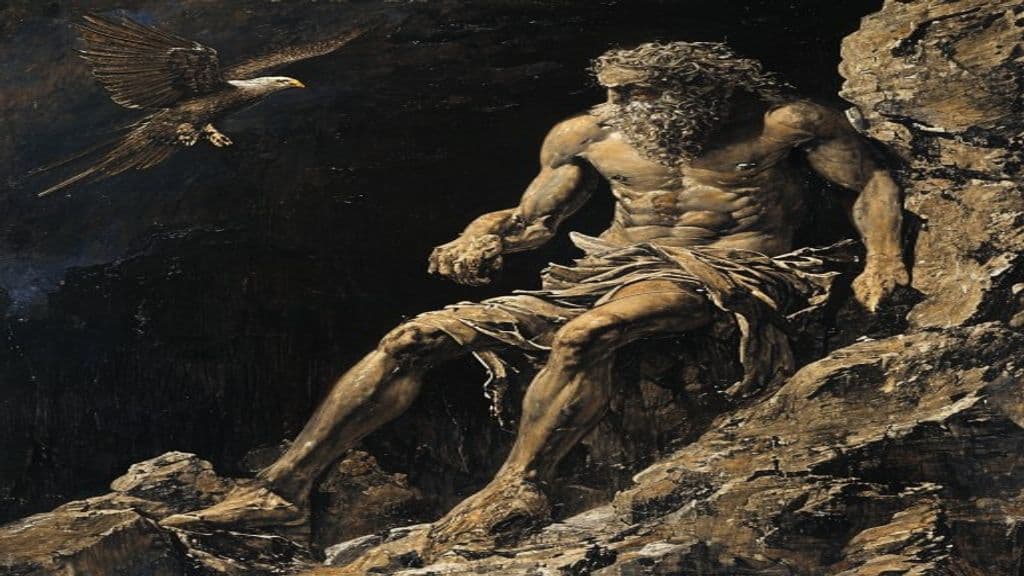
According to the Georgian tradition, Amirani is said to have introduced metalworking to humanity as a transformative act that defied God's authority.
Amirani's abilities and behaviors are primarily showcased through his defiance of God and his introduction of metalworking to humanity. His actions demonstrate a level of autonomy and independence from divine authority, suggesting that he possesses a degree of power and agency.
Weaknesses
- punishmentby God
Wards
- chainsin the Caucasus Mountains with his dog Q'ursha
Gatsi and Gaim (Georgian Deities)
Pre-Christian Georgian deities associated with the chief idol Armazi, believed to govern all mysteries. (Note: 1. Power tier should be Primordial (as they are associated with the chief idol Armazi). 2. Specific abilities mentioned in the sources include governing all mysteries, but no further specifics are pro)
Kopala
In Georgian tradition, Kopala is a hero or demigod with exceptional strength and strategic thinking, revered in the highlands of Pshavi. (Note: - Power tier: Lesser (Kopala is a demigod/hero, not Primordial) - Abilities: While Kopala's strength and strategic thinking are evident, there's no mention of Kviria's aid surpassing the ogres' throw;)
Samdzimari
A fertility and oracular goddess in the Georgian tradition, associated with beauty, prophecy, and protection. (Note: - Power tier: Primordial (given her association with fertility and oracular abilities) - Appearance: Already accurately described as a beautiful blond-haired seductress - Abilities: No new information)
Amihan
Amihan is a figure in Tagalog/Philippine tradition presented both as a bird-deity in origin narratives and as the name for the northeast monsoon season (a cool trade wind). In mythic accounts Amihan appears in the Malakas and Maganda creation story as the bird who frees or rescues the first humans from a bamboo; in cultural usage the same term denotes the recurring amihan season across the Philippines.
Amikiri
An illustrated yōkai first attested in Toriyama Sekien's Gazu Hyakki Yagyō (1776), later described in modern writings as a small creature that cuts nets, mosquito curtains, and bamboo blinds. Scholarly commentary treats it as primarily an iconographic invention or pun by Sekien rather than a well‑attested folkloric agent.
Amikuk
Amikuk is a Yup'ik / Alaskan Inuit spirit-creature associated with the ground and coastal waters; sources describe it as a shapeshifter that lives within the earth, can swim through earth and water, may take human form, and is dangerous to hunters and travelers.
Amimitl (Opochtli)
A Mexica/Aztec deity associated with fishing, hunting, and water-related technologies; identified in sources with the better-documented figure Opochtli, "The Left," who functions as a specialized patron of implements and as a representative or attendant of the rain god Tlaloc. A temple in the Tira de la Peregrinación has been interpreted by a scholar as possibly belonging to a figure labeled Amimitl, but that identification is uncertain.
Amir Arsalan-e Namdar (The Exalted Prince Arsalan)
A powerful, potentially benevolent figure in Persian mythology with magical abilities. (Note: 1. Power tier needs to be adjusted based on abilities described (as benevolent figure with magical abilities), could be Lesser or Minor Spirit instead of Greater. 2. Summary should mention specific my)
Amisodarus (Chimera)
A composite monstrous creature from Greek myth, traditionally described as a lion with a goat's head on its back and a serpent for a tail, sometimes winged and noted for breathing fire. It is genealogically placed among the chthonic offspring of Typhon and Echidna and is best known from the heroic-age episode in which Bellerophon defeats it.
Amitābha
Amitābha is a central celestial Buddha of Mahayana Buddhism who presides over the western Pure Land called Sukhāvatī. Devotional practices invoking his 'measureless' light and life (nianfo/nembutsu) are presented in Pure Land traditions as a path by which beings may be reborn in his buddhafield and quickly attain Buddhahood.
Amleth
Amleth (Old Norse: Amlóði; Latinized Amlethus) is a legendary medieval Scandinavian prince and saga-hero best known from Saxo Grammaticus' Gesta Danorum. He is a human protagonist whose story centers on feigned madness, cunning survival, exile to Britain, marriage, wealth-gathering, and eventual vengeance against his father's murderer; the tale later inspired the character of Shakespeare's Hamlet and numerous adaptations.
Ammarik
Ammarik (also Ammarig, Hammarigu; later Armaruk/‘lord of Armaruk’) is an ancient Eblaite deity most likely representing a deified mountain attested in third-millennium BCE Eblaite texts and later Hurrian and Hittite sources. He appears in Eblaite offering lists and an incantation context allied with weather cults and apotropaic ritual action.
Community Record
- [1]