Not mythological: Amor asteroids are a taxonomic grouping in modern astronomical practice, named after the exemplar 1221 Amor. They are understood to arise from dynamical processes that transfer small bodies from source reservoirs (primarily the main asteroid belt, with possible contributions from extinct cometary nuclei) into near-Earth space, where gravitational perturbations shorten their dynamical lifetimes relative to Solar System age.
Members are solid small Solar System bodies with diverse sizes, shapes, albedos, and spectral types. Observations report S-complex (silicate), M-class (metal-rich), and carbonaceous-like spectra among Amors. Individual diameters range from tens to many hundreds of meters (examples: (190491) 2000 FJ10 ~130 ± 20 m estimated; larger examples include 433 Eros and 1221 Amor). Photometry constrains rotation periods and shapes for many objects; spacecraft visit (e.g., NEAR Shoemaker at 433 Eros) provide detailed surface data.
As dynamical objects, Amors orbit the Sun with semi-major axes greater than 1 AU and perihelia outside Earth's aphelion; many cross Mars' orbit and approach the inner Solar System. Their orbits evolve under planetary perturbations and nongravitational forces, producing lifetimes of ~10^7–10^8 years before removal, so the population is continuously replenished. Some Amors may become Earth-crossing on 10^4–10^5 year timescales. They are accessible as spacecraft targets and some meet criteria for Potentially Hazardous Asteroids (PHAs) when their orbits bring them within defined thresholds of Earth's orbit and they are large enough to cause regional damage.
Weaknesses
- conditionnon-crossing perihelion (q > 1.017 AU)
- otherdynamical instability (limited lifetime without replenishment)
Wards
- ritualSpace surveillance and cataloging (Spaceguard)
- ritualDeflection/mitigation mission planning
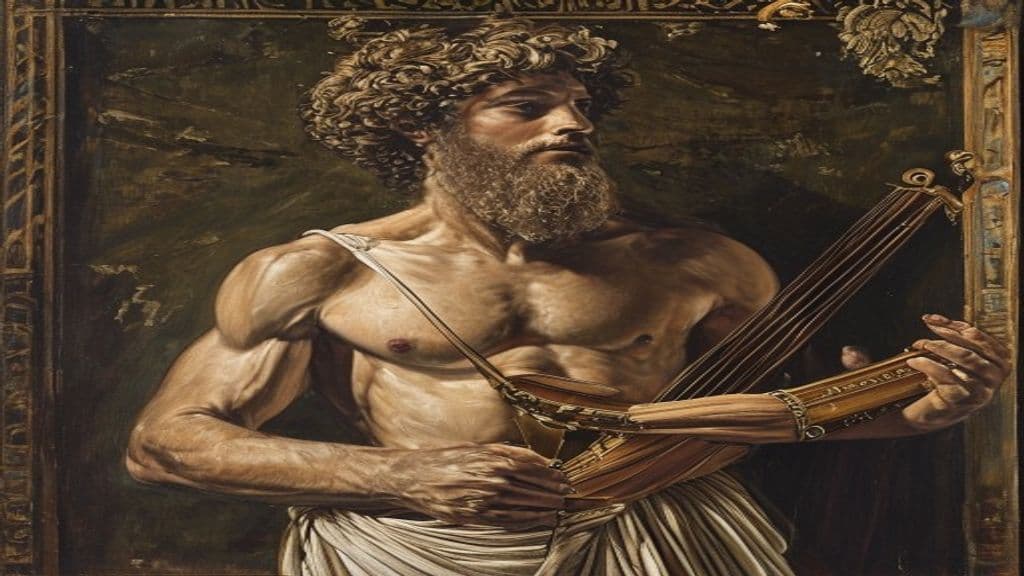
Apollo
Olympian deity of ancient Greek religion associated with prophecy, healing, music, archery, purification, and civic order. Principal patron of the Delphic oracle, protector of youth and flocks, and ambivalently both healer and bringer of plague.

Aten
Aten (Ancient Egyptian jtn, reconstructed *[ˈjaːtin]) is the visible solar disc in ancient Egyptian religion that, during the Amarna period under Akhenaten, was elevated to the central focus of state cult (Atenism). Represented as a life-giving solar orb whose rays reach the world, Aten functions as creator and sustainer in Amarna inscriptions while lacking the extensive genealogical mythology of other Egyptian gods.
Community Record
- [1]Amor asteroid — Wikipedia. Wikipedia contributors. "Amor asteroid." Wikipedia, The Free Encyclopedia.wiki
- [2]Physical and dynamical characterisation of low Delta-V NEA (190491) 2000 FJ10. Archived preprint: dynamical and physical study of (190491) 2000 FJ10.academic
- [3]Doomsday Asteroid: Can We Survive?. Cox, Paul. Doomsday Asteroid: Can We Survive? (popular treatment of planetary defense and calls for organizational responses).literary
- [4]NASA NTRS: The 1986 DA and 1986 EB: M-class asteroids in near-Earth orbits. NASA Technical Reports Server report on M-class NEAs and ground-based observations.academic
- [5]List of Amor asteroid records — Wikipedia. Wikipedia contributors. "List of Amor asteroid records."wiki