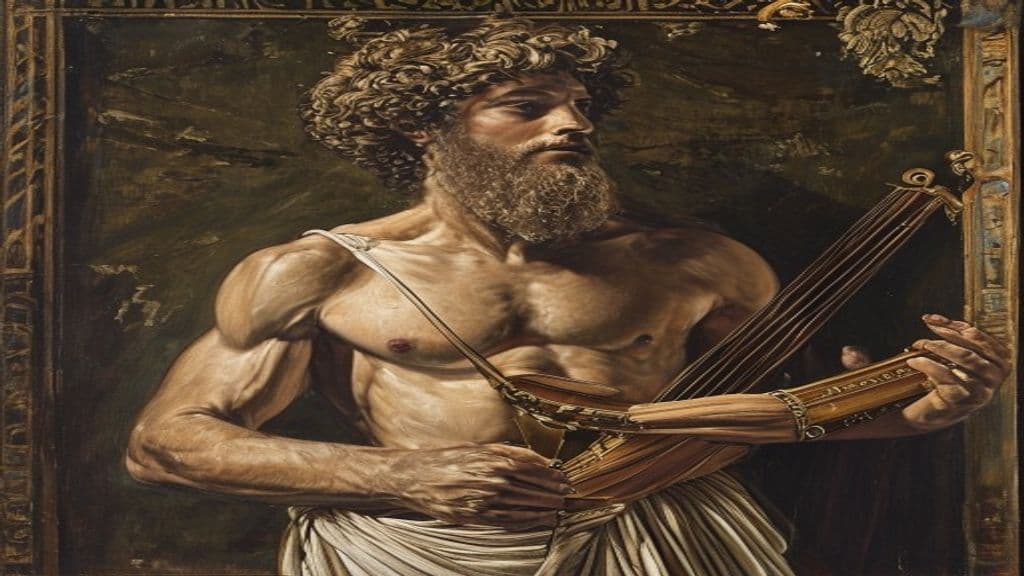
Apollo is presented in Greek myth as the son of Zeus and Leto and the twin brother of Artemis; within Greek religion he occupies an institutionalized role among the Olympian gods. He is the principal deity of Delphi (Apollo Pythios), where he functions as the oracular and purificatory god whose sanctuary and oracle are consulted for civic decisions. Apollo appears across civic, pastoral, and initiatory contexts—patron of town founding, lawgiving, and assemblies (connections attested in festivals and the Doric month Apellaios and apellaia offerings tied to youth initiation), protector of herds and streets (e.g., Apollo Agyieus), and a mediator of health both directly and through his son Asclepius. Comparative attestations (Hittite Apaliunas, Etruscan Apulu) and later identification with Helios/Sol show a long trajectory of adaptation and syncretism; the etymology of his name is uncertain and variously connected in scholarship and ancient glosses to pre-Greek forms and folk etymologies.
Apollo is iconographically represented as the ideal kouros: a beardless, athletic youth (ephebe) often shown as the most beautiful of the gods with long, uncut hair suggesting eternal youth. Common attributes in the sources include a lyre (signifying his role as god of mousikē and patron of music, poetry, and dance) and a bow and quiver of arrows (silver or golden), marking his association with archery and with sending or averting plague. In artistic and cult contexts these elements—youthful form, lyre, and bow—regularly identify him and evoke his combined cultural roles.
Apollo functions across multiple interlocking capacities in the supplied material: as an oracular and prophetic deity (patron of Delphi and the Delphic Oracle), as a deity of ritual purification, and as a god of medicine and healing (both directly and via his son Asclepius). He presides over music, song, dance, and poetry and is closely associated with the Muses, acting as their frequent companion and chorus leader in tradition. Apollo also plays protective civic and domestic roles (e.g., Alexicacus the 'averter of evil', and Agyieus protector of streets and house entrances), patronage of herdsmen and shepherds, and functions in town founding and lawgiving where oracular consultation secures civic decisions. The sources emphasize his ambivalence: he can deliver people from epidemics yet also inflict ill health and deadly plague with his arrows. From the fifth century BCE onward he is increasingly identified with solar figures (Helios/Sol) in later reception.
Weaknesses
None recorded.
Wards
- ritualinstallation of Apollo Agyieus at thresholds
- ritualinitiation offerings in apellai / apellaia (Apellaios month)

Artemis
Artemis is an ancient Greek goddess of hunting, the wilderness and wild animals, transitions (especially childbirth and puberty), vegetation, and chastity. Twin sister of Apollo and daughter of Zeus and Leto, she functions as a protector of young children and maidens while also capable of inflicting disease or punishment for transgressions against her sacred laws.

Asclepius
Asclepius is the ancient Greek divine figure and hero of medicine who personifies curing, medical expertise, and sanctuary-based therapeutic practice. Worshipped at major healing centers (notably Epidaurus), he functions as both mythic miracle-worker (including traditions of restoring life) and the patron-model for professional physicians and ritual healing procedures.
Community Record
- [1]Apollo (Wikipedia). Wikipedia contributors, 'Apollo', Wikipedia, The Free Encyclopediawiki
- [2]Apollo (Wikidata). Wikidata entry Q665812wiki
- [3]Secret Invasion (archive references). Archive item referencing modern uses of the name 'Apollo'other
- [4]951 - Safe Place for Grogu | Mandaborian on Mandalorian Chapter 16 (archive). Archive item referencing modern uses of the name 'Apollo'other
- [5]Live with CHRIS SKY (archive). Archive item referencing modern uses of the name 'Apollo'other