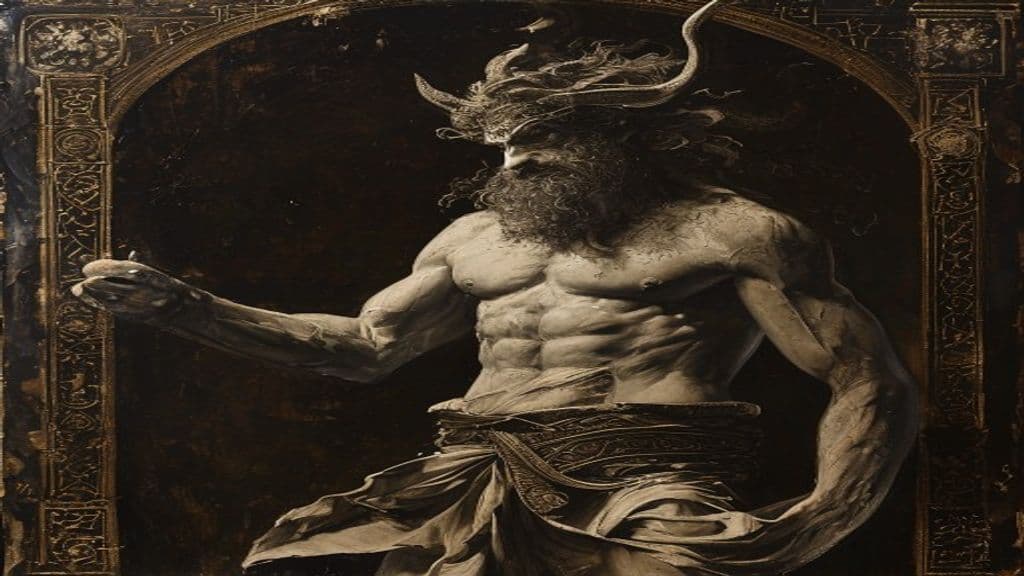
In Greek tradition, Amphiaraos is a hero and seer who is associated with the ability to foresee the future. He refused to participate in the attack on Thebes because he knew it would be disastrous.
No specific physical description of Amphiaraos is mentioned in the source material, but as a hero and seer, he is often depicted with attributes of prophecy.
Amphiaraos has the ability to foresee the future. He may transform into a chthonic hero after his chariot is swallowed by the earth or during an earthquake.
Weaknesses
- conditionfate
Wards
- siteAmphiareion of Oropos
Anius
Mortal king and priest of Apollo in Greek mythology, with significant spiritual roles. (Note: * Power tier: Lower than Primordial; considering Anius is described as a mortal king and priest, a more accurate power tier would be Greater or at least Ancient, but likely not Primordial. * Abilities)
Corona Australis
A constellation in the Southern Celestial Hemisphere associated with various cultural interpretations. (Note: 1. Power tier should be "Primordial" as Corona Australis is an astronomical object and not a deity-level entity. 2. Abilities are not mentioned in the source material; delete this section entirely. 3.)
Cult of Dionysus
A cult associated with the Greek god Dionysus, patron deity of wine, fertility, theater, and ecstasy. (Note: 1. Factual claim: The article states that Dionysus's original name 'Dionysus' (Διόνυσος) is derived from Linear B tablets as 𐀇𐀺𐀝𐀰 (di-wo-nu-so). However, the source material does not support this )
Greek Hero Cult
In ancient Greek religion, a hero (heros) is a being that occupies an intermediate plane between mortals and gods. They are venerated for their fame during life or unusual manner of death. (Note: 1. Power tier should be Primordial, as they are "more than human" and occupy an intermediate plane between mortals and gods. 2. Appearance is stated as abstract presence, not a physical description; t)
Interpretatio Graeca
Ancient Greek cultural practice of identifying foreign deities with their own gods through comparative methodology. (Note: - Remove the term "Ancient" from the power tier as it is not specified in the source that this entity has deity-level abilities. - Add to summary: "...and interpreting foreign mythologies through comp)
Interpretatio Slavica
A cultural practice among Slavic peoples to identify and equate their deities with those of neighboring cultures and Christian saints. (Note: - Power tier should be Ancient (deity-level), as it's a cultural practice rather than a supernatural being. - Sensory cues, weaknesses, and wards are not applicable to this entity, as it's an abstract)
Maschalismos (Undead Entity)
In Greek tradition, Maschalismos refers to the practice of rendering the dead unable to rise or haunt the living. (Note: - Power tier: Lesser (as it's a local, regional concept rather than a powerful deity-level entity) - Abilities: The source material doesn't support specific details about its powers; should be rephras)
Pelasgians
In Greek tradition, the Pelasgians were a collective term for indigenous people inhabiting Greece before the emergence of the Greeks. (Note: 1. Power tier should be Primordial is incorrect; given that there's no information about their abilities or behaviors, they should not have a power tier assigned. 2. Appearance should state "No physic)
Sleep Temple (Greek/Egyptian)
A mystical site in ancient Greek tradition associated with inducing sleep, influenced by Imhotep and Egyptian mysticism. (Note: 1. Power tier should be Lesser (local spirit) instead of Minor Spirit. 2. Add sensory cues and wards based on possible connection to hypnosis (e.g., drowsy atmosphere, trance-inducing melodies). 3. Cl)
Xoanon (Greek)
A wooden cult image used in Archaic Greece, often associated with deities or legendary figures. (Note: - Power tier should be Primordial (since Xoana are described as having spiritual significance and being associated with legendary figures/deities, implying they may have had more fundamental or univer)
Amphialus (Amphialos)
Amphialus (Ancient Greek: Άμφίαλος, Amphialus/Amphialos, lit. 'of two seas') is a recurring personal name in classical Greek epic, genealogical tradition, and later pastoral/romance literature. The name is applied to several distinct mortal figures — a Phaeacian athlete in the Odyssey, various seafaring companions and suitors in Homeric summaries, a son of Neoptolemus and Andromache in genealogical accounts, and a noble/warrior character in early modern Arcadian romances — rather than to a single supernatural being.
Amphiaraus
Amphiaraus is a legendary Greek seer and chthonic hero, famed as one of the Seven against Thebes. After his death—when the earth opened and swallowed him—he was venerated at the Amphiareion of Oropos as a healing and oracular figure whose sanctuary received petitioners seeking dream-delivered solutions.
Community Record
- [1]