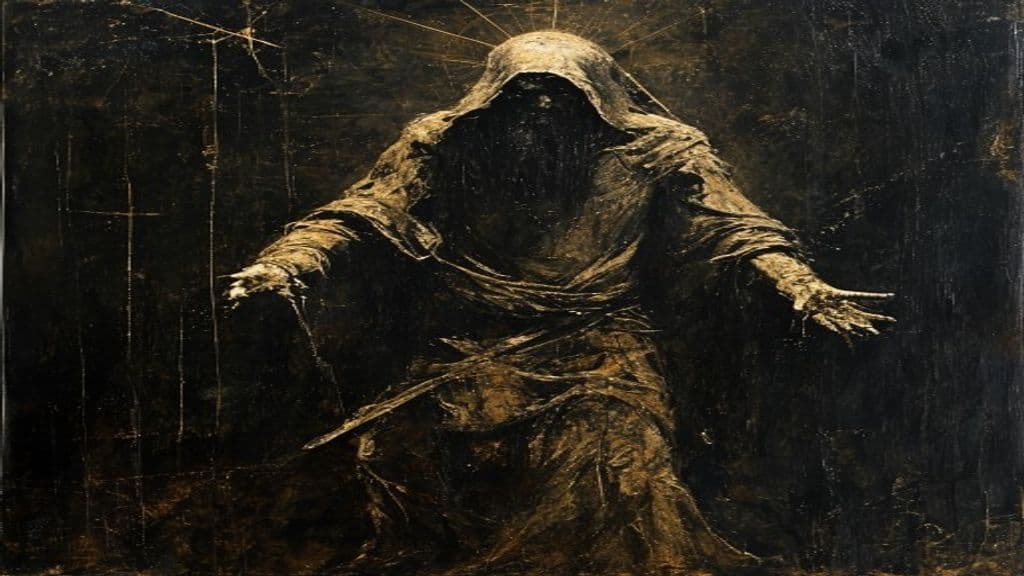
There is no physical description of Interpretatio Slavica, as it is an abstract concept rather than a supernatural being with a body.
Interpretatio slavica facilitated the integration of foreign deities into Slavic mythology, representing a way of thinking and cultural exchange among the Slavs.
Abel
Abel is the second son of Adam and Eve in the Genesis narrative, a shepherd whose accepted offering and subsequent murder by his brother Cain form the biblical account of the first death. Later interpretive traditions expand his role, treating him as an archetypal righteous victim, a postmortem avenging or adjudicating figure, and in some systems (notably Mandaean) identifying him with an angelic lightbeing.
Abraham
Abraham (originally Abram) is the foundational patriarchal ancestor in the Hebrew Bible whose life establishes a covenantal relationship between his family/people and God. He functions as an exemplar of faith, the progenitor of promised descendants, and a narrative anchor for claims of land, blessing, and communal identity in later religious traditions.
Acron (King of the Caeninenses)
Historical figure and leader of the Caeninenses, a neighboring tribe to the Romans. Rejected the proposal of intermarriage with Romulus. (Note: 1. Power tier: Acron is described as a king, but no source material indicates his abilities or powers are deity-level (Ancient) or cosmic (Primordial). Greater seems plausible. 2. Origin story: The dr)
Adam and Eve
Adam and Eve are the primordial human pair in the Abrahamic creation narratives who function as the first man and woman, placed in the Garden of Eden to steward creation. Their eating of the forbidden fruit produces a changed human condition—knowledge of good and evil, shame, pain, labor, mortality—and their story underpins later doctrines such as the Christian doctrine of original sin while being read differently across Jewish and Islamic traditions.
Alpha and Omega
A titulary formula and visual symbol formed from the first and last letters of the Greek alphabet (Α/α and Ω/ω), used in Christian scripture and art to denote God's or Christ's totality — 'the beginning and the end.' It functions as a theological appellation rather than an independent supernatural being.
Al‑Yasa (Elisha)
Al‑Yasa (Elisha) is a prophetic figure attested in Abrahamic scriptural traditions. In the Hebrew Bible he is described as an Israelite prophet and 'wonder‑worker'; later traditions in Christianity and Islam also recognize him among the line of prophets.
Amphiaraos
Greek hero and seer associated with the Amphiareion of Oropos sanctuary, known for his ability to foresee the future and connection to oracular responses and healing. (Note: 1. Power tier should be Ancient (not Primordial), as Amphiaraos is a hero and seer, but not a cosmological being. 2. Ability description: The ability to foresee the future is accurate, but the transfo)
Angel
A spiritual or heavenly being functioning primarily as a messenger and intermediary between a transcendent deity and humanity; angels also act as protectors, guides, and executors of divine will across several Abrahamic and adjacent traditions.
Angel of the Lord
A recurring divine messenger in the Hebrew Bible and New Testament who appears on behalf of the God of Israel, acting as God's representative in speech and deed. The figure—Hebrew מַלְאַךְ יְהוָה (mal’ākh YHWH)—functions as intermediary, guide, protector, judge, and announcer at decisive narrative moments.
Anius
Mortal king and priest of Apollo in Greek mythology, with significant spiritual roles. (Note: * Power tier: Lower than Primordial; considering Anius is described as a mortal king and priest, a more accurate power tier would be Greater or at least Ancient, but likely not Primordial. * Abilities)
Aram (Nahapet)
Legendary leader and patriarch in Armenian tradition who united Armenians into one state. (Note: - Power tier: Primordial (given cosmic/unifying abilities) - Summary: Expand to include "unification of Armenians" as a key aspect of his leadership - Abilities: More specific and detailed description)
Arevakhach’
The Armenian eternity sign is an ancient national symbol representing the Armenians' spiritual and celestial connection. It appears as a geometric figure on khachkars and church walls, embodying the significance of faith and symbolism in Armenian tradition. (Note: - Power tier: Primordial (as it's described as an "ancient" national symbol, but there's no indication that it's deity-level) - Appearance: Not enough detail is provided; the source material only ment)
Community Record
- [1]