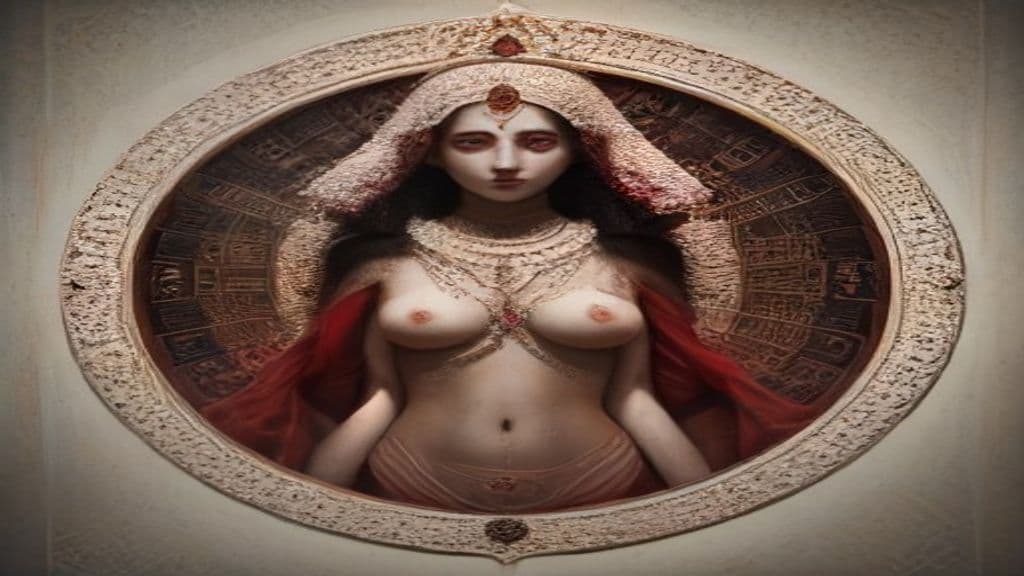
Primary scholarly summaries locate Anath within the Amorite cultural milieu of Bronze Age upper Mesopotamia and report her prominence in the religious texts of Ugarit. The academic consensus presented in the source material treats the Mari-era goddess Ḫanat—attested in Mari texts and worshiped in a city bearing her name in Suhum—as a historical antecedent to the Anat/Anath figure. These lines of transmission indicate that a martial and hunting female divine figure emerged in Amorite-speaking contexts and became incorporated into the Ugaritic pantheon, where she is best known from extant texts. (Source: Wikipedia summary of Anat/Anath.)
The provided sources do not include descriptions of Anath's physical appearance or iconography. No anthropomorphic details, garments, attributes, or artistic depictions are recorded in the cited material; therefore the sources supply no reliable information about how Anath was represented visually in ancient art or texts. Any reconstructions of her appearance are not supported by the excerpts provided. (Source: Wikipedia summary; absence noted in research notes.)
According to the sourced summary, Anath's primary functional associations are with warfare and hunting. Within the Ugaritic textual corpus she is identified culturally as a goddess connected to martial activity and the chase, suggesting roles that encompass combat, prowess, and pursuits associated with hunting. Beyond these broad domains the supplied material does not enumerate specific supernatural powers, ritual acts, myths, or interactions with humans or other deities. (Source: Wikipedia summary of Anat/Anath.)
Arsay
Arsay is a goddess attested in the late Bronze Age Ugaritic corpus. She appears as one of the daughters of the storm god Baal in the Baal Cycle and is known from a small number of offering-list and god-list documents; interpretations of her function range between associations with the underworld and with subterranean or meteorological waters, but the textual evidence is ambiguous.
El
El (ʼEl, ʾil, ʾilu) is a Northwest Semitic term meaning 'god' that also functions as the proper name and title of a senior, patriarchal deity in Canaanite/Ugaritic and related West Semitic traditions. He is portrayed in surviving texts as the father of the gods, presiding over a divine council, a progenitor of major deities and humankind, and a figure whose attributes were later conflated with those of Yahweh in Israelite religion according to scholarly reconstructions.
Ilib
Ilib (Ugaritic ‘l’b) is an ambivalent ancient Ugaritic term attested as both a primordial ancestral theogonic figure placed before El in ritual lists and as a generic designation for household ancestor-spirits honored by families. Evidence for Ilib is primarily ritual and onomastic: the name occurs early in offering lists, in temple sacrificial contexts, and in literary instruction about filial memorials.
Anapus
Anapus (Ancient Greek: Ἄναπος) is the personification and divine presence of a river called Anapus/Anapo in Greek tradition. Best attested in eastern Sicily where Syracusans worshiped him and depicted him as a young man, the name also appears for a separate river in ancient Acarnania.
Anarky
Anarky is a fictional anti‑hero and recurring adversary in DC Comics' Batman mythos, created as a politically driven vigilante figure who embodies and critiques anarchist and anti‑statist ideas. Introduced in Detective Comics #608 (November 1989), the character functions as a vehicle for political and philosophical themes rather than a supernatural being.
Anastasia of Sirmium
A Christian martyr venerated in Eastern and Western traditions, traditionally said to have died during the Diocletian persecutions and remembered as a specialist intercessor against poisons and harmful potions (Pharmakolytria). Her cult entered central liturgical usage in Rome and spread to Constantinople, where relic translations and church dedications reinforced her role as healer and deliverer.
Anasuya (Hindu tradition)
In Hinduism, Anasuya is a type of ascetic and the wife of Sage Atri. She possesses 'miraculous powers' due to her spiritual practices and ascetic lifestyle. (Note: 1. Power tier: Primordial seems too high; according to source material, Anasuya's 'miraculous powers' are not specified and her description suggests a more subtle or internal quality rather than cosmi)
Anat
Anat is a Bronze Age Levantine goddess best known from Ugaritic texts, associated primarily with warfare and hunting. She is a major divine figure in the Ugaritic pantheon who regularly received offerings, appears as an active agent in mythic narratives (notably the Baal Cycle), and was attested across the Levant, into Egypt, Cyprus, Hurrian ritual contexts, and later in Suhum.
Anatole
Anatole is attested in the provided sources as a French masculine given name applied to various real and fictional individuals (e.g., Anatole France, Anatole the mouse, a 19th-century dancer, Alex Anatole). The supplied materials do not present Anatole as a supernatural being or part of a mythological cosmology.
Anatoli Knyazev (KGBeast)
Anatoli Knyazev, commonly known by the alias KGBeast, is a fictional supervillain created for American comic books published by DC Comics. Created by Jim Starlin and Jim Aparo, he first appears as an adversary of Batman and figures in the publisher's shared superhero universe and its adaptations.
Anaxarete
Anaxarete is a mythic mortal woman in Greco-Roman tradition who, according to Ovid's Metamorphoses, scorned a suitor named Iphis and was transformed by Aphrodite into a stone statue preserved at Salamis. Her story is cited as an exemplum of divine punishment for cruel disregard of love and belongs to the broader corpus of metamorphosis myths.
Anaxibia
Anaxibia (Ancient Greek: Ἀναξίβια) is a personal name used for multiple distinct figures in Classical Greek mythic genealogies — chiefly mortal women who serve as wives and mothers in heroic-age lineages, and in one attestation a naiad associated with a river. The name also appears in modern biological nomenclature as a reused classical label.
Community Record
- [1]Anat (Wikipedia). Wikipedia contributors. "Anat." Wikipedia, The Free Encyclopedia. https://en.wikipedia.org/wiki/Anatwiki
- [2]Anathallis (Wikidata entry, unrelated plant genus). Wikidata. Q20952 (Anathallis). http://www.wikidata.org/entity/Q20952other
- [3]MAHATMA GANDHIR KARAKAHINI মহাত্মা গান্ধীর কারাকাহিনী (archive bibliographic record, unrelated). Archive.org bibliographic record. MAHATMA GANDHIR KARAKAHINI. https://archive.org/details/dli.bengal.10689.15533other
- [4]SHUNO BARONARI শুন বরনারী (archive bibliographic record, unrelated). Archive.org bibliographic record. SHUNO BARONARI. https://archive.org/details/dli.bengal.10689.21638other