
The entity is not presented in the supplied sources as a mythic origin-being but as a biological and cultural exemplar: a locally prevailing ovicaprine form present in ancient southern Egypt and Nubia that was commonly domesticated and routinely depicted on early pharaonic tomb reliefs. Because its distinctive horn morphology became visually associated with certain gods, the animal’s head-attributes were incorporated into divine representation; the horn form continued to be used in depictions of ram-headed deities even after the actual sheep disappeared from the archaeological and textual record by the end of the Middle Kingdom (c. 1782 BC).
Described in the sources as a type of extinct wild Barbary sheep (ovicaprine) notable for unique, loosely spiraling horns that emerged laterally from the skull — a morphology summarized by the descriptive English label "corkscrew-horned." Sources also note a related form, Ovis platyura aegyptiaca, with horns that developed downward and curled forward. Beyond horn shape, the animal is treated as a typical caprine in body form and in some contexts appears as a commonly domesticated sheep in early pharaonic funerary reliefs.
The sources do not ascribe supernatural powers or agency to the animal. Instead, the taxon’s cultural "ability" lies in its influence on visual religion: its horn form was adopted as the head-attribute for ram-headed deities such as Khnum and Banebdjedet. This is an iconographic and symbolic influence documented in scholarly accounts rather than a description of any literal, active power possessed by the animal.
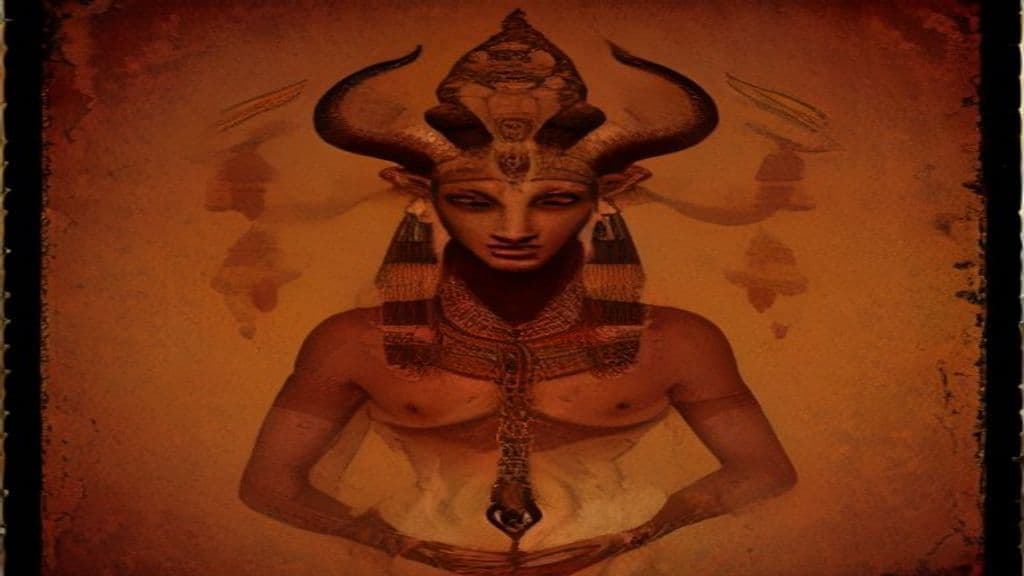
Khnum
Khnum is an ancient Egyptian deity associated with the Nile cataract(s), the regulation of the annual inundation, and the crafting of human bodies and life‑force using a potter's‑wheel metaphor. He was principally worshipped at Elephantine and Esna from the Early Dynastic period into the Greco‑Roman era and was integrated into local temple triads and wider syncretic identities (e.g., Khnum‑Ra).

Banebdjedet
An ancient Egyptian ram deity worshipped at Mendes (Djedet), understood as the local 'Ba' or soul‑manifestation tied to fertility, virility, and aspects of rulership; depicted commonly as a ram or ram‑headed man and sometimes as a four‑headed ram representing multiple Bas of the sun god.
Aani
Aani (ancient Egyptian jꜥnr) is the lexical term for the baboon in ancient Egyptian language and functions in religious contexts as an animal icon and theophoric epithet. Attested repeatedly in Egyptian texts and images, the baboon image is used to represent or denote aspects of gods such as Thoth, Hapy, Khonsu, and Osiris rather than implying the animal itself is an independent deity.
Aker
Aker is an ancient Egyptian personification of the horizon and an earth and underworld deity who is described in surviving summaries as guardian of the eastern (Bakhu) and western (Manu) horizons, marking liminal boundaries between day and night and between the living world and the netherworld.
Akhty
Akhty (also read Netjer-akhty) is an ancient Egyptian deity identified with the northern bald ibis and linked to the akh (the transfigured, luminous human spirit). Attested from early 2nd dynasty inscriptions and in Old Kingdom personal names and priestly titles, Akhty was associated with the evening horizon and believed to guide the setting sun and carry the deceased's spirit into the night sky.
Amaunet (Amunet)
Amaunet (also spelled Amunet, Amonet) is a primordial female deity of ancient Egyptian religion, attested from early religious texts and represented as the feminine counterpart and consort of the god Amun. She is presented in sources as a pre-creation or primeval principle associated with hiddenness; Thebes is recorded as a principal center of her cult into the late dynastic and Ptolemaic periods.
Amenhotep, son of Hapu
Amenhotep, son of Hapu was a historically attested 18th‑Dynasty official who was posthumously venerated and integrated into Egyptian temple cult as a deified, local healing intercessor. His cult appears in Thebes and resurges in the Ptolemaic period, represented in votive reliefs, chapels, and statues.
Ammit
Ammit is an ancient Egyptian funerary guardian-demon of the Duat who stands at the Hall of Two Truths during the weighing of the heart. Feared and not worshipped, she awaits the verdict and consumes hearts judged impure, thereby preventing the deceased from joining the blessed dead.
Ammut
Ammut is an ancient Egyptian chimeric creature associated with the Judgment of the Dead; traditionally described as a composite of lion, hippopotamus, and crocodile, she is said to consume the souls or the symbolic heart of those judged unworthy, preventing admission to the afterlife. Modern artistic and speculative retellings recast Ammut as a large scavenging semi‑aquatic animal whose corpse‑consuming habits inspired funerary beliefs.
Amset (Imsety)
Amset (Egyptian Imsety) is one of the four sons of Horus in ancient Egyptian mortuary religion, a named funerary guardian commonly associated with protection of the liver and represented as the human-headed canopic-jar lid in mummification and afterlife iconography.
Amun
Amun is a major ancient Egyptian deity whose name (imn) means 'the hidden one.' Originating as a local Theban tutelary god, he rose to national prominence and was syncretized with the sun‑god Ra (Amun‑Ra), becoming a transcendent, self‑created creator and king of the gods closely tied to royal legitimation and personal petitionary religion.
Amun-Re
Amun-Re is a major ancient Egyptian state deity formed by syncretism of Amun with the sun-god Re. Attested from the Old Kingdom and rising to prominence as the patron god of Thebes by the 11th Dynasty, Amun-Re is closely tied to pharaonic kingship, temple cult, and oracular activity (notably at Siwa).
Amunet
Amunet (jmnt) is a primordial Egyptian goddess originally one of the female members of the Ogdoad of Hermopolis whose name means ‘The Hidden One.’ In later Theban religion she became a localized consort and cult companion of Amun, serving protective and liturgical roles in royal coronation, Sed festivals, temple liturgies, and funerary invocations.
Ancient Egyptian deities (nṯr / nṯrt)
In ancient Egyptian religion the beings called nṯr (masculine) and nṯrt (feminine) encompass a wide, fluid range of gods and divine figures — from state-level creators like Ra and Amun to local personifications, animal-headed figures, and certain deceased humans elevated by ritual. Deities embody natural forces, maintain cosmic order (maat), and are engaged through temple cults and ritual performance.
Community Record
- [1]Ancient Egyptian corkscrew-horned sheep (Wikipedia). Wikipedia, "Ancient Egyptian corkscrew-horned sheep"wiki
- [2]Wikidata entry for Ancient Egyptian corkscrew-horned sheep. Wikidata Q7114179 summaryother
- [3]Barbary sheep (Wikipedia). Wikipedia, "Barbary sheep"wiki
- [4]Khnum (iconography notes). Khnum | Public Domain Super Heroes | Fandom (iconographic summary noting original horizontally spiraled horns)other