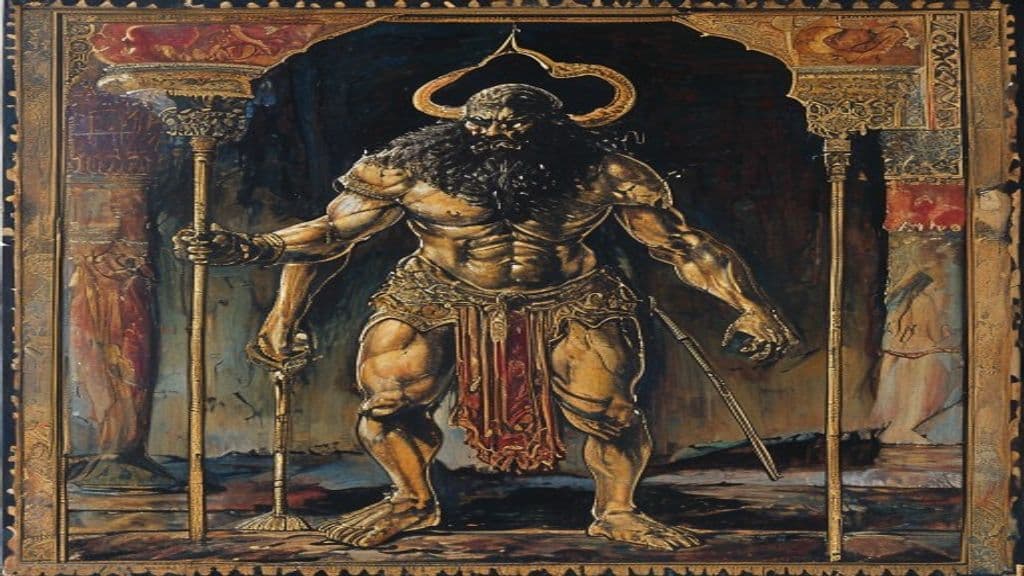
Accounts vary across sources. Later Persian tradition and medieval compilers present the divs as an ancient class of beings distinct from humans: Abu Ali Bal'ami's rendition of Tarikh al-Tabari is cited as saying divs were created before humans and jinn. Another medieval source (the Süleymanname) states that God created divs from the "fires of the stars, wind, and smoke," some with wings or exceptional speed; angels later fought and greatly reduced their numbers. Historically and conceptually the div are also described as a monotheistic reinterpretation or demonization of the Indo‑Iranian devas (deva → daeva → div), a process by which formerly divine or semi‑divine figures became classified as hostile or monstrous in Persian religious memory. In Islamicized contexts authors often equated divs with ʿifrīt and shayāṭīn, folding them into broader categories of evil spirits subject to God's final judgement.
Epic and folkloric sources give a variable but recurring physical profile. Typical descriptions render divs as humanlike in form but of gigantic size, frequently depicted with two horns on their heads and teeth compared to the tusks of a boar. Individual divs in the Shahnameh appear with variant attributes (e.g., named figures such as a "White Div" or a "Div King"), and armament ranges from primitive stones to full warrior's armour and metal weapons. Some medieval accounts (Süleymanname) attribute wings or extreme speed to certain divs. Narrative episodes also record shapeshifting or transformation motifs (for example, a Div King briefly taking the form of stone when captured).
Across the materials divs combine prodigious physical strength and martial capacity with magical faculties. They are portrayed as powerful and cruel, often preying upon humans and presenting a "relish for the taste of human flesh" in epic imagery. Many are described as masters of sorcery, able to afflict enemies with nightmares or magical assaults and to employ enchantment in combat. Their mobility may include flying or rapid movement in specific accounts. Behaviorally they are adversarial toward human communities and heroes (Shahnameh episodes cast them as principal antagonists whose harassment of peoples demands heroic response). Narrative motifs show they can be killed, bound, or executed by human heroes or royal authority, and in cosmological accounts angels or divine agents were able to slay many of them.
Weaknesses
- conditionvulnerable to heroic/martial defeat (slain in combat)
- otherparts/organs may have curative or ritual efficacy (narrative instance: Div's liver blood used to cure a king)
Wards
- ritualheroic combat / slaying
Aghrirat
Aghrirat is a named Turanian noble and peacemaker in the Shahnameh and Iranian mythic tradition, presented as a son of Pashang and brother of Afrasiab and Garsivaz. He is notable for his kind and gentle character and for attempting, largely unsuccessfully, to end the hostilities between Iran and Turan.
Akvan Div
Akvan Div is a named div (دیو) from the Persian epic Shahnameh who confronts the hero Rostam during the era of Kay Khosrow. In the tale Akvan appears among onager herds, can vanish or assume forms such as a brilliant onager, wind, or storm, and is ultimately snared with a lasso and beheaded by Rostam.
Andariman
Andariman is a named antagonist in the Shahnameh cycle of Greater Iran, depicted in manuscript illustrations and genealogical lists as an enemy combatant—described in a manuscript caption as "one of the Turkman host"—who fights the Iranian hero Gorgin (Gurgin) and is shown slain in illustrated episodes.
Arjasp
Arjasp (Arjāsp) is a legendary Iranian antagonist attested in the Avesta, Middle Persian literature, and the epic Shahnameh. In earlier Zoroastrian hymns he appears as leader of the hostile Xyaona tribe opposed to Vishtaspa/Goshtasp's adoption of Zoroastrianism; in later Pahlavi and epic tradition he is historicized as a Turanian king and military rival who besieges Iranian strongholds and is slain by the hero Esfandiyar.
Arzhang Div
Arzhang Div (Aržang Dēw; ارژنگ دیو) is presented in Shahnameh manuscript tradition as the chief or commander of the divs of mythic Mazandaran and an antagonist defeated by the hero Rustam during the episode commonly called Rustam's Sixth Feat (part of the Seven Labours). His defeat is treated by commentators as emblematic of the collapse of a demonic ruling order in the epic.
Bârmân (بارمان)
Bârmân is a Turanian hero and commander in Ferdowsi’s Shahnameh who fights in the Great War of Iran and Turan during the reign of Nowzar. In the epic he kills the Iranian Qobád and is later slain by the Iranian warrior Qaran; he is represented in Safavid illustrated Shahnameh folios as a recognizable martial figure.
Esfandiyār
Esfandiyār is a legendary human prince and warrior in the Iranian epic tradition (the Shahnameh). Presented as a Kayanian crown prince and a divinely supported champion who aids the cause of Zarathustra, his career includes seven labors, receipt of heavenly armor and a binding chain, and a fatal duel with the hero Rostam that functions as a moral and providential pivot in the epic.
Eskandar (Alexander the Great) — Shahnameh tradition
In Ferdowsi’s Shahnameh Eskandar (Sikandar/Alexander) is a legendary royal-hero integrated into the Iranian royal sequence: a world-conquering monarch who also undertakes spiritual journeys and erects a barrier against apocalyptic forces. The episodes function as a narrative and cosmological bridge from the poem’s mythic Kayanian age to a more historical time-frame.
Farangis
Farangis is a human literary character in the Persian epic the Shahnameh: the eldest daughter of Afrasiab of Turan, the second and favourite wife of the Iranian prince Siyâvash, and the mother of the hero and later king Kai Khosrow. Her role in the epic is genealogical and political, marked by loyalty, mourning, and participation in dynastic succession.
Farud
Farud (also Firoud, Forud) is a human princely figure in the Persian epic Shahnameh, presented as the son of Siavash and ruler of Kelat. His encounter with the army of his brother Kai Khosrow—marked by misrecognition, restrained tactics, and tragic wounding—functions as a moral episode about kinship, counsel, and the ethics of warfare.
Garsivaz
Garsivaz is a human courtier in the Persian epic tradition, presented in Ferdowsi's Shahnameh as a brother of Afrasiab of Turan whose counsel leads to the killing of Siyâvash; later illustrated manuscript traditions expand his role in reception to include capture and disclosure of Afrasiab's location.
Giv (Gev)
Giv (Persian: گیو), also rendered Gev, is a legendary Iranian knight and one of the main human heroes in the New Persian epic Shahnameh. He is presented as a noble paladin of the House of Goudarz, father of Bizhan, brother of Roham, and a loyal companion of kings such as Key Khosrow.
Community Record
- [1]Div (mythology) - Wikipedia. "Div or dev are monstrous creatures of Middle Eastern lore and probably of Persian origin." (Wikipedia: Div (mythology))wiki
- [2]Rustam's seventh course: He kills the White Div, folio 124 from a Shah-nama (Book of Kings) of Firdausi. Cleveland Museum of Art caption: "The legendary hero Rustam brutally takes the demon chief’s liver blood, needed to cure his king of blindness."literary
- [3]Div-e Sepid - Wikipedia. "In the Persian epic of Shahnameh Div-e Sepid (Persian: دیو سپید , lit. White Div), is the chieftain of the Divs (demons) of Mazandaran. He is a huge being. He possesses great physical strength and is skilled in sorcery and necromancy. He destroys the army." (Div-e Sepid article)wiki
- [4]Rostam’s Fight with the White Dīv in the Context of the Primeval Myth of the 'Rain Shaman' (Persica Antiqua article). Scholarly article discussing Shahnameh episode and interpretive contexts (cited in research notes).academic
- [5]Pre‑Zoroastrian Aryan Religions & Religious Wars (Heritage Institute). Comparative‑religious context describing transformations of Indo‑Iranian religious figures; cited in research notes on devas → div reinterpretation.other
- [6]Wikidata entry: div (mythology). Wikidata Q1157107other
- [7]Folio 124r: Rustam Finds and Kills the White Div (Shahnameh manuscript). Shahnameh folio 124r (archive caption)literary
- [8]Folio 127v: Rustam Brings the Div King to Kay Kavus for Execution (Shahnameh manuscript). Shahnameh folio 127v (archive caption)literary
- [9]The Safavids - Epic Music (archive page linked in research notes). Archive catalogue entry referenced in supplied materialsother