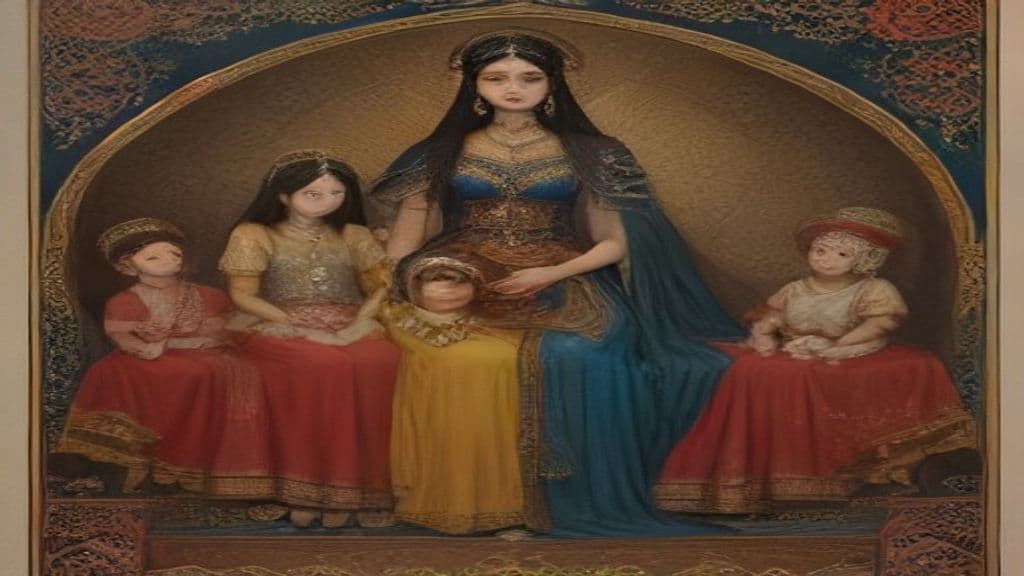
Farangis is introduced in the Shahnameh as the eldest daughter of Afrasiab, king of Turan. By marriage she becomes the second and favourite wife of Siyâvash, a prince of Iran. Her narrative arc in the epic is bound up with Siyâvash’s murder, the raising of their son Kai Khosrow, and the subsequent political and military actions taken to avenge Siyâvash and restore dynastic continuity. The provided sources frame her origin and identity in terms of her familial and political positions within Shahnameh’s opposed polities of Turan and Iran.
Traditional presentations of Farangis in the supplied sources emphasize her familial relationships, social rank, and actions rather than offering a concrete physical description. The Shahnameh-focused materials and encyclopedic summaries highlight her role as a noblewoman, wife, and mother; extant excerpts do not detail her bodily features, dress, or visual particulars, placing narrative weight on her loyalties and decisions.
Farangis possesses no supernatural powers in the cited materials; her significance is social and narrative. Notable behaviors recorded in the sources include sustained loyalty to her husband's kingdom despite her Turanian birth, a year-long mourning for Siyâvash after his murder, accompanying her son Kai Khosrow when he departs Turan to gather an Iranian army to avenge Siyâvash, and participating in courtly succession processes in which Fariborz is presented as a suitable husband and Rostam aids Fariborz in bringing Farangis to his seraglio. Her agency is expressed through mourning, familial allegiance, and movement within the epic’s political sphere.

Aghrirat
Aghrirat is a named Turanian noble and peacemaker in the Shahnameh and Iranian mythic tradition, presented as a son of Pashang and brother of Afrasiab and Garsivaz. He is notable for his kind and gentle character and for attempting, largely unsuccessfully, to end the hostilities between Iran and Turan.
Akvan Div
Akvan Div is a named div (دیو) from the Persian epic Shahnameh who confronts the hero Rostam during the era of Kay Khosrow. In the tale Akvan appears among onager herds, can vanish or assume forms such as a brilliant onager, wind, or storm, and is ultimately snared with a lasso and beheaded by Rostam.
Andariman
Andariman is a named antagonist in the Shahnameh cycle of Greater Iran, depicted in manuscript illustrations and genealogical lists as an enemy combatant—described in a manuscript caption as "one of the Turkman host"—who fights the Iranian hero Gorgin (Gurgin) and is shown slain in illustrated episodes.
Arjasp
Arjasp (Arjāsp) is a legendary Iranian antagonist attested in the Avesta, Middle Persian literature, and the epic Shahnameh. In earlier Zoroastrian hymns he appears as leader of the hostile Xyaona tribe opposed to Vishtaspa/Goshtasp's adoption of Zoroastrianism; in later Pahlavi and epic tradition he is historicized as a Turanian king and military rival who besieges Iranian strongholds and is slain by the hero Esfandiyar.
Arzhang Div
Arzhang Div (Aržang Dēw; ارژنگ دیو) is presented in Shahnameh manuscript tradition as the chief or commander of the divs of mythic Mazandaran and an antagonist defeated by the hero Rustam during the episode commonly called Rustam's Sixth Feat (part of the Seven Labours). His defeat is treated by commentators as emblematic of the collapse of a demonic ruling order in the epic.
Bârmân (بارمان)
Bârmân is a Turanian hero and commander in Ferdowsi’s Shahnameh who fights in the Great War of Iran and Turan during the reign of Nowzar. In the epic he kills the Iranian Qobád and is later slain by the Iranian warrior Qaran; he is represented in Safavid illustrated Shahnameh folios as a recognizable martial figure.
Div (Dīv)
Div (Persian: دیو dēw / dīv) are monstrous, often sorcerous antagonists in Persian epic and folkloric tradition, best known from the Shahnameh where they oppose heroes such as Rustam. Scholarly sources trace their cultural history to a re‑interpretation and demonization of older Indo‑Iranian divine figures (devas).
Esfandiyār
Esfandiyār is a legendary human prince and warrior in the Iranian epic tradition (the Shahnameh). Presented as a Kayanian crown prince and a divinely supported champion who aids the cause of Zarathustra, his career includes seven labors, receipt of heavenly armor and a binding chain, and a fatal duel with the hero Rostam that functions as a moral and providential pivot in the epic.
Eskandar (Alexander the Great) — Shahnameh tradition
In Ferdowsi’s Shahnameh Eskandar (Sikandar/Alexander) is a legendary royal-hero integrated into the Iranian royal sequence: a world-conquering monarch who also undertakes spiritual journeys and erects a barrier against apocalyptic forces. The episodes function as a narrative and cosmological bridge from the poem’s mythic Kayanian age to a more historical time-frame.
Farud
Farud (also Firoud, Forud) is a human princely figure in the Persian epic Shahnameh, presented as the son of Siavash and ruler of Kelat. His encounter with the army of his brother Kai Khosrow—marked by misrecognition, restrained tactics, and tragic wounding—functions as a moral episode about kinship, counsel, and the ethics of warfare.
Garsivaz
Garsivaz is a human courtier in the Persian epic tradition, presented in Ferdowsi's Shahnameh as a brother of Afrasiab of Turan whose counsel leads to the killing of Siyâvash; later illustrated manuscript traditions expand his role in reception to include capture and disclosure of Afrasiab's location.
Giv (Gev)
Giv (Persian: گیو), also rendered Gev, is a legendary Iranian knight and one of the main human heroes in the New Persian epic Shahnameh. He is presented as a noble paladin of the House of Goudarz, father of Bizhan, brother of Roham, and a loyal companion of kings such as Key Khosrow.
Community Record
- [1]Farangis. Wikipedia: Farangiswiki
- [2]Wikidata: Farangis. Wikidata entry Q85973484 for Farangisother
- [3]Ferdowsi Shahnameh Characters. Heritage Institute — Shahnameh Charactersliterary
- [4]Archive item (name occurrences and related materials). Archive.org item referencing the name Farangis (contextual/bibliographic)other