
Atlas is a member of the Titan generation, son of the Titan Iapetus and an Oceanid (named in various traditions as Asia or Clymene), and brother to Prometheus, Epimetheus and Menoetius. After the Titanomachy— the cosmic war between the Titans and the Olympian gods—Zeus punished Atlas by consigning him to stand at the ends of the earth in the extreme west and support the heavens upon his shoulders for eternity. Over time his figure is doubled with place-names and other legendary figures: his daughters include groups tied to celestial and geographic features (the Hesperides, the Hyades, the Pleiades) and the nymph Calypso; later traditions identify him with the Atlas Mountains and other eponymous kings named Atlas (including a legendary king figure in later accounts), so that the name functions both as a personal mythic actor and as an etiological name for landscape and genealogical networks.
Classical literary and visual sources portray Atlas as a gigantic figure bearing a representation of the heavens — commonly a celestial sphere — on his shoulders. Sculptural exemplars (e.g., the Farnese Atlas tradition) depict him supporting a marble celestial globe, and literary accounts stress that the burden is the sky rather than the terrestrial globe. In Ovid’s formulation of the Perseus episode, Atlas is represented in a metamorphic, etiological mode: Perseus turns him to stone and Ovid poetically describes the transformation as the formation of a mountain range — "Atlas's head the peak, his shoulders ridges and his hair woods" — so that in some narratives Atlas literally becomes the Atlas Mountains.
Atlas' defining capacity is superhuman endurance: as his eternal punishment he supports the heavens and thereby sustains cosmic order. Classical and later sources additionally ascribe to him technical and intellectual skill — particularly in astronomy, mathematics and philosophy — and credit him in antiquity with inventing the first celestial sphere and with founding or exemplifying astronomical knowledge. In narrative episodes his capacities interact with heroes: he negotiates with Heracles over the retrieval of the Hesperides' golden apples (agreeing to relinquish the sky temporarily) and is in some accounts vulnerable to Perseus' use of Medusa's head, which petrifies him in etiological variants. Modern numeric strength-attributions are later extrapolations and are not attested in the classical sources summarized here.
Weaknesses
- othernarrative susceptibility to Medusa's head (Perseus’ petrification) — attested in Ovid/Poetic accounts as a story event, not a ritual vulnerability
- othersusceptibility to trickery/negotiation as shown in the Heracles episode (Heracles temporarily relieves Atlas and uses deception to recover the apples)
Wards
- otherNo classical wards attested — sources supply no communal apotropaic rites, amulets or prayers directed at Atlas; narrative responses are hero action (trickery, magical weapon) rather than ritual protections
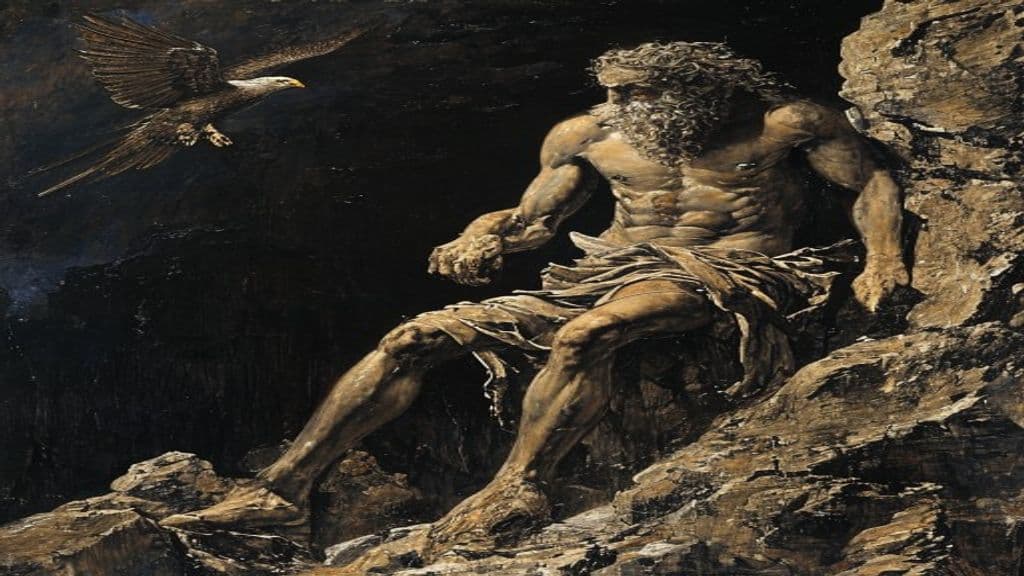
Prometheus
Prometheus is a Titan of ancient Greek myth credited as a benefactor and culture-bringer to humanity, most famously for stealing fire from the Olympian gods and giving it to people. He is portrayed as intelligent and forward-looking (etymologically associated with 'forethought'), and as punished by Zeus for his transgression.

Pleiades
The Pleiades is an asterism — the open star cluster Messier 45 — visible as a compact group of bright stars and, in many cultures, personified as a set of mythic figures (notably the Seven Sisters in Greek myth). It functions both as a concrete astronomical object and as a widespread cultural calendrical and mythic motif used to mark seasons, navigation, and genealogies.
Acacallis
Acacallis (Ancient Greek: Ἀκακαλλίς; also Acalle) is a mythological princess of Crete in Greek tradition, daughter of King Minos and Pasiphae. She functions primarily as a dynastic and etiological figure: in varying accounts she is mother, by gods such as Hermes (Mercury) or Apollo, of eponymous or founder-figures like Cydon (founder of Cydonia), Miletus, or Lydon/ Lydus.
Acanthis
Acanthis is a young woman in Greek myth, daughter of Autonous and Hippodamia, who is transformed into a thistle finch by the gods as an etiological explanation for the bird's name. The story is preserved chiefly in Antoninus Liberalis' Metamorphoses and summarized in modern reference works.
Acaste
Acaste (Ancient Greek: Ἀκάστη) is a named Oceanid — one of the daughters of the Titans Oceanus and Tethys — recorded among the companions of Persephone at the moment of her abduction; the name also appears separately as a nurse of the daughters of King Adrastus of Argos in later genealogical lists.
Achaeus
Achaeus (Ancient Greek: Ἀχαιός, Akhaiós) is an eponymous personal name borne by three mythological human figures in Greek tradition; best attested is Achaeus, son of Xuthus and Creusa, brother of Ion and grandson of Hellen, who is named as father of Archander and Architeles in Pausanias. The name is glossed as meaning "griever," from ἄχος (achos, "grief, pain, woe").
Aegle
Aegle (Ancient Greek: Αἴγλη, 'brightness' or 'dazzling light') is a name applied to several distinct female figures in Greek myth: a daughter of Asclepius associated with health, a Naiad mother of the Charites by Helios and Neaera, one of the Heliades transformed into a poplar after Phaeton's death, a named Hesperid, an alternate name for Coronis in some traditions, a daughter of Panopeus beloved by Theseus, and a nurse of Dionysus. The recurrence of the name links these figures by the themes of brightness, beauty, and filial or nymph-like status rather than by a single unified identity.
Aello
Aello (Ancient Greek: Ἀελλώ) is a named figure in Greek myth primarily attested as one of the Harpies—winged female personifications of storm-wind who harry, snatch, and torment. The name also appears in variant lists as applied to an Actaeonian hunting dog, showing onomastic fluidity in the tradition.
Agaptolemus
Agaptolemus (Ancient Greek: Ἀγαπτόλεμος) is a mythic Greek prince, one of the fifty sons of King Aegyptus, best known as the husband of the Danaid Pirene who, like most of the Danaids, slew her husband on their wedding night at the command of her father Danaus.
Agave
Agave (Ancient Greek: Agaue/Agaúē) is a personal name borne by at least two distinct figures in Greek myth: a Nereid (one of the fifty sea-nymph daughters of Nereus) and a Theban princess, daughter of Cadmus, who appears in myths connected with Dionysus. The name is glossed in Greek sources as 'illustrious', 'noble', or 'high-born'.
Agrius
Agrius (Ancient Greek: Ἄγριος, 'wild') is an onomastic figure in Greek myth whose name is applied to multiple distinct personae—including a Giant, a centaur, a bear‑born twin, a princely son, a suitor of Penelope, and one of Actaeon's dogs—rather than a single unified supernatural being. Each attestation places an Agrius in different narrative registers (Gigantomachy, Heracles' labors, heroic genealogies, the Odyssean cycle, and the Actaeon hunt).
Agron
Agron (Ancient Greek: Ἄγρων, 'wild' or 'rustic') is a human/mortal figure attested in the summary of Antoninus Liberalis' Metamorphoses (as presented on Wikipedia) who, because of impiety toward certain gods, is transformed by Hermes into a plover. The tale functions as an etiological metamorphosis and moral exemplum about observing cult obligations.
Aitolos
Aitolos is a name that appears in Greek-language traditions referring to two distinct figures: Aetolus, a mythic genealogical ancestor in classical Greek myth (son of Endymion, descendant of Deucalion), and Kosmas Aitolos (St. Cosmas of Aetolia), a historical/hagiographic Orthodox teacher whose collected writings emphasize pastoral and ascetical themes. The sources do not present Aitolos as a single folkloric supernatural being.
Alcestis
Alcestis (Ancient Greek: Ἄλκηστις, Álkēstis) is a mortal princess of Greek myth famed for voluntarily dying in place of her husband Admetus and being temporarily returned from the underworld through Heracles’ intervention. Her story highlights conjugal devotion, substitutive death, and the need for purification after contact with chthonic powers.
Community Record
- [1]Atlas (mythology) - Wikipedia. Wikipedia, 'Atlas (mythology)'wiki
- [2]Atlas (mythology) - Wikipedia (duplicate entry as provided). Wikipedia, 'Atlas (mythology)'wiki
- [3]The Moon: Atlas (planetary/astronomical reference). The-Moon.us, 'Atlas'other
- [4]Marvunapp Appendix: Atlas (Titan). Marvunapp, 'Atlas (Titan)'other
- [5]Alchetron: Atlas (mythology). Alchetron, 'Atlas (mythology)'other
- [6]Archive: Origine de tous les cultes, ou religion universelle (catalog entry). Archive.org catalog entry included in supplied materialsother
- [7]Archive index: Contents of Mythology and Religious Rites. Archive.org index page provided in research notesother