
The supplied sources do not record an origin story for a figure named Ayar Anca. What they do document is the broader Inca cosmogonic framework in which creator and culture-hero figures appear: for example, Viracocha (Wiraqucha) as a creator figure and the culture-founders Manco Cápac and Mama Ocllo (Mama Uqllu) credited with establishing Cusco and instructing people. Because Ayar Anca is not mentioned in the provided materials, no primary-source narrative of origin can be asserted here. The absence may reflect variant local names, orthographic variation in Quechua, or lack of preservation in the cited texts; confirming any connection would require checking colonial chronicles and Quechua lexica for similar or variant Ayar-names.
No description of appearance for Ayar Anca is present in the supplied sources. The available materials on related Inca figures emphasize roles and genealogies rather than consistent visual descriptions in the excerpts provided; therefore no physical attributes can be reliably reported for the queried name from this corpus.
There are no documented abilities, powers, or behaviors attributed to Ayar Anca in the supplied sources. Related, attested figures in the Inca cycle (e.g., Viracocha, Manco Cápac, Mama Ocllo) are described in those sources as creator, founder, or civilizing personalities; however, transferring those roles to the unconfirmed name would be speculative and is not supported by the provided material.
Weaknesses
- otherNot attested in sources
Wards
- otherNot attested in sources

Viracocha
Viracocha (Quechua Wiraqucha, Huiracocha) is the principal creator and civilizing deity in pre-Inca and Inca mythology, portrayed as the originator of the universe, time, and human society who emerges from watery places to bring light, order, and knowledge.
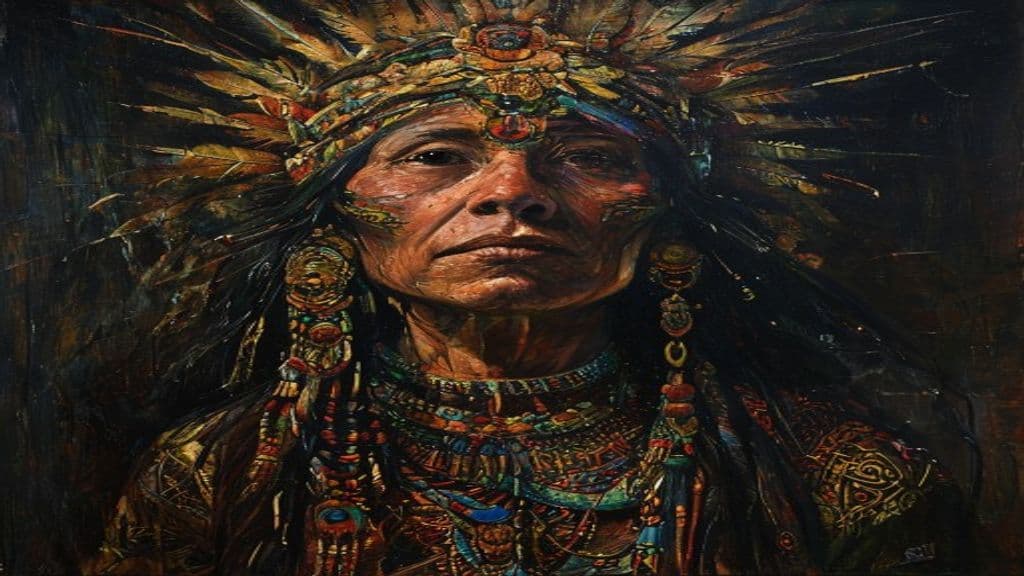
Mama Ocllo
Deified mother and fertility goddess associated with the establishment of the city of Cusco and foundational power within Inca society. (Note: - Power tier: Primordial (due to her association with creation and foundational power) - Abilities: The text only mentions reproductive and maternal care powers, but it is likely that Mama Ocllo's abi)

Manco Cápac
Manco Cápac is the foundational ancestral figure and culture‑founder of the Inca (Quechua) tradition: remembered as the first ruler (Sapa Inca) and progenitor who, according to origin legends, established Cusco after emerging with Mama Ocllo from Lake Titicaca. Sources treat him variably as mythic ancestor, legitimizing founder, and a possibly historical early ruler.
Axtya
Evil sorcerer in Zoroastrian mythology, posing intellectual challenges to humans with his riddle-crafting and solving abilities, rivaling or surpassing deities. (Note: - Power tier: Axtya should be classified as Greater (powerful regional), not Primordial (cosmic). - Abilities: Axtya poses intellectual challenges, but his ability is specifically riddle-crafting and )
Axylus
Axylus (Ancient Greek: Ἄξυλος) is a Trojan warrior featured in Homer's Iliad (Book VI). Portrayed as a wealthy and hospitable man from Arisbe, he is slain in battle by the Greek warrior Diomedes, a brief episode used by Homer to underscore themes of hospitality, mortality, and the costs of war.
Ay Ata
Ay Ata (Ay Dede) is the personified Moon in Turkic myth and traditional Tengrism, commonly glossed as 'Moon Father.' He is paired with the sun-being (Gun Ana / Kün Ana) in a layered sky cosmology and figures in folk tales, epic traditions, and shamanic prayer contexts.
Aya
Aya is a Mesopotamian goddess associated with the dawn and worshiped as the consort of the sun god Shamash. She is principally attested in the city of Sippar, appears in royal inscriptions there, and was incorporated into Hurrian religion as the wife of the Hurrian sun Šimige.
Ayagunna (Yoruba Tradition)
A manifestation of Obatala, the Sky Father, embodying martial prowess and a desire for global peace through domination. (Note: - Power tier should be Greater (Ayagunna is described as manifesting the Sky Father's "fierceness" and having achieved global conquest). - Appearance needs clarification or deletion, as there is no ex)
Ayakashi
Ayakashi (アヤカシ / あやかし) is a category of yōkai in Japanese folklore associated with phenomena that appear above the surface of bodies of water. The term covers a range of regional reports including atmospheric ghost lights, apparitions, and sea-serpent–type illustrations, and in some locales is identified with vengeful sea-spirits or hazardous marine occurrences.
Ayar Auca
Ayar Auca is named in modern accounts as one of the Ayar siblings in the Inca origin cycle who emerge from the cave at Paqariq Tampu; in the provided sources he appears as a member of the founding-ancestor group rather than as a separately detailed supernatural class.
Ayar Cachi
In Inca mythology, Ayar Cachi is one of the brothers of Manco Cápac and a significant figure in the origin myth of the Incas. (Note: 1. Power tier: Lower to Ancient (deity-level) since Ayar Cachi is described as one of Manco Cápac's brothers and shares an origin myth, but does not appear to possess cosmic powers. 2. Abilities: The )
Ayar Uchu
Ayar Uchu is a name that appears in at least one modern web listing as an 'Inca God of Mystery' but lacks corroboration in the supplied primary and reference sources. There is no reliable ethnographic or classical mythic documentation for an entity by this exact name in the provided materials.
Ayaz Ata
Ayaz Ata is identified in the provided source as a winter-associated figure originating from Tengrism and also as a fictional tale character who serves as the Turkic counterpart to Santa Claus and Ded Moroz. The single source presents both a religious origin (Tengrist) and a later folkloric/seasonal role without further detail.
Ayida Wedo
Ayida Wedo is a primordial rainbow-serpent loa of Haitian Vodou (with counterparts in Fon and Ewe vodun) associated with water, the rainbow, and the elemental forces; she often appears paired with Damballa as the dual cosmic serpent that assisted the creator in forming and upholding the world.
Ayizan
Ayizan is a racine (root loa) in Haitian Vodou and related West African-derived Vodoun traditions, functioning as the archetypal mambo (priestess) and a guardian of ritual order, initiation (kanzo), and the transmission of sacerdotal implements such as the asson. She is also associated with the marketplace and commerce and is syncretized with the Catholic Saint Clare.
Community Record
- [1]Mama Ocllo (Wikipedia). Wikipedia contributors. "Mama Ocllo." Wikipedia, The Free Encyclopedia.wiki
- [2]Inca Creation Myths - Crystalinks. Crystalinks. "Inca Creation Myths."other
- [3]Viracocha - Crystalinks. Crystalinks. "Viracocha."other
- [4]Inca Creation Myths | WeirdSciences (blog). WeirdSciences blog. "Inca Creation Myths."other
- [5]Pre-Inca Civilization - lost-civilizations.net. lost-civilizations.net. "Pre-Inca Civilization."other
- [6]Mesoamerican Religions - HIST 211 (library.vcsu.edu). Valley City State University research guide. "Mesoamerican Religions - HIST 211."other
- [7]Research notes supplied: summary and recommendations (internal). Compiled research notes provided with query (no direct attestation of 'Ayar Anca').other