
The bakeneko yūjo arises from late‑Edo circulating rumors and their literary elaboration in the An'ei–Tenmei era (c. 1772–1788). Sources trace a core rumor to Shinagawa‑juku about an inn called Iseya where a serving wench was reputed to be a bakeneko; the inn was nicknamed Bakemono Iseya. These rumors appeared in printed entertainments and plays (kibyōshi, sharebon, hanashibon, and kabuki), with examples and related narratives appearing in works of the 1770s–1790s (for instance, references to nekomata rumors in the 1776 hanashibon Urikotoba and kabuki pieces such as late‑Edo dramas). Over time the rumor was fictionalized into a recognisable character type who embodied urban anxieties about courtesans, secrecy in the pleasure quarters, and the mysteriousness of cats.
Typical depictions show a courtesan who, after spending the night with a customer, secretly rises once the customer falls asleep; when observed she has a cat's face on a human body and is engaged in eating. Literary and theatrical scenes repeatedly describe her quietly eating seafood in hidden parts of the brothel — notably shrimp (including an image of 'crunching on a shrimp, head and all') and fish — and in some variants more gruesome imagery appears (for example a kyōgen picture book of a kabuki play that shows a leftover human arm at the courtesan's feet, or a scene that seems to show a courtesan gnawing on a human arm, later revealed as comic misperception such as a sweet potato). The visual trope thus combines a human female form, a distinctly feline face, nocturnal postures of feeding, and brothel settings such as corridors and the 'lowly room' where courtesans ate out of public view.
In the cited material the bakeneko yūjo is principally a theatrical and literary shapeshifting motif: nocturnal transformation from human courtesan to a cat‑faced being and secretive nocturnal eating. Sources do not enumerate broader supernatural powers; the figure is portrayed within narratives as capable of surprising or alarming a sleeping customer by revealing a cat's face and eating in private spaces. Variants in the literature depict the act as potentially dangerous or gruesome (suggestions of human‑flesh consumption) while other representations treat the scene as comic or satirical (mistaken perceptions, comic reversals). One specific fictional tale frames the transformation as part of an inheritance/lineage plot (a filial daughter training to shapeshift to inherit her parents' house), but this is a narrative detail of particular stories rather than a generalized supernatural system.
Bakasura (Hindu Tradition)
A malevolent rakshasa from Hindu mythology with supernatural strength and ferocity. (Note: - Power tier: Primordial (due to its cosmic and epic-scale impact in Hindu mythology) - Abilities: Remove "at will" as it's not present in the source material - Weaknesses: Not specified in the source)
Bake-danuki
Bake-danuki (化け狸) are a class of yōkai in Japanese folklore: tanuki (Japanese raccoon dogs) that acquire supernatural powers, most notably shapeshifting and trickery. They appear throughout Japan with strong regional concentrations and some locally named, ritualized exemplars.
Bake-kujira
A skeletal whale yōkai from coastal western Japan, especially Shimane (Izumo) and the Oki region. Appearing offshore as a large white figure that is revealed to be a baleen whale's bare skeleton and attended by strange fish and birds, the bake-kujira is interpreted in sources as a vengeful or resentful whale-spirit that portends misfortune and prompted local placation practices.
Bakebi
No information about an entity named 'Bakebi' is present in the supplied Tshiluba Bible-heading sources. The name does not occur in the provided excerpts, so all attributes of a folkloric entity cannot be documented from these materials.
Bakeichōnosei
No verifiable information about 'Bakeichōnosei' is present in the supplied source. The only available material is a biographical note on Shigeru Mizuki; there is no description, classification, or rituals associated with Bakeichōnosei in that source.
Bakeneko
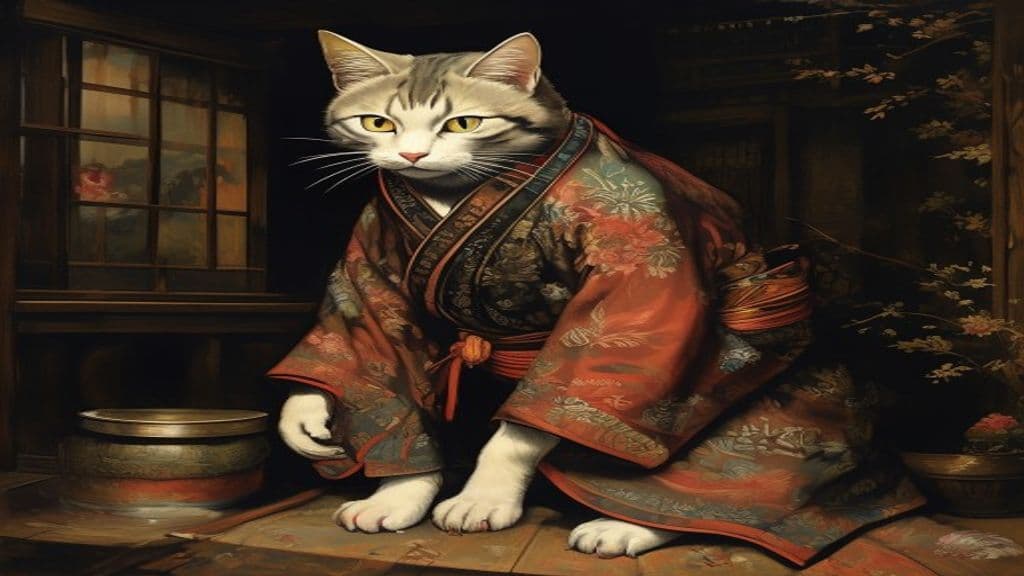
The bakeneko (ばけ猫, "changed cat") is a Japanese yōkai classed as a kaibyō (supernatural cat). Folklore presents it as a household cat that, through age, long residence, or other local conditions, acquires uncanny abilities such as shapeshifting, speech, and vengeance against cruel humans.
Bakezōri
A Bakezōri is an animated zōri (straw sandal) from Japanese folklore, classified among tsukumogami — formerly inanimate household implements that become sentient after long use or neglect. They are typically mischievous, running through houses at night and chanting, and are generally described as harmless nuisances rather than truly dangerous beings.
Bakla
Bakla is a Philippine social and gender category—commonly an assigned‑male‑at‑birth person who adopts a feminine gender expression and is often treated as a third gender. Historically some bakla served as indigenous ritual specialists (babaylan, katalonan), but the term itself denotes a social identity, not a supernatural being.
Bakotsu
Bakotsu (馬骨, literally "horse bone") is an Edo-period yōkai entry depicted in the Tosa Obake Zōshi as the skeletal, flaming spirit of a horse that perished in a fire. It is an iconographic example of transformed-animal remains in Edo visual folklore.
Baku
A composite supernatural creature in East Asian (Chinese → Japanese) folklore best known in Japan as a benevolent dream‑devourer invoked to remove bad dreams and protect children at bedside. Its depiction and roles developed over time from an older Chinese chimera (mo) into a household protective being with a cautionary moral about overuse.
Bakunawa
A dragon- or serpent-like mythic being from Philippine tradition associated with the moon and eclipses; its actions explain lunar eclipses and some natural phenomena and were integrated into ritual practice and calendrical knowledge.
Bal-Bal
A Philippine folkloric undead/monster that steals corpses from funerals and graves and feeds on them, noted for keen scent for dead bodies, sharp claws and teeth, foul breath, and reportedly leaving a banana‑tree trunk in the coffin as a substitute for the stolen corpse.
Community Record
- [1]Bakeneko yūjo. Wikipedia contributors, 'Bakeneko yūjo', Wikipedia, The Free Encyclopedia, https://en.wikipedia.org/wiki/Bakeneko_y%C5%ABjowiki