
Sources do not provide a detailed origin myth for the Bal-Bal. Ethnographic and secondary summaries consistently classify it within Philippine traditions of necrophagic undead and flesh-eating supernatural beings. It is commonly grouped with other corpse‑focused creatures such as the aswang, amalanhig, and busaw; this classificatory placement frames the Bal-Bal as part of a moral and cosmological category of beings that transgress the boundary between the living and the dead and threaten burial integrity and community order.
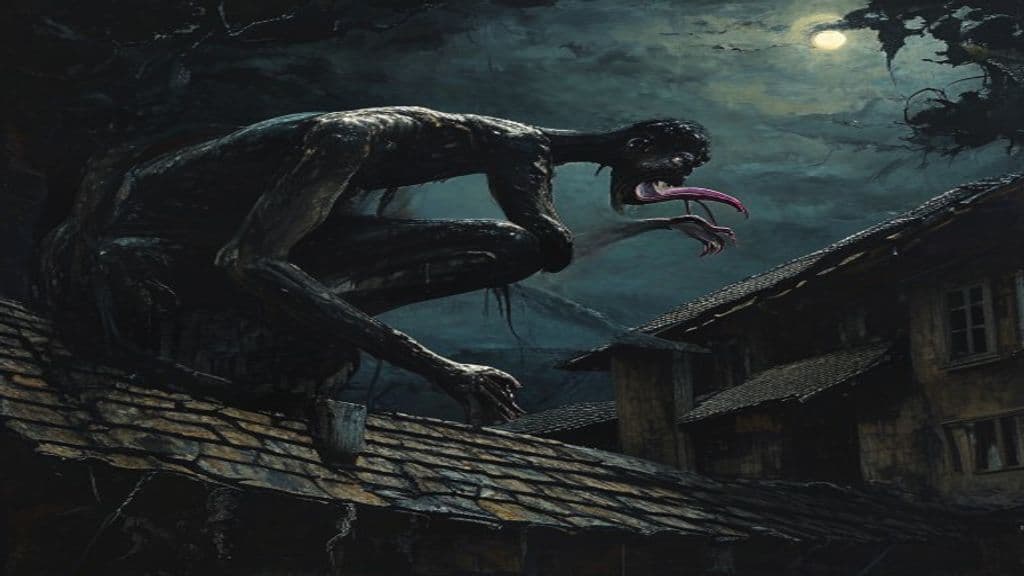
Descriptions in the available sources emphasize functional anatomy: the Bal-Bal is said to possess sharp claws and teeth capable of ripping clothing and tearing corpses, and to have foul breath as a consequence of eating only corpses. Sources also describe it as a fearful or intimidating creature and compare it to Western vampire-type figures to communicate its necrophagic character, but do not supply a consistent, detailed physical portrait (such as skin color, stature, or precise humanoid vs. bestial morphology).
The Bal-Bal actively seeks, steals, and consumes human corpses at funerals and gravesites and is described as having a strong sense of smell specifically attuned to dead human bodies. It tears apart corpses with its claws and teeth and consumes the flesh. A distinctive behavior reported in the sources is that after eating a corpse the Bal-Bal will leave the trunk of a banana tree inside the coffin to create the illusion that the body remains, thereby tricking the living.
Aswang
The most feared supernatural being in Philippine folklore — a shape-shifting monster that appears human by day but transforms at night to prey on pregnant women and children.

Amalanhig
Amalanhig are Visayan undead beings in Philippine folk belief, described as aswang who failed to transfer their monstrosity or power before death and who rise from graves to attack living humans. Accounts portray them as externally human in appearance with enlarged upper canines and as predators that bite, feed with a pointed tongue in some tellings, or — in an alternative variant — tickle victims to death.

Busaw
A malign corpse‑stealing being that resembles humans by day, lives near burial grounds, and preys on freshly dead corpses—stealing them from coffins, transforming them into pigs, and consuming them. It also attempts to spread its condition by feeding stolen human flesh to neighbors.
Anggitay
A Philippine folkloric female equid–human hybrid often described with the upper body of a woman and the lower body of a horse. Frequently compared to the Greek centauride and sometimes presented as a female counterpart to the tikbalang; traditionally associated with an attraction to gemstones and jewelry and with a local homeland in Santo Tomas, Batangas in some accounts.
Berbalang
The Berbalang are legendary creatures from the Philippines described in available sources as corpse-eating ghouls associated with grave-digging; some accounts also report they can fly or send a spirit to do so. Documentation is limited and drawn from summarised folkloric reports.
Bungisngis
The Bungisngis is a one-eyed giant from Philippine folklore, described as humanoid, always laughing, and possessing great strength but easily outwitted. Tales place it in specific Philippine localities and often portray it as a comic yet dangerous antagonist defeated by clever protagonists.
Dalaketnon
A Visayan Philippine engkanto lineage associated with Dalakit/Balete trees; portrayed as an elitist, tree‑dwelling supernatural people who host feasts, abduct humans, and bind victims by compelling them to eat enchanted black rice. Contemporary media elaborates additional powers and aristocratic styling.
Ekek
A nocturnal birdlike human predator from Philippine folklore, the Ekek (or Ek Ek) is a winged creature said to hunt at night for flesh and blood, particularly targeting sleeping pregnant women and draining fetuses with a long proboscis.
Juan Tamad
Juan Tamad (Tagalog for "Lazy Juan") is a stock character in Philippine folklore known for extreme laziness. Portrayed usually as a child (sometimes a young man), he appears in short comic or moralized tales that exemplify sloth through absurd behavior and its social consequences.
Kapre
A Philippine tree-dwelling humanoid spirit commonly described as a very tall, dark-skinned, tobacco-smoking being that inhabits large trees and wooded edges; kapres interact with humans as tricksters, companions, or retaliatory guardians of their trees. The modern folkloric figure is often linked in etymological accounts to Spanish/Arabic terms used in colonial discourse and so carries layered cultural meanings.
Krasue
A nocturnal Southeast Asian female spirit typically depicted as a floating, disembodied woman's head with internal organs trailing beneath the neck. The figure forms part of a regional cluster of related body-detaching female spirits and is presented in local traditions as a transformed or cursed human who leaves the living body by night to seek food.
Santelmo
Santelmo in Philippine contexts is a luminous fireball or glowing phenomenon treated variously in sources as a folkloric apparition or as a cultural interpretation of the meteorological St. Elmo's fire. It appears in popular media and folklore inventories alongside other Philippine supernatural beings, and accounts emphasize its fiery appearance and association with storms and pointed objects.
Sigbin
A nocturnal, predatory creature of Philippine folklore, chiefly attested in Visayas and Mindanao accounts. In legend it is said to suck blood from victims' shadows, walk backwards with its head lowered between its hind legs, emit a nauseating odor, and be associated with families who command it and with the broader class of aswang.
Wakwak
The Wakwak is a nocturnal, predatory creature in Philippine popular belief, typically described as a bird-like vampiric being that hunts humans at night. It is named onomatopoeically for the wak-wak sound associated with its flight or call and occupies the same folkloric cluster as the manananggal, ekek, and aswang.
Bakunawa
A dragon- or serpent-like mythic being from Philippine tradition associated with the moon and eclipses; its actions explain lunar eclipses and some natural phenomena and were integrated into ritual practice and calendrical knowledge.
Community Record
- [1]Bal-Bal. Wikipedia contributors, "Bal-Bal," Wikipedia, The Free Encyclopedia.wiki
- [2]Bal-Bal | Villains Wiki. Villains Wiki, "Bal-Bal" (fan/secondary summary of folklore).other
- [3]Balbal (disambiguation / non-Philippine usage noted). Against The Wicked City: Monsters from Central Asian Mythology 4: Balbals (blog) — cited to note unrelated similarly named items.other
- [4]Wikidata: Bal-Bal. Wikidata entry for Bal-Bal.wiki