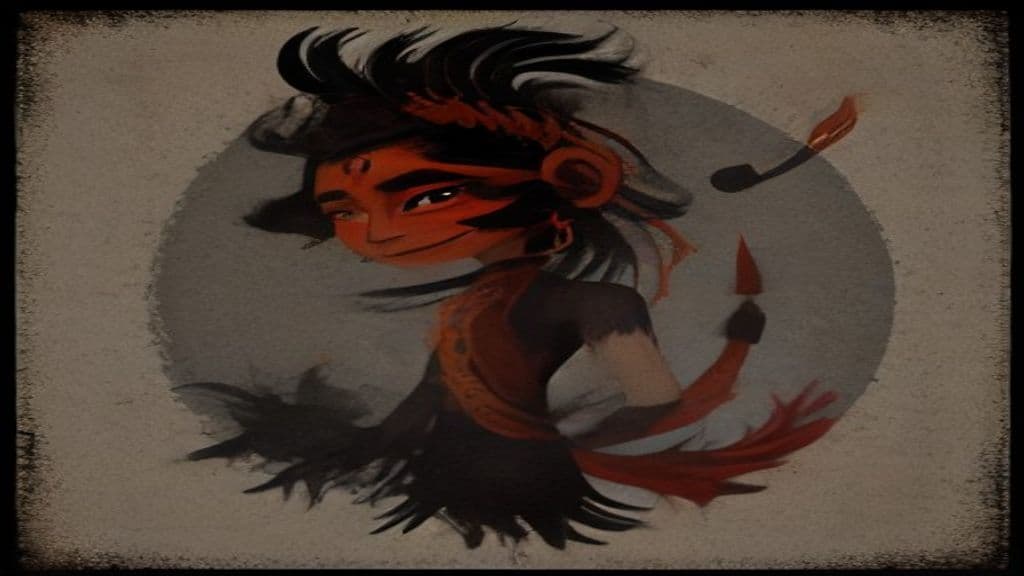
In the genealogical framework recorded in Javanese sources, Batara Sambu is the first-born son of Batara Guru (the supreme god in the local Hinduized cosmology) and Batari Uma. As a named member of Batara Guru's divine household he functions within that familial pantheon: he is identified specifically as the god of teachers and, in wayang narrative, as the progenitor or ancestor of the rakshasa (giants). These relationships place Sambu within a hereditary divine hierarchy that explains social functions (patronage of teachers) and the origin of particular classes of mythic beings in wayang storytelling. (Sources: Wikipedia: Batara Sambu; Wikidata: Batara Sambu; Wikipedia: Batara Guru.)
The supplied sources do not provide a detailed bodily or iconographic description of Batara Sambu (no specific notes on facial features, clothing, coloration, or weapons). Wayang-associated descriptions instead locate him spatially and materially: his kahyangan (heavenly abode) is named Kahyangan Swelagringging in the southern part of the heavens, his palace is described as made of copper, and he is said to have two wives—Bathari Siwagnyana and Bathari Astuti—details that mark his status and household within the pantheon even though they do not yield a physical portrait. (Sources: Wikipedia: Batara Sambu.)
The sources attribute to Sambu a small set of specific domains: he is the deity associated with teachers (patron of teaching and possibly learning) and, in wayang tradition, a god who rules the clouds, indicating an atmospheric or meteorological jurisdiction. He is also described as the ancestor of rakshasa (giants) within wayang genealogies. The provided materials do not record additional powers, moral dispositions, interactions with humans, or specialised rituals enacted by or upon Sambu. (Sources: Wikipedia: Batara Sambu; Wikidata: Batara Sambu.)

Batara Guru
Batara Guru is a supreme divine figure in multiple Indonesian mythological traditions (Indonesian Hinduism, Batak, Bugis, Javanese). He functions variously as a guru-aspect of Shiva, a creator or world-recoverer in Batak narrative fragments, an ancestor and progenitor in Bugis and Batak genealogies, and a high deity of the kahyangan in Javanese cosmology.

Rakshasa (Himalayan variants)
A Himalayan reception of the pan-Indian rakshasa motif: hostile or disruptive non‑human beings known from Sanskrit epic and Puranic literature, here noted where Himalayan sources and discussions intersect with the broader epic tradition. The supplied sources do not document distinct, well‑attested Himalayan folklore variants; the entry therefore presents primarily the epic/legendary profile as transmitted into Himalayan contexts in general references.
Babi Ngepet
In Indonesian mythology, the Babi Ngepet is a boar demon associated with malevolent intentions towards humans. (Note: * Power tier: Downgrade to Ancient (deity-level) as there's no indication of Primordial powers. * Abilities: Specify what malevolent intentions towards humans implies, e.g., ability to curse or cause )
Batara Guru
Batara Guru is a supreme divine figure in multiple Indonesian mythological traditions (Indonesian Hinduism, Batak, Bugis, Javanese). He functions variously as a guru-aspect of Shiva, a creator or world-recoverer in Batak narrative fragments, an ancestor and progenitor in Bugis and Batak genealogies, and a high deity of the kahyangan in Javanese cosmology.
Genderuwo
Genderuwo is a Javanese/Indonesian supernatural humanoid spirit, commonly depicted in modern sources as a large, hairy, muscular creature with reddish or black skin and bulging eyes; it is described as able to appear, disappear, and assume human form. It is treated in regional folklore and popular culture as one member among many named hantu (supernatural beings) in the Malay–Indonesian mythic landscape.
Nyi Roro Kidul (Queen of the Southern Sea)
Nyi Roro Kidul is a supernatural female figure in Sundanese and Javanese tradition identified as the Queen of the Southern Sea off the coast of Java. She functions as a regionally significant sea sovereign connected in local narratives and place‑based traditions (for example Pelabuhan Ratu) and appears in contemporary poetic and popular media.
Panakawan
A class of supernatural entities serving as clown servants to heroes in Javanese wayang, personifying qualities of humility and loyalty. (Note: - Power tier should be Ancient (deity-level) not Primordial (cosmic) - Summary could be more specific about the entity's role in Javanese wayang, e.g., "serve as clown servants to heroes" - Sensory cu)
Bastet
Bastet (Ancient Egyptian bꜣstt; also rendered Bast, Ubasti, Bubastis) is an ancient Egyptian goddess whose character shifted over millennia from a lioness warrior-protector of the king and Ra to a later cat-associated deity linked to domestic protection, fertility, motherhood, and healing against disease and evil spirits. Her principal cult center was Per-Bastet (Bubastis) in the Nile Delta.
Bat
Bat is an ancient Egyptian cow- and sky-goddess, attested from the late Predynastic period as the chief deity of the 7th Upper Egyptian nome (Seshesh/Hu). She is closely associated with the sistrum and was later syncretized into the cult of Hathor by the Middle Kingdom.
Bata
Bata is an Egyptian local deity associated with cattle and with a territorial cult in Upper Egypt. In New Kingdom religious geography he appears as the co-representative of the 17th Upper Egyptian Nome alongside Anubis and also functions as the protagonist of the Tale of Two Brothers (Papyrus D’Orbiney), a mythic narrative that includes motifs of kinship, death and postmortem continuity.
Batara Kala
Batara Kala is a Javanese and Balinese underworld deity associated with death, time, and destruction; feared as an ogre-like devourer of the unlucky, he is also ritually propitiated to avert misfortune, especially for at-risk children.
Batea
Batea is a polysemous term found in scientific, geographic, material-culture, mythological, and modern technical contexts. In the supplied sources it appears as a genus of amphipod crustaceans, two named figures in Greek mythology (without further detail in these sources), a municipality in Catalonia, a traditional gold-panning pan, and as the name/acronym of contemporary technical and policy documents.
Batea of Troad
Batea (Ancient Greek: Βάτεια) is a mythic female ancestor and eponym in early Greek accounts tied to the foundation myths of the Trojans/Dardanians. Presented as a member of the Teucrian royal house and consort of Dardanus, she is credited with giving her name to a hill in the Troad and to the town Bateia and functions mainly to link genealogical descent and territorial claims.
Batgirl
Batgirl is a comic-book superheroine identity published by DC Comics, used by multiple human characters as a female counterpart and ally to Batman within the shared Gotham City vigilante continuity. The mantle has been assumed by different women across publication history and has been used to explore themes of gender, disability, and editorial continuity in modern popular culture.
Community Record
- [1]Batara Sambu. Wikipedia contributors. "Batara Sambu." Wikipedia, The Free Encyclopedia.wiki
- [2]Batara Sambu (Wikidata). Wikidata entry Q4868627: Batara Sambu.wiki
- [3]Batara Guru. Wikipedia contributors. "Batara Guru." Wikipedia, The Free Encyclopedia.wiki